🐑 What Is Sheep Milk?
Sheep milk is milk obtained from dairy sheep breeds specifically selected for milk production. Unlike conventional sheep farming, where animals may primarily be raised for meat or wool, dairy sheep farming focuses on producing milk for human consumption and processing.
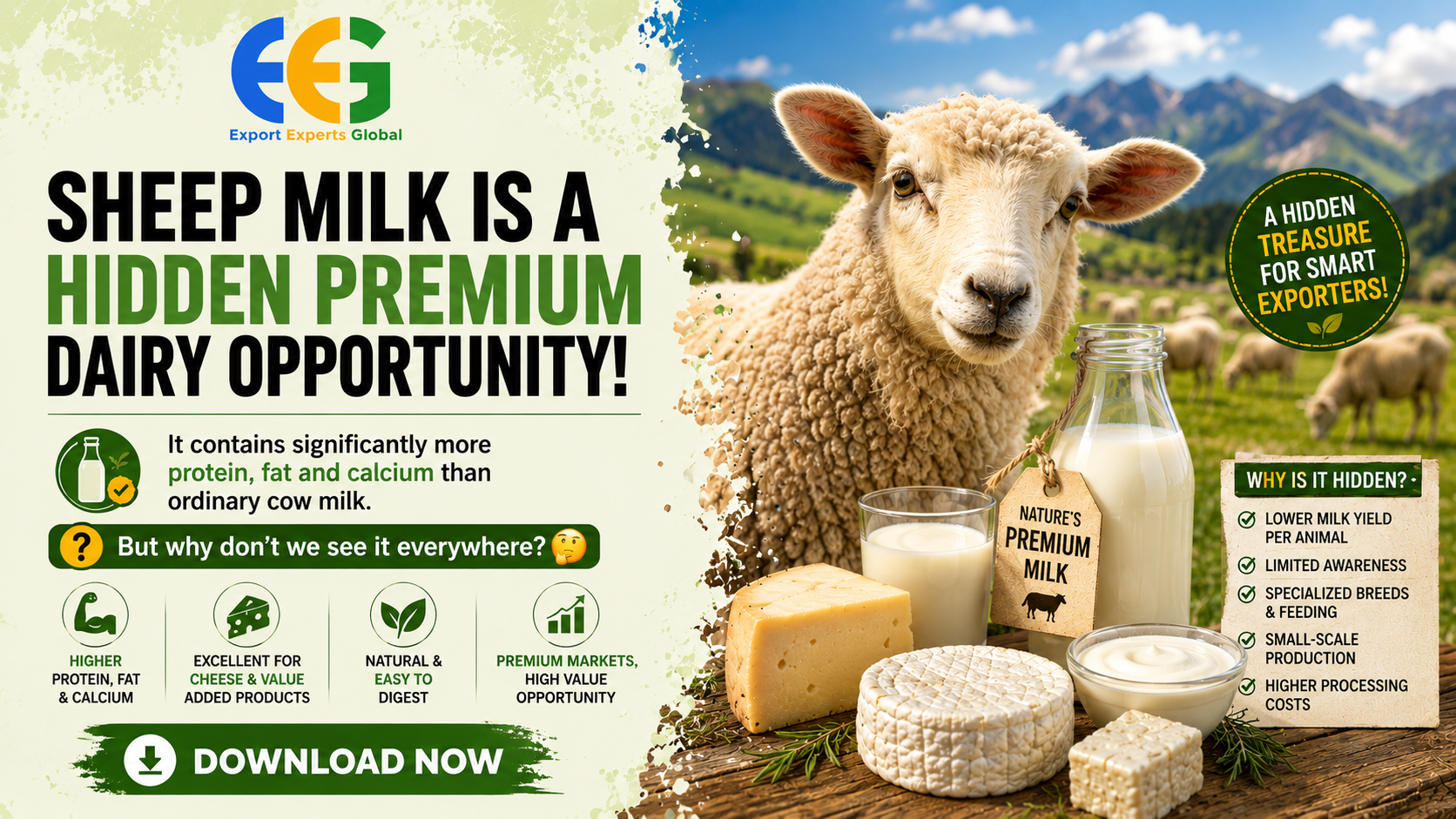
Sheep milk is naturally concentrated compared with many common dairy milks. Its composition varies according to breed, feed, stage of lactation, season and farming practices. Generally, it contains higher levels of milk solids, protein and fat than standard cow milk. 🥛📊
This composition is especially useful for cheese manufacturing because the processor is working with a milk that contains a substantial amount of components that contribute to cheese yield, texture and flavor.
That is why sheep milk has historically been important in several traditional cheese-producing regions around the world. 🧀🌍
💪 Why Is Sheep Milk Considered Premium?
One of the biggest attractions of sheep milk is its nutritional and processing profile.
Compared with ordinary cow milk, sheep milk commonly contains substantially more protein and fat, although exact differences depend on the animals and milk being compared. It also contains significant quantities of calcium and other minerals. 🦴🥛
Its higher total solids can be particularly valuable for dairy processors.
Think about the business from a manufacturing perspective:
Milk → Processing → Value Addition → Premium Product → Higher Selling Price
Instead of treating milk as a commodity, an entrepreneur can develop products with stronger differentiation.
Potential products include:
🧀 Specialty cheese
🥣 Sheep milk yogurt
🍦 Premium ice cream
🥛 Pasteurized sheep milk
🧈 Specialty dairy products
🍰 Sheep-milk-based desserts
🧀 Artisan and gourmet cheese products
This is where the sheep milk business opportunity becomes more interesting.
🧀 Sheep Milk and Cheese Production
Cheese is arguably one of the most important commercial applications of sheep milk.
The relatively high concentration of protein, fat and milk solids can make sheep milk particularly suitable for cheese manufacturing. Different countries and regions have developed their own traditional sheep-milk cheeses, demonstrating that this is not simply a theoretical opportunity. 🧀🌍
For a modern entrepreneur, there are several possible business models.
1️⃣ Fresh Specialty Cheese
Produce fresh or semi-soft cheese for:
🍽️ Restaurants
🏨 Hotels
🛒 Premium grocery stores
🧀 Specialty cheese shops
2️⃣ Aged Cheese
Aging can create a differentiated premium product with a distinct flavor profile.
3️⃣ Artisan Cheese Brand
A small producer can focus on:
✨ Farm-to-table positioning
✨ Traditional processing
✨ Premium packaging
✨ Traceability
✨ Gourmet branding
This allows a small operation to compete through quality and differentiation rather than production volume.
💰 Is Sheep Milk a Good Business Opportunity?
The answer depends heavily on the business model.
Selling raw sheep milk as a commodity may present challenges because sheep generally produce substantially less milk than high-yield dairy cows.
This creates an important business lesson:
Low production volume doesn’t automatically mean low business potential.
If a product is differentiated and processed into a premium product, the economics can be very different.
For example:
🐑 Sheep milk
⬇️
🧀 Premium cheese
⬇️
📦 Attractive packaging
⬇️
🏨 Gourmet restaurants
⬇️
🌍 International specialty-food market
The value of the final product can be significantly higher than simply selling raw milk.
📉 Why Isn’t Sheep Milk Commonly Available?
This is one of the most important questions for entrepreneurs.
If sheep milk has desirable characteristics, why isn’t it available everywhere?
The primary reason is production economics.
Dairy cows can produce large quantities of milk, while sheep generally produce much smaller quantities. Therefore, building a large-scale sheep-milk supply chain can be more complicated.
Other challenges include:
🐑 Limited availability of specialized dairy breeds
🌾 Feed and animal-management requirements
🥛 Seasonal milk production
🏭 Limited processing infrastructure
❄️ Cold-chain requirements
📦 Specialized packaging
📊 Smaller consumer market
💰 Higher production costs
This creates a niche market rather than a mass-market commodity.
For entrepreneurs, however, this can sometimes create an advantage.
Less competition + premium positioning + differentiated product = potential niche opportunity.
🌱 Sheep Farming for Milk Production
Anyone considering a sheep milk farming business should begin with the right breed and production system.
Not every sheep breed is equally suitable for commercial dairy production.
Before starting a farm, entrepreneurs should investigate:
🐑 Dairy sheep breeds
🥛 Average milk yield
🌾 Feed requirements
💉 Veterinary requirements
🏠 Housing requirements
📅 Lactation cycle
👩🌾 Local climate suitability
📊 Production economics
The objective should be to identify a breed and management system that works economically under local conditions.
Simply purchasing sheep without understanding their milk-production potential can create unnecessary financial risk.
🏭 Sheep Milk Processing Business
Another opportunity exists beyond farming.
You don’t necessarily need to own a large sheep farm to participate in the sheep dairy value chain.
An entrepreneur could potentially build a model around:
🐑 Contract farmers
🥛 Milk collection
🧪 Quality testing
🏭 Processing
🧀 Cheese production
📦 Packaging
🛒 Distribution
This model can connect small-scale farmers with premium markets.
A processing-focused company can potentially aggregate milk from multiple producers and develop a standardized product.
However, maintaining consistent quality and food safety is essential.
🌍 Sheep Milk Export Business
The international market is another area worth researching.
Sheep-milk products are associated with established specialty-dairy traditions in parts of Europe and other markets. Products such as specialty cheeses can appeal to consumers looking for distinctive flavors, traditional production methods and premium foods. 🧀🌍
For an Indian entrepreneur, the export opportunity should be approached primarily through value-added dairy products, rather than assuming raw sheep milk will be the easiest export product.
Potential categories to research include:
🧀 Specialty sheep-milk cheese
🥣 Processed dairy products
🍦 Premium frozen dairy products
🥛 Shelf-stable specialty dairy products
However, international dairy trade is highly regulated.
Before exporting, businesses need to investigate:
📋 Product-specific regulations
🧾 Export documentation
🧪 Food-safety requirements
🏷️ Labeling regulations
❄️ Cold-chain requirements
📦 Packaging standards
🌍 Import-country requirements
🏭 Approved processing facilities
Never select an export market solely because a product appears popular there.
📦 Packaging Is Extremely Important
Premium dairy products require premium presentation.
A sheep-milk product can be positioned around:
✨ Gourmet quality
🐑 Farm origin
🧀 Artisan production
🌱 Responsible farming
🌍 Traceability
🏆 Premium ingredients
Packaging should protect the product while communicating its unique identity.
For export markets, packaging also needs to comply with the destination country’s labeling and food-packaging regulations.
A strong brand could potentially transform an unfamiliar product into an attractive specialty-food proposition.
🎯 Who Could Be the Target Customer?
The target customer should not necessarily be the average milk consumer.
Instead, consider customers who actively purchase premium or specialty foods.
Potential customer segments include:
🏨 Luxury hotels
🍽️ Fine-dining restaurants
🧀 Gourmet cheese stores
🛒 Premium supermarkets
🥗 Specialty food retailers
👨🍳 Chefs and culinary businesses
🌍 Food importers
📦 Specialty-food distributors
This is a B2B and premium B2C opportunity.
A restaurant may value the uniqueness of a sheep-milk cheese because it gives chefs another ingredient to differentiate their menu.
📊 How to Calculate the Business Opportunity
Before investing, prepare a detailed cost sheet.
Consider:
🐑 Animal purchase cost
🌾 Feed cost
💉 Veterinary expenses
🏠 Farm infrastructure
👨🌾 Labour
🥛 Milk collection
🧪 Quality testing
🏭 Processing
🧀 Cheese production
📦 Packaging
🚚 Transportation
❄️ Cold storage
📢 Marketing
📋 Compliance
🚢 Export logistics
Then calculate:
Total Cost ÷ Total Saleable Product = Cost per Unit
After that, compare the production cost with your target wholesale or retail price.
Don’t calculate profit simply by looking at the selling price of premium sheep cheese online.
Your real margin depends on yield, processing efficiency, wastage, logistics, packaging, marketing and market price.
🚢 Export Strategy for Beginners
If you want to enter the sheep dairy export business, start with market research.
STEP 1 — Select the Product 🔎
Choose between:
🧀 Cheese
🥣 Yogurt
🥛 Milk
🍦 Frozen dairy
📦 Other processed products
STEP 2 — Study HS Classification 📋
Identify the appropriate HS code based on the exact product composition and form.
Do not copy an HS code from another product without verification.
STEP 3 — Research Import Markets 🌍
Study:
📊 Import demand
💰 Average prices
🏢 Major importers
🧾 Regulations
🚢 Logistics
🥛 Dairy standards
STEP 4 — Find Buyers 🤝
Potential buyers can include:
🌍 Importers
🧀 Cheese distributors
🏨 Hotels
🍽️ Restaurant suppliers
🛒 Specialty food distributors
STEP 5 — Prepare Samples 📦
For premium food products, samples can be critical for buyer evaluation.
STEP 6 — Negotiate Commercial Terms 💼
Discuss:
📦 MOQ
💰 Price
🚢 Incoterms
💳 Payment terms
📅 Delivery schedule
🧾 Documentation
⚠️ Challenges You Must Understand
Sheep milk is not a “quick money” business.
There are genuine operational challenges.
🐑 1. Low Milk Volume
Individual sheep produce relatively small quantities compared with dairy cows.
🌾 2. Feed Management
Feed quality has a direct impact on animal health and milk production.
🧀 3. Processing
Specialty dairy processing requires technical expertise.
❄️ 4. Cold Chain
Many dairy products require temperature-controlled transportation and storage.
📋 5. Compliance
Food products require strict regulatory compliance.
📊 6. Market Education
Consumers who are unfamiliar with sheep milk may need education before purchasing it.
💰 7. Higher Costs
Premium products often have higher production and marketing costs.
The business therefore requires planning rather than speculation.
🚀 How to Build a Sheep Milk Brand
A strong brand could focus on a clear story.
For example:
🐑 From Farm to Table
Tell customers:
Where the sheep are raised
🌱 What they are fed
🥛 How the milk is collected
🧀 How the product is processed
📦 How it is packaged
Premium food customers increasingly value traceability and authenticity.
Instead of simply writing “Sheep Milk Cheese,” the brand can communicate the origin, craftsmanship and product characteristics—provided every claim is accurate and legally supportable.
💡 The Bigger Entrepreneurship Lesson
Sheep milk teaches an important lesson about business.
Many entrepreneurs look only for products with huge production volumes.
But sometimes the better opportunity exists in specialized categories with limited competition.
Think about the difference:
Commodity Model
🥛 Large volume
📉 Low differentiation
💰 Price competition
Premium Niche Model
🧀 Smaller volume
✨ Strong differentiation
🎯 Targeted customers
💰 Premium pricing potential
The second model can be attractive when the entrepreneur understands the customer and controls the value chain.
🇮🇳 Sheep Milk Opportunity in India
India has a large livestock and dairy ecosystem, but sheep milk remains a relatively specialized category.
This creates a possible opportunity for entrepreneurs willing to work on:
🐑 Dairy sheep farming
🥛 Milk aggregation
🧀 Specialty cheese
🏭 Small-scale processing
📦 Premium branding
🛒 Gourmet retail
🌍 Export development
However, entrepreneurs should validate local availability, milk yields, processing economics and customer demand before investing in infrastructure.
A pilot project can be more sensible than immediately establishing a large farm or processing plant.
📈 Start Small, Test the Market
A practical strategy is:
Research → Pilot → Test → Improve → Scale
🔎 Research: Understand the product and market.
🐑 Pilot: Work with a small number of animals or sourcing partners.
🧀 Test: Develop a small batch of value-added products.
👥 Validate: Get feedback from chefs, retailers and customers.
📊 Calculate: Measure actual costs and margins.
🚀 Scale: Expand only after the economics are proven.
This approach reduces the risk of investing heavily before finding product-market fit.
Overall Analysis
Sheep milk represents an interesting niche dairy business opportunity because of its distinctive composition and strong suitability for value-added products, particularly specialty cheese. 🐑🧀
The biggest opportunity may not be in selling raw milk. It can be in developing a complete value chain:
Sheep Farming → Milk Collection → Processing → Value Addition → Branding → Premium Distribution → Export 🚀
For entrepreneurs, exporters and agricultural-business professionals, this is an excellent example of how specialized agricultural products can be converted into premium businesses.
The future of agriculture is not only about producing more.
It is also about producing smarter, adding value and reaching the right customer. 🌱📈
If you’re exploring sheep milk farming, sheep milk cheese manufacturing, premium dairy products or dairy export business, conduct detailed feasibility research before investing. Product regulations, animal-management requirements, processing standards and export conditions can vary significantly by market.
Find the niche. Build the value. Create the brand. Take it global. 🌍🚢