🌍 What Are Textile Dyes?
Textile dyes are chemical substances that permanently impart color to textile fibers, yarns, or fabrics. Unlike pigments, dyes chemically bond or physically attach to fibers, creating vibrant and durable shades.
A good textile dye should provide:
✅ Bright colors
✅ Excellent wash fastness
✅ Good rubbing fastness
✅ Light resistance
✅ Sweat resistance
✅ Uniform dyeing
✅ Eco-friendly processing
🧵 Why Dye Selection Is Important
Every textile fiber has a unique chemical structure.
Choosing the correct dye ensures:
🎨 Better color depth
🧺 Longer garment life
💧 Improved washing durability
🌞 UV resistance
💰 Reduced production cost
😊 Higher customer satisfaction
🧶 Classification of Textile Dyes
Textile dyes are generally classified according to:
✔ Chemical composition
✔ Method of application
✔ Type of fiber
✔ Dyeing mechanism
✔ Solubility
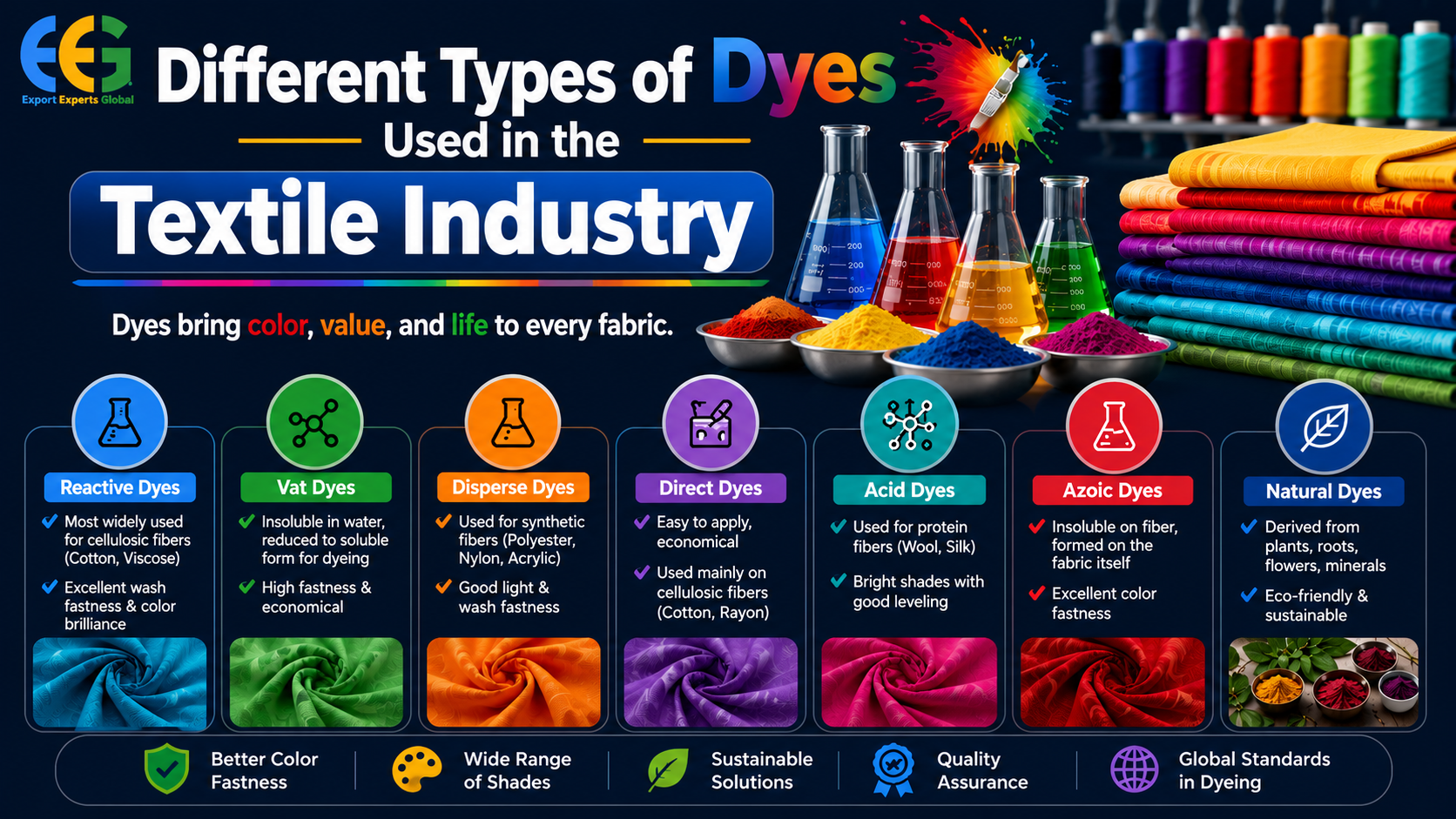
1️⃣ Reactive Dyes
🎯 Best For:
✔ Cotton
✔ Linen
✔ Rayon
✔ Viscose
Reactive dyes are among the most widely used dyes in the textile industry. They chemically react with cellulose fibers, forming strong covalent bonds that produce bright shades and excellent wash fastness.
Advantages
✅ Bright shades
✅ Excellent wash fastness
✅ Wide color range
✅ Eco-friendly modern formulations
Limitations
❌ Require salt and alkali
❌ Water-intensive washing process
2️⃣ Direct Dyes
🎯 Best For:
✔ Cotton
✔ Rayon
✔ Paper
✔ Cellulose fibers
Direct dyes dissolve in water and can be applied directly without creating chemical bonds.
Advantages
✔ Easy dyeing process
✔ Low cost
✔ Suitable for economical fabrics
Limitations
❌ Moderate wash fastness
❌ Limited durability
3️⃣ Vat Dyes
🎯 Best For:
✔ Denim
✔ Cotton
✔ Workwear
✔ Industrial textiles
Vat dyes are insoluble in water. During dyeing, they are converted into soluble forms and later oxidized inside the fiber.
Advantages
✔ Outstanding wash fastness
✔ Excellent light fastness
✔ Highly durable
Popular Example
👖 Indigo Dye
Used extensively in denim jeans manufacturing.
4️⃣ Sulfur Dyes
Sulfur dyes are economical dyes mainly used for dark shades.
Suitable For
✔ Cotton
✔ Industrial fabrics
Advantages
✅ Low cost
✅ Excellent dark colors
✅ Good wash fastness
Common Shades
⚫ Black
🟤 Brown
🟢 Olive
5️⃣ Acid Dyes
Acid dyes are specially designed for protein fibers.
Suitable For
🐑 Wool
🧶 Silk
🎽 Nylon
Advantages
✔ Bright shades
✔ Excellent color brilliance
✔ Smooth dye penetration
Limitations
❌ Poor performance on cotton
6️⃣ Basic (Cationic) Dyes
Basic dyes carry a positive charge.
Suitable For
✔ Acrylic fibers
✔ Modified polyester
Advantages
🌈 Extremely bright colors
✨ High brilliance
🎨 Excellent shade intensity
Applications
Sweaters
Blankets
Carpets
Acrylic fabrics
7️⃣ Disperse Dyes
Disperse dyes are specially developed for synthetic fibers.
Suitable For
✔ Polyester
✔ Acetate
✔ Nylon blends
Advantages
🔥 Excellent sublimation resistance
💧 Good wash fastness
🎨 Brilliant colors
Dyeing Method
High Temperature Dyeing
or
Thermosol Process
8️⃣ Azoic Dyes
Azoic dyes are produced directly on the fabric through chemical reactions.
Suitable For
✔ Cotton
Advantages
✔ Bright red shades
✔ Orange colors
✔ Excellent wash fastness
9️⃣ Pigment Dyes
Although pigments are technically different from dyes, pigment coloration is widely used in textile printing.
Suitable For
✔ Cotton
✔ Polyester
✔ Blended fabrics
Advantages
✔ Applicable to almost every fiber
✔ Excellent printing quality
✔ Economical
🔟 Natural Dyes
Natural dyes are extracted from plants, insects, and minerals.
Examples include:
🌿 Turmeric
🌿 Indigo
🌿 Henna
🌿 Madder
🌿 Pomegranate Peel
🌿 Onion Skin
Advantages
♻ Eco-friendly
🌱 Sustainable
🌍 Biodegradable
Limitations
❌ Lower color consistency
❌ Higher production cost
🌿 Bio-Based Textile Dyes
Modern sustainable textiles increasingly use bio-based dyes.
These include dyes obtained from:
🍃 Leaves
🌸 Flowers
🌳 Tree Bark
🍎 Fruit Waste
🌾 Agricultural Waste
These dyes reduce environmental pollution.
♻ Sustainable Dyeing Technologies
The textile industry is moving toward greener dyeing.
Popular innovations include:
💧 Waterless Dyeing
🌱 Plant-Based Dyes
⚡ Digital Dyeing
♻ Foam Dyeing
💨 Supercritical CO₂ Dyeing
🌍 Low Salt Reactive Dyeing
🏭 Dyeing Methods Used in Textile Manufacturing
Common dyeing methods include:
🧵 Fiber Dyeing
🧶 Yarn Dyeing
👕 Piece Dyeing
👔 Garment Dyeing
🧥 Package Dyeing
🎽 Beam Dyeing
🌈 Color Fastness Properties
Quality dyeing depends upon:
💦 Wash Fastness
☀ Light Fastness
🤲 Rubbing Fastness
💧 Perspiration Fastness
🧼 Dry Cleaning Fastness
🔥 Heat Fastness
⚙ Factors Affecting Dye Selection
Manufacturers consider:
✔ Fiber type
✔ Shade requirement
✔ Production cost
✔ Export standards
✔ Environmental regulations
✔ Customer expectations
✔ Fastness properties
🧪 Chemicals Used Along with Textile Dyes
Successful dyeing requires auxiliary chemicals.
Common chemicals include:
🧂 Salt
⚗ Soda Ash
🧪 Acetic Acid
💧 Wetting Agent
🫧 Detergent
🧴 Leveling Agent
🛡 Sequestering Agent
🌡 pH Controller
🌍 Textile Industries Using Different Dyes
Different sectors rely on different dye classes:
👕 Apparel Industry
🛏 Home Textiles
🚗 Automotive Textiles
🏥 Medical Textiles
🎒 Technical Textiles
👟 Sportswear
🪑 Upholstery
👜 Bags & Accessories
📦 Importance of Dyes in Textile Exports
Export-quality textiles demand:
✅ Color consistency
✅ REACH compliance
✅ OEKO-TEX certification compatibility
✅ Excellent fastness
✅ Eco-friendly processing
Proper dye selection helps exporters meet international buyer requirements and reduce claims related to shade variation or color bleeding.
🚀 Future of Textile Dyes
The future of textile dyeing is centered on sustainability, digitalization, and resource efficiency. Manufacturers are investing in low-impact dye chemistries, AI-assisted color matching, closed-loop water systems, and renewable raw materials to reduce environmental impact while maintaining high-quality coloration.
Emerging trends include:
🌱 Bio-based dye molecules
💧 Water-saving dyeing systems
🤖 AI-powered color prediction
♻ Circular textile recycling
⚡ Energy-efficient dyeing equipment
🌍 Carbon footprint reduction
Overall Analysis
Textile dyes are the backbone of modern textile manufacturing, influencing both product aesthetics and performance. From reactive dyes for cotton to disperse dyes for polyester, each dye class is engineered for specific fibers and end uses. Understanding these differences enables manufacturers to improve quality, optimize production, and satisfy domestic and international buyers.
As sustainability becomes a priority, the industry is steadily adopting cleaner dyeing technologies and environmentally responsible dye formulations. Professionals who stay updated with these developments are better equipped to produce competitive, export-ready textiles.