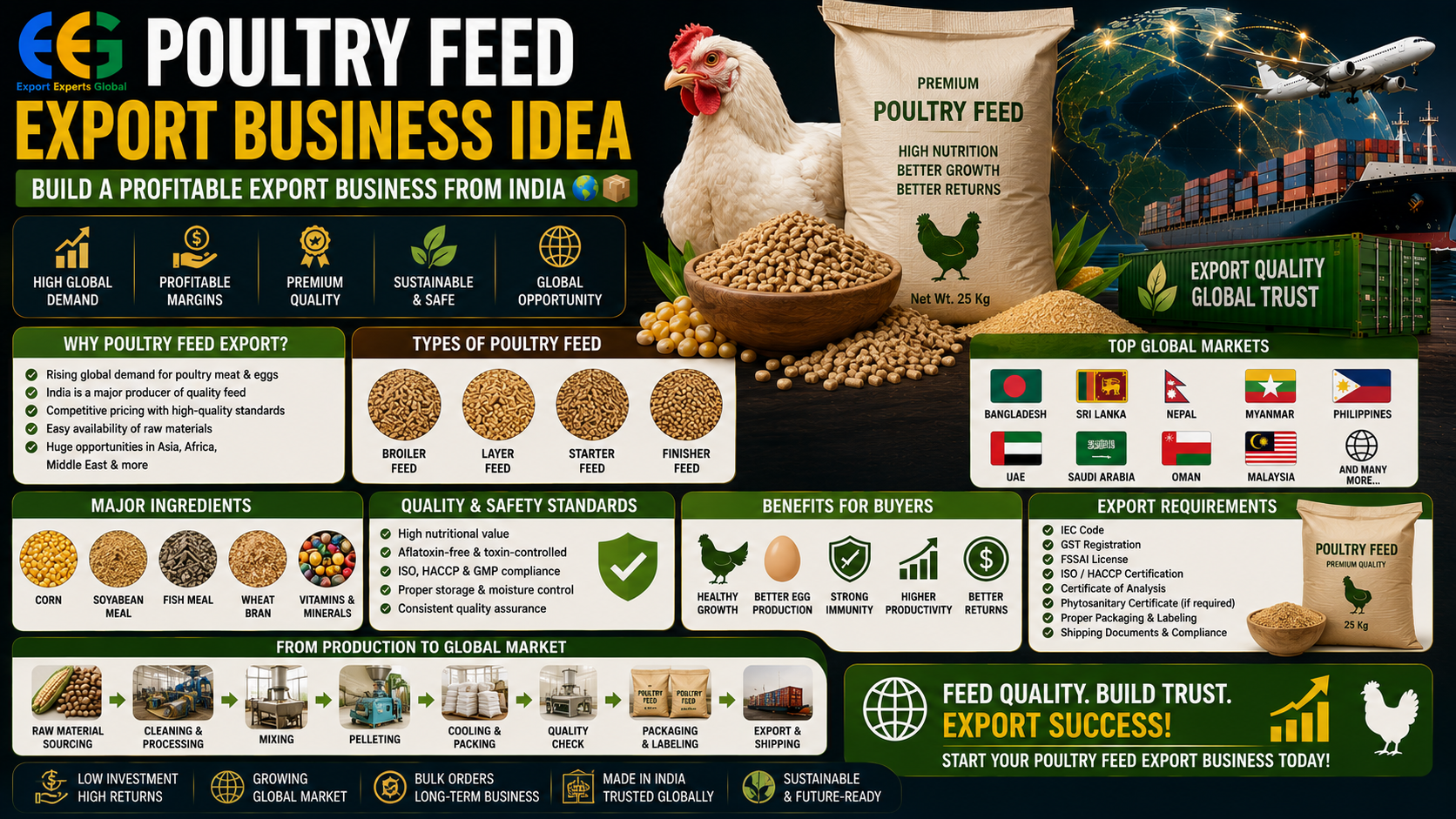
🌍 Why Poultry Feed Has Strong Export Potential
The poultry industry is one of the fastest-growing segments of global agriculture. Rising populations, increasing protein consumption, urbanization, and changing food habits are driving the demand for poultry products.
Every poultry farm requires feed every single day. Unlike many products that are purchased occasionally, poultry feed is a recurring necessity. This creates repeat business opportunities for exporters.
Some of the major reasons why poultry feed exports are growing include:
✅ Continuous demand from commercial poultry farms
✅ Expansion of broiler and layer farming worldwide
✅ Increasing investment in food security
✅ Growth of integrated poultry businesses
✅ Demand for nutritionally balanced feed
✅ Opportunities for private-label manufacturing
🐣 What Is Poultry Feed?
Poultry feed is a scientifically formulated mixture of grains, proteins, vitamins, minerals, amino acids, and nutritional supplements designed to support healthy poultry growth.
Different birds require different nutritional formulations depending on their age and purpose.
The major categories include:
🐥 Starter Feed
Designed for young chicks during their early growth stage.
🐔 Grower Feed
Supports muscle development and healthy body weight.
🥚 Layer Feed
Specially formulated for egg-laying hens.
🍗 Broiler Feed
Prepared for meat-producing birds with higher protein requirements.
🌱 Organic Poultry Feed
Made using natural ingredients without synthetic additives.
🌾 Pellet Feed
Compressed feed with better feed conversion efficiency.
🥣 Mash Feed
Finely ground feed commonly used in small farms.
🧩 Crumble Feed
Broken pellets suitable for younger birds.
🌽 Major Raw Materials Used
A quality poultry feed formulation depends upon carefully selected ingredients.
Common raw materials include:
🌽 Maize
Provides carbohydrates and energy.
🌱 Soybean Meal
Excellent source of protein.
🌾 Rice Bran
Adds fiber and nutrients.
🥜 Groundnut Cake
Provides protein and healthy fats.
🐟 Fish Meal
Rich in essential amino acids.
🌿 Sunflower Meal
Alternative plant protein.
🦴 Mineral Mixture
Supports bone development.
💊 Vitamins
Improve immunity and productivity.
🧂 Salt
Maintains electrolyte balance.
🧬 Amino Acids
Improve feed efficiency.
🇮🇳 Why India Is a Strong Exporter
India enjoys several competitive advantages.
🌾 Large agricultural production
🚢 Well-developed ports
🏭 Modern feed manufacturing plants
💰 Competitive labor costs
📦 Reliable logistics network
🌍 Strong trade relationships
India also has experienced exporters capable of supplying customized formulations according to international buyer requirements.
📍 Best States for Poultry Feed Manufacturing
Several Indian states have excellent feed manufacturing infrastructure.
🏭 Maharashtra
🌽 Karnataka
🌾 Telangana
🚜 Andhra Pradesh
🌱 Tamil Nadu
🐔 Punjab
🌾 Haryana
🌿 Gujarat
These states have abundant raw materials and efficient transportation networks.
🌎 Best Countries to Export Poultry Feed
Many countries import poultry feed because local production is insufficient.
Popular export destinations include:
🇧🇩 Bangladesh
🇳🇵 Nepal
🇧🇹 Bhutan
🇦🇪 United Arab Emirates
🇴🇲 Oman
🇸🇦 Saudi Arabia
🇶🇦 Qatar
🇰🇪 Kenya
🇳🇬 Nigeria
🇬🇭 Ghana
🇹🇿 Tanzania
🇪🇹 Ethiopia
🇻🇳 Vietnam
🇵🇭 Philippines
🇲🇻 Maldives
📈 Who Buys Poultry Feed?
Potential buyers include:
🏭 Feed distributors
🐔 Poultry farms
🏢 Agricultural wholesalers
🌍 Import companies
🏬 Retail feed suppliers
🚜 Livestock cooperatives
🏛 Government procurement agencies
📦 Packaging Options
Professional packaging improves product quality and buyer confidence.
Popular packaging sizes include:
📦 25 kg bags
📦 40 kg bags
📦 50 kg bags
Bulk jumbo bags
Private-label packaging
Moisture-resistant laminated bags
Woven polypropylene bags
Customized branding
📑 Documents Required for Export
Before exporting poultry feed, businesses should complete the required registrations and documentation.
Essential documents generally include:
✅ Import Export Code (IEC)
✅ GST Registration
✅ Commercial Invoice
✅ Packing List
✅ Bill of Lading or Airway Bill
✅ Certificate of Origin
✅ Insurance Certificate (if applicable)
✅ Phytosanitary or veterinary-related certificates if required by the importing country
Always verify the importing country’s feed regulations before shipment, as requirements differ between markets.
🚢 Shipping Methods
Poultry feed is generally exported through:
🚢 Full Container Load (FCL)
📦 Less than Container Load (LCL)
🚛 Multimodal transportation
Bulk vessel shipments for very large orders
Sea freight remains the preferred option due to its cost efficiency.
💰 Profit Opportunities
Profit depends on:
✔ Product quality
✔ Manufacturing efficiency
✔ Freight cost
✔ Packaging
✔ Destination market
✔ Exchange rates
✔ Volume of exports
Businesses that secure repeat buyers often achieve stronger long-term profitability than those relying on one-time orders.
📊 Value Addition Opportunities
Instead of exporting only standard feed, businesses can develop premium products.
Examples include:
🌿 Organic feed
💊 Vitamin-enriched feed
🐔 Antibiotic-free feed
🌽 High-protein formulations
🥚 Layer-special formulations
🐣 Chick starter premium feed
Private-label manufacturing
Customized nutrition programs
These value-added products can help differentiate your business in competitive markets.
⚠️ Challenges in Poultry Feed Export
Like any export business, poultry feed comes with challenges.
⚠ Quality consistency
⚠ Moisture management
⚠ Storage conditions
⚠ Feed shelf life
⚠ International quality standards
⚠ Currency fluctuations
⚠ Freight cost changes
⚠ Country-specific import regulations
⚠ Competition from global suppliers
Careful planning and strong quality control help reduce these risks.
📢 Marketing Strategies
Successful exporters focus on building trust and visibility.
Effective strategies include:
🌐 Professional website
📱 LinkedIn networking
📧 Email outreach
🌍 B2B marketplaces
🤝 International trade fairs
📸 Product catalogs
🎥 Educational videos
📦 Sample shipments
⭐ Customer testimonials
Consistent branding increases buyer confidence.
📈 How to Find International Buyers
Reliable buyers can be sourced through:
🔹 International trade exhibitions
🔹 Export promotion councils
🔹 B2B sourcing platforms
🔹 Chambers of commerce
🔹 Overseas distributors
🔹 Industry associations
🔹 Direct outreach to poultry businesses
Always perform due diligence before entering into commercial agreements.
🌟 Tips for Long-Term Success
✔ Maintain consistent product quality.
✔ Understand the nutritional requirements of your target market.
✔ Deliver shipments on schedule.
✔ Communicate clearly with buyers.
✔ Invest in attractive packaging.
✔ Keep accurate export documentation.
✔ Build long-term relationships rather than chasing only one-time sales.
✔ Stay updated with international regulations and market trends.
Overall Analysis
The poultry feed export business offers significant opportunities for entrepreneurs, manufacturers, and exporters looking to enter the global agricultural supply chain. Because poultry farming depends on a continuous supply of quality feed, exporters who focus on consistency, compliance, and customer relationships can create a resilient and scalable business.
India’s strong agricultural base, experienced manufacturers, and access to international shipping routes provide a solid foundation for serving markets across Asia, Africa, and the Middle East. Whether you choose to export standard feed or develop premium formulations, success will come from understanding buyer requirements, maintaining quality standards, and delivering value over the long term.