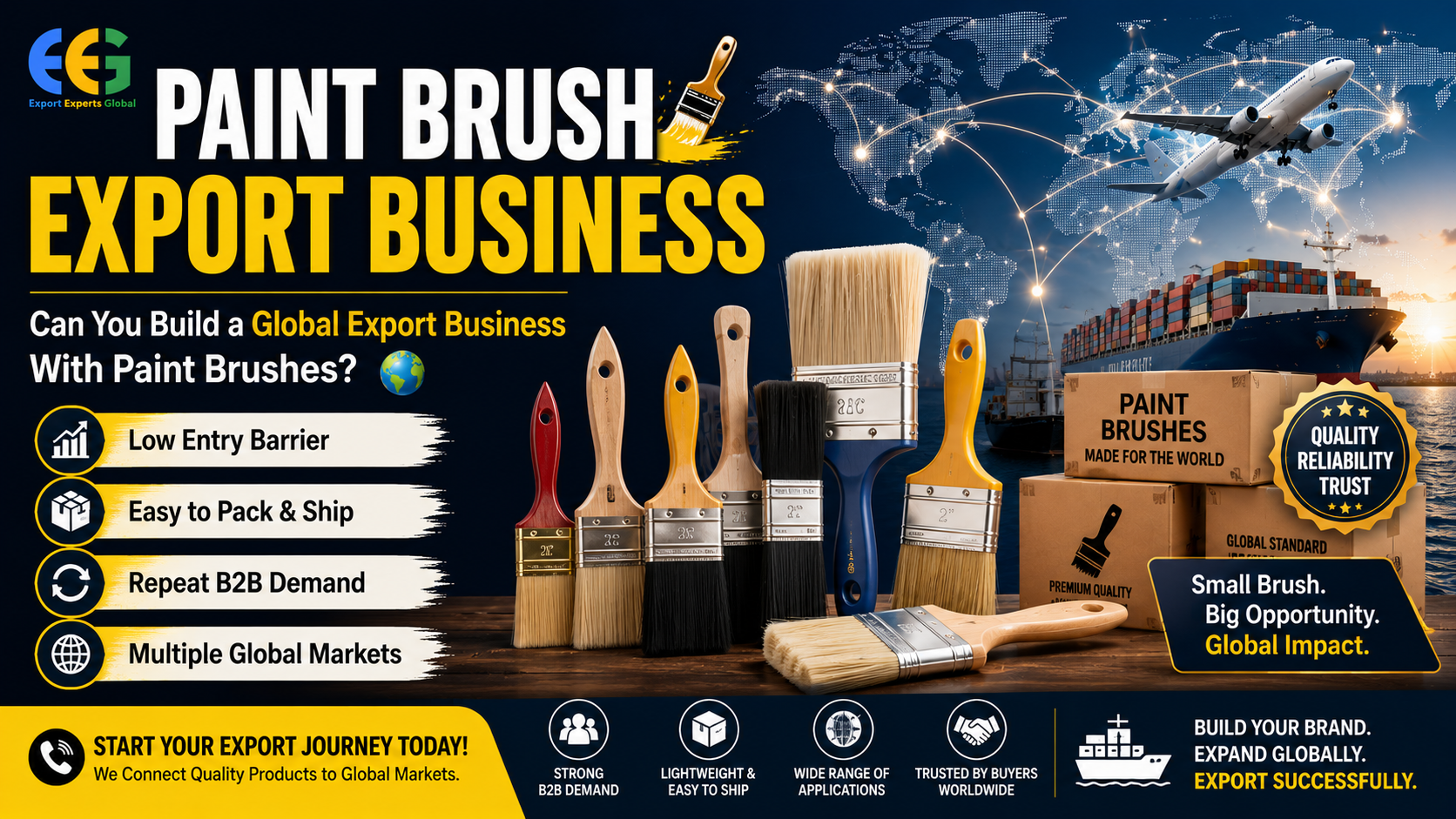
🎨 What Is the Paint Brush Export Business?
The paint brush export business involves sourcing paint brushes from Indian manufacturers or producing them yourself and selling them to buyers in international markets.
An exporter does not necessarily need to establish a manufacturing factory. A beginner can work as a merchant exporter, source products from suitable Indian manufacturers, conduct quality checks and supply them to overseas customers.
The basic business model is:
🏭 Indian Manufacturer
⬇️
📦 Exporter
⬇️
🚢 International Shipment
⬇️
🌍 Importer / Distributor
⬇️
🏪 Retailer / Hardware Store
⬇️
👨🎨 End Customer
The key to success is not simply finding a cheap product. The exporter needs to identify the right market, understand buyer requirements, maintain consistent quality and develop a reliable supply chain.
💡 Why Export Paint Brushes?
There are several reasons why entrepreneurs may consider paint brushes for international trade.
1️⃣ Non-Perishable Product
Unlike agricultural or food products, paint brushes generally do not have a short shelf life. This can make inventory management comparatively easier.
2️⃣ Multiple Applications
Paint brushes are used for:
🏠 House painting
🏗️ Construction projects
🪑 Furniture finishing
🚗 Automotive applications
🏭 Industrial coating
🎨 Art and decoration
🔧 Maintenance work
🛠️ DIY projects
This wide application base creates opportunities across different customer segments.
3️⃣ Multiple Price Segments
An exporter can work with:
💰 Economy brushes
💼 Professional brushes
⭐ Premium brushes
🏭 Industrial brushes
This allows businesses to target different markets according to buyer budgets and quality expectations.
4️⃣ Private-Label Opportunity
International buyers may not always want an Indian brand. Some distributors prefer to sell products under their own brand.
This creates a private-label export opportunity, where an Indian manufacturer produces brushes according to the buyer’s specifications and packaging requirements.
🖌️ Types of Paint Brushes You Can Export
Before entering the market, exporters should understand the different product categories.
🎨 Wall Paint Brushes
These are commonly used for household and construction painting projects.
🖌️ Flat Paint Brushes
Flat brushes are suitable for larger surfaces and applications requiring controlled strokes.
🖼️ Artist Brushes
These serve art, craft, decoration and hobby markets.
🏭 Industrial Brushes
Industrial users may require brushes designed for specific coating, cleaning or manufacturing applications.
🚗 Automotive Brushes
Specialized brushes can be marketed to automotive workshops, body shops and maintenance businesses.
🛠️ Professional Brush Sets
Brush kits combining multiple sizes can be attractive to contractors, painters and DIY customers.
📦 Paint Brush & Roller Sets
Exporters can also explore bundled painting kits instead of selling individual brushes.
🌍 Which Countries Can Import Indian Paint Brushes?
A successful export strategy requires market research rather than randomly selecting a country.
Potential markets to investigate include:
🇦🇪 United Arab Emirates
🇸🇦 Saudi Arabia
🇴🇲 Oman
🇶🇦 Qatar
🇺🇸 United States
🇬🇧 United Kingdom
🇦🇺 Australia
🇿🇦 South Africa
These should be treated as potential markets for research, not guaranteed markets.
Before approaching buyers, analyze:
🔎 Import volume
💰 Average import prices
📊 Existing competitors
🚢 Freight cost
📦 Packaging requirements
📑 Import regulations
💵 Import duties
🎯 Buyer requirements
An exporter should select a market where the product has a combination of demand, acceptable competition and commercially viable landed cost.
🏭 Where Can You Source Paint Brushes in India?
A beginner exporter can identify manufacturers through industrial clusters, trade exhibitions, B2B platforms, business directories and direct manufacturer outreach.
Potential sourcing regions can include:
📍 Delhi-NCR
📍 Maharashtra
📍 Gujarat
📍 Tamil Nadu
📍 Other manufacturing clusters
However, the location alone should not determine supplier selection.
A professional exporter should evaluate the supplier on:
✅ Manufacturing capacity
✅ Product quality
✅ MOQ
✅ Production lead time
✅ Packaging capability
✅ Private-label facility
✅ Export experience
✅ Quality-control system
✅ Payment terms
✅ Sample availability
🔍 How to Select the Right Manufacturer?
Supplier selection is one of the most important stages of an export business.
Do not select a supplier simply because they offer the lowest quotation.
Instead, compare multiple manufacturers.
Ask for:
📸 Product photographs
📋 Product specifications
💰 Price list
📦 MOQ
🧪 Samples
🏷️ Packaging options
🚢 Previous export experience
⏱️ Production timeline
Order samples before placing a large order.
Inspect:
🖌️ Bristle density
🔩 Ferrule attachment
🪵 Handle quality
💪 Overall durability
📏 Size consistency
📦 Packaging quality
A low-cost supplier that produces inconsistent goods can ultimately become more expensive because of buyer complaints and rejected shipments.
💰 How Does the Paint Brush Export Business Make Money?
The basic business model is based on purchasing from manufacturers at competitive rates and selling to overseas customers at a commercially viable export price.
However, the calculation should go beyond the factory purchase price.
An exporter should calculate:
Product Cost + Packaging + Inland Transportation + Documentation + Handling + Freight + Insurance, where applicable + Other Export Costs = Export Cost
Then consider the desired profit margin while preparing the quotation.
For example:
🏭 Manufacturer Price
➕ Packaging
➕ Transportation
➕ Export-related expenses
➕ Logistics
➕ Other applicable costs
= Total Export Cost
Then:
Total Export Cost + Desired Margin = Selling Price
📌 Never promise a fixed profit percentage without calculating the complete transaction cost, destination and Incoterm.
📦 Packaging for Paint Brush Exports
Packaging plays an important role in international trade.
Paint brushes should be packed according to the product type, transportation method and buyer requirements.
Possible packaging formats include:
📦 Individual packaging
📦 Poly packaging
📦 Printed cartons
📦 Master cartons
📦 Retail-ready packaging
📦 Private-label packaging
Export packaging should protect the product from:
❌ Dust
❌ Moisture
❌ Physical damage
❌ Compression
❌ Handling during transportation
If the buyer is purchasing under a private label, packaging becomes even more important because it directly affects the customer’s perception of the brand.
📄 Documents Required for Export
An Indian exporter should understand the basic export documentation process.
Depending on the transaction and destination, documentation can include:
📑 Commercial Invoice
📑 Packing List
📑 Shipping Bill
📑 Bill of Lading / Air Waybill
📑 Certificate of Origin, where required
📑 Insurance documents, where applicable
📑 Purchase Order / Sales Contract
📑 Export-related declarations and compliance documents
The exporter should also ensure that the business has the applicable registrations and tax/export setup before beginning commercial shipments.
Important:
🔹 IEC — Import Export Code
🔹 GST registration, where applicable
🔹 Appropriate RCMC/EPC registration, depending on the product and applicable framework
🔹 Correct HS classification
🔹 Bank/export documentation setup
Requirements can vary by product, transaction and destination country, so they should be verified before shipment.
🔢 Understand the HS Code
One of the most important steps in international trade is correctly classifying the product under the Harmonized System (HS).
Paint brushes may fall under specific tariff classifications depending on their exact characteristics.
The exporter should not simply copy an HS code from another seller.
Instead, verify the classification based on:
🖌️ Product composition
🧵 Bristle material
🪵 Handle material
📦 Product construction
🌍 Destination-country tariff schedule
Correct classification helps determine:
💰 Import duty
📊 Trade statistics
📑 Documentation
⚖️ Regulatory requirements
🎯 How to Find International Paint Brush Buyers?
Finding genuine buyers is one of the most important skills for a new exporter.
Potential buyers include:
🏪 Hardware importers
🎨 Paint distributors
🏗️ Construction suppliers
🛒 Home-improvement retailers
🏭 Industrial supply companies
🏷️ Private-label brands
📦 Wholesale distributors
🛠️ DIY product importers
Buyer Research Strategy
Start by identifying companies that already import or distribute similar products.
Research:
🔎 Company website
🔎 Product catalogue
🔎 Current suppliers
🔎 Import activity
🔎 Market presence
🔎 Contact details
🔎 Purchasing department
Then prepare a professional introduction containing:
📸 Product catalogue
📋 Specifications
💰 Indicative pricing
📦 MOQ
🏷️ Packaging options
🚢 Shipping terms
🧪 Sample availability
📧 Don’t Send Generic Buyer Messages
A common mistake made by beginners is sending the same message to hundreds of buyers.
Instead of:
❌ “We are an Indian exporter. Please give us an order.”
Create a buyer-focused approach.
For example, understand whether the buyer sells:
🎨 Professional painting tools
🏠 Home improvement products
🛠️ Hardware supplies
🏭 Industrial tools
Then present the specific products relevant to their business.
Buyer research + customized communication = better prospecting.
🚢 Choosing the Right Incoterm
International trade involves commercial terms that define responsibilities between buyer and seller.
Common Incoterms include:
📦 EXW
🚚 FCA
🚢 FOB
🚢 CFR
🚢 CIF
🌍 DAP
🏠 DDP
For beginners, understanding the difference between FOB, CIF, CFR, FCA and DAP is particularly important.
The correct Incoterm affects:
💰 Pricing
🚢 Freight responsibility
🛡️ Risk transfer
📦 Logistics responsibility
📄 Documentation
Never quote an international buyer without understanding what your quotation actually includes.
⚠️ Major Challenges in Paint Brush Export
Every export opportunity comes with risks.
1️⃣ Quality Variation
Different batches may have different bristle density or finishing.
2️⃣ Price Competition
Some international markets are highly competitive.
3️⃣ Freight Costs
A product can appear inexpensive until freight and other costs are added.
4️⃣ Buyer Rejection
If specifications are not followed, the buyer may raise a quality claim.
5️⃣ Payment Risk
New exporters should carefully evaluate buyer credibility and negotiate appropriate payment terms.
6️⃣ Packaging Problems
Poor packaging can lead to damaged products during transportation.
7️⃣ MOQ Issues
Some overseas buyers may initially demand small quantities, while manufacturers may require larger minimum orders.
💡 How Can You Build a Strong Competitive Advantage?
Instead of competing only on price, develop a stronger export proposition.
⭐ Focus on:
✔️ Consistent quality
✔️ Competitive pricing
✔️ Attractive packaging
✔️ Private labeling
✔️ Product customization
✔️ Multiple brush sizes
✔️ Reliable delivery
✔️ Professional documentation
✔️ Responsive communication
An overseas buyer is not only purchasing a brush.
They are purchasing quality consistency, reliability and supply assurance.
🚀 Step-by-Step Paint Brush Export Business Roadmap
If you want to start this business, follow a structured process.
STEP 1️⃣ — Select Your Product
Choose the exact brush category and quality level.
STEP 2️⃣ — Research the HS Code
Confirm the correct classification and destination-country requirements.
STEP 3️⃣ — Find Manufacturers
Compare at least several potential suppliers.
STEP 4️⃣ — Order Samples
Check quality before negotiating a large order.
STEP 5️⃣ — Identify Target Countries
Use trade data and market research.
STEP 6️⃣ — Find Buyers
Target distributors, importers, wholesalers and private-label companies.
STEP 7️⃣ — Send a Professional Offer
Include specifications, MOQ, packaging, price basis and delivery timeline.
STEP 8️⃣ — Negotiate
Discuss quantity, quality, payment terms, Incoterms and delivery schedule.
STEP 9️⃣ — Confirm the Order
Use a proper purchase order or sales contract.
STEP 🔟 — Arrange Production
Maintain quality control throughout manufacturing.
STEP 1️⃣1️⃣ — Complete Documentation
Prepare the required export documents.
STEP 1️⃣2️⃣ — Ship the Goods
Coordinate with your freight forwarder and logistics partners.
STEP 1️⃣3️⃣ — Build Repeat Business
After successful delivery, focus on the next purchase order.
📈 Can Paint Brushes Become a Large Export Business?
Yes, but scale depends on execution.
A small exporter can begin with a few products and gradually expand into:
🎨 Paint brushes
🛠️ Painting tools
🧰 Hardware accessories
📦 Painting kits
🏷️ Private-label products
🏭 Industrial brushes
The objective should be to move from single-product trading to a broader international product portfolio.
Once you develop relationships with overseas distributors, repeat orders can potentially become an important source of revenue.
Overall Analysis
The paint brush export business from India offers an interesting opportunity for entrepreneurs interested in B2B international trade. With multiple product categories, different quality segments, private-label possibilities and applications across construction and maintenance industries, it can be explored as a potential export product.
However, success will depend on product quality, supplier selection, market research, pricing, buyer verification, documentation, logistics and after-sales communication.
Start small. Test the market. Get samples approved. Build buyer relationships. Then scale.
🎨 One brush can be a product.
A reliable supply chain can become a business.
A strong international buyer network can become an export company. 🌍🚢