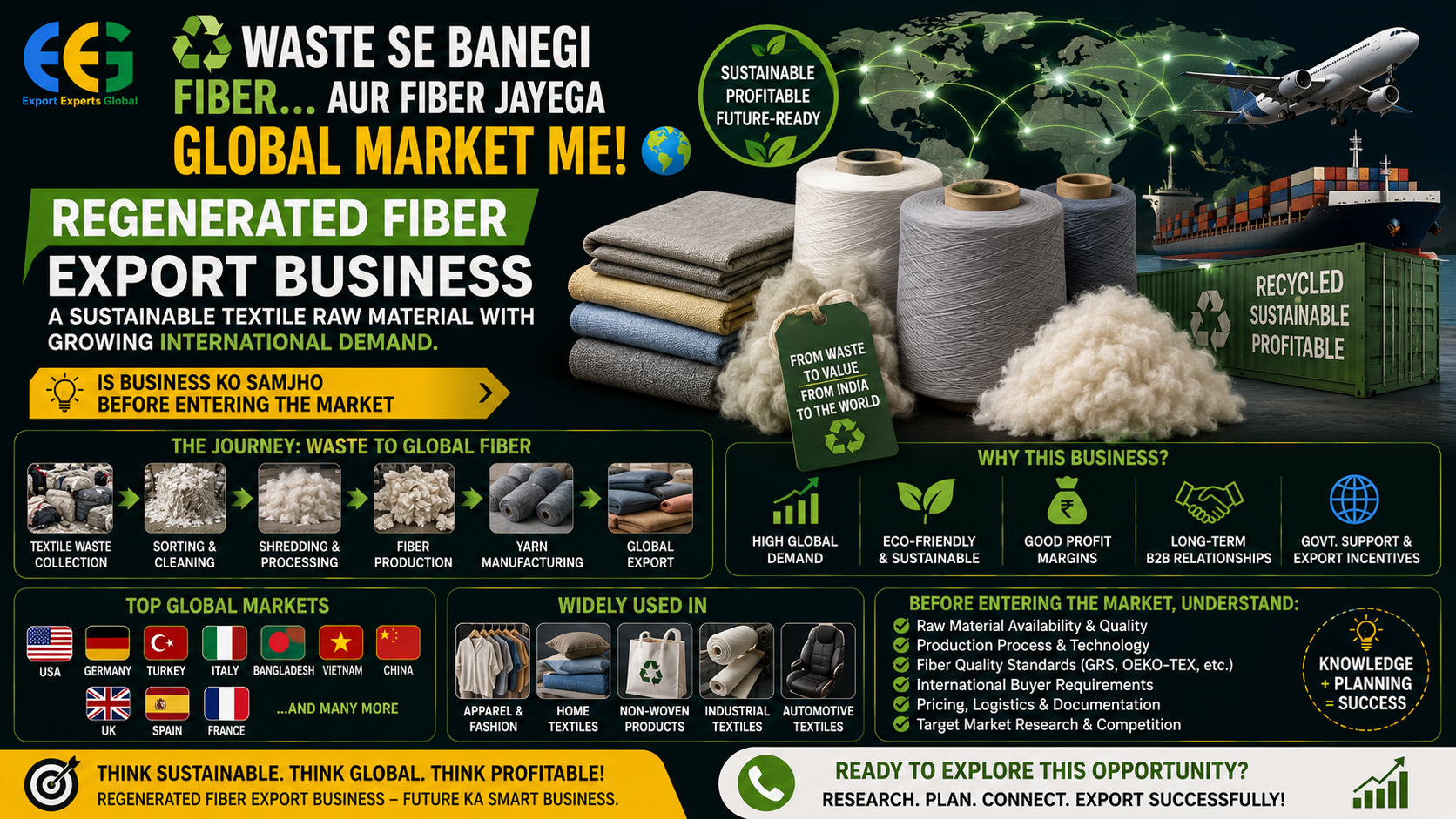
♻️ What Is Regenerated Fiber?
Regenerated fiber refers broadly to fibers produced by transforming a natural or cellulose-based raw material into a fiber that can again be used in textile manufacturing.
Unlike many conventional synthetic fibers that are produced from petrochemical-based materials, regenerated cellulose fibers are generally manufactured from cellulose sources through industrial processing.
Some well-known categories associated with regenerated fibers include:
🧵 Viscose
🌱 Modal
🌿 Lyocell
♻️ Recycled cellulose fibers
🧶 Recycled cotton fibers
The exact manufacturing process differs according to the fiber. Therefore, an exporter should understand the technical specification and commercial classification of the particular product before approaching international buyers.
🌍 Why Consider Regenerated Fiber for Export?
The biggest attraction is the changing purchasing behavior of textile companies.
Fashion and textile companies are increasingly interested in:
♻️ Circular production
🌱 Sustainable raw materials
🧵 Recycled content
🌍 Responsible sourcing
📦 Traceable supply chains
💧 Resource-efficient manufacturing
This does not mean every regenerated fiber automatically has a large profit margin. Export success depends on quality, price, certifications, buyer relationships, logistics, and consistent supply.
For an Indian entrepreneur, the opportunity can be approached through two different models.
Model 1: Manufacturing
You establish or operate a manufacturing facility and produce regenerated/recycled fiber.
Model 2: Merchant Export
You purchase material from established Indian manufacturers and sell it to overseas textile companies.
For beginners, the second model can require less manufacturing infrastructure, although working capital, quality control, supplier reliability, and export compliance remain extremely important.
📦 Which Regenerated Fiber Products Can Be Exported?
A diversified product portfolio can help an exporter target different categories of textile buyers.
Potential products include:
🧵 Regenerated cellulose staple fiber
♻️ Recycled cotton fiber
🌱 Lyocell fiber
🪡 Modal fiber
🧶 Viscose staple fiber
♻️ Recycled textile fiber
🧵 Sustainable yarn
🌿 Cellulose-based textile materials
However, don’t simply create a catalog containing dozens of products.
A better approach is to select one or two products, understand their specifications thoroughly, identify suitable suppliers, and then build a focused international buyer database.
🎯 Who Buys Regenerated Fiber?
Your customers are primarily B2B industrial buyers.
Potential customer categories include:
🏭 Textile spinning mills
🧶 Yarn manufacturers
👕 Garment manufacturers
🧵 Fabric manufacturers
🏠 Home-textile companies
📦 Non-woven manufacturers
🌱 Sustainable fashion companies
👗 Apparel brands
🏢 Textile sourcing companies
The purchasing decision of an industrial buyer is different from that of a retail customer.
A textile mill may ask questions about:
✔️ Fiber length
✔️ Denier
✔️ Strength
✔️ Moisture
✔️ Color
✔️ Purity
✔️ Composition
✔️ Packaging
✔️ Technical specifications
✔️ Sustainability documentation
Therefore, an exporter needs to become comfortable with technical product communication.
🌎 Potential International Markets
Textile manufacturing hubs can be interesting markets for regenerated and recycled fiber suppliers.
Potential countries to research include:
🇧🇩 Bangladesh
🇻🇳 Vietnam
🇹🇷 Türkiye
🇮🇩 Indonesia
🇵🇰 Pakistan
🇮🇹 Italy
🇩🇪 Germany
🇨🇳 China
The ideal market should not be selected simply because a country has a large textile industry.
You should investigate:
🔎 Import volumes
🔎 Existing suppliers
🔎 Buyer requirements
🔎 Import regulations
🔎 Tariffs
🔎 Freight costs
🔎 Payment practices
🔎 Competitor pricing
🔎 Sustainability requirements
A country with huge textile production may also have extremely strong local competition. Therefore, market research must come before market selection.
🔎 How to Find Regenerated Fiber Suppliers in India?
Supplier sourcing is one of the most important parts of this business.
Potential sources include:
🏭 Fiber manufacturers
♻️ Textile recycling companies
🧵 Yarn manufacturers
🏢 Sustainable material producers
📦 Industrial raw-material suppliers
Trade exhibitions and industrial networks can also help identify manufacturers.
But never select a supplier only because they offer the lowest price.
Before finalizing a supplier, evaluate:
✔️ Production capacity
✔️ Product specification
✔️ Quality consistency
✔️ Testing facilities
✔️ Packaging
✔️ Lead time
✔️ Export experience
✔️ Minimum order quantity
✔️ Payment terms
✔️ Certifications
✔️ Sample availability
A cheap supplier with inconsistent quality can become an expensive mistake.
💰 How Does the Export Business Model Work?
A simple business structure looks like this:
Supplier → Sample → Quality Testing → Buyer Search → Negotiation → Purchase Order → Production → Inspection → Documentation → Shipment → Payment
The exporter acts as the bridge between the Indian manufacturer and international buyer.
For example, suppose an overseas textile company needs a particular type of regenerated fiber.
You can:
🔎 Identify the requirement
📋 Collect technical specifications
🏭 Find a suitable Indian manufacturer
📦 Obtain samples
🧪 Conduct quality verification
💰 Calculate export pricing
📑 Prepare the commercial offer
🤝 Negotiate terms
🚢 Arrange shipment
💳 Complete the payment process
The objective should not be to make one shipment.
The real business opportunity comes from repeat orders and long-term B2B relationships.
📊 How to Calculate Export Pricing?
Export pricing should be calculated systematically.
Your basic cost structure can include:
Product Cost
Packaging Cost
Transportation to Port
Testing/Inspection Cost
Documentation Cost
Port & Handling Charges
Freight
Insurance, where applicable
Banking/Payment Charges
Exporter Margin
= Final Export Price
You also need to decide the appropriate Incoterm, such as FOB, CFR or CIF, depending on the buyer’s requirement and commercial arrangement.
⚠️ Never quote an international buyer a random price without calculating the complete landed/export cost.
🚢 Packaging & Logistics
Regenerated fiber is an industrial product, so packaging must protect the material during storage and transportation.
Depending on the product, packaging may involve:
📦 Bales
📦 Bags
📦 Cartons
📦 Industrial packaging
The packaging method should be confirmed with the manufacturer and buyer according to the fiber’s characteristics.
For container shipments, consider:
🚢 Container type
⚖️ Gross weight
📦 Number of packages
📐 Package dimensions
💧 Moisture protection
🏷️ Shipping marks
📋 Commercial documentation
Freight optimization can significantly influence the final competitiveness of your quotation.
📑 Export Documentation
The exact documentation depends on the product, destination, transaction structure, and applicable regulations.
Common export documents may include:
📄 Commercial Invoice
📄 Packing List
📄 Shipping Bill
📄 Bill of Lading
📄 Certificate of Origin
📄 Purchase Order
📄 Insurance documents, where applicable
📄 Inspection or testing documents, where required
📄 Product-specific certificates
An exporter should also ensure that the HS classification is correct before quoting or shipping.
Incorrect classification can create problems related to:
⚠️ Customs
⚠️ Duties
⚠️ Documentation
⚠️ Import requirements
⚠️ Buyer clearance
Always verify the applicable HS code and destination-country requirements rather than relying on an internet list or another company’s invoice.
🌱 Sustainability Can Become Your USP
One of the strongest marketing angles for regenerated fiber is sustainability.
But there is an important rule:
Never make unsupported sustainability claims.
If your product is recycled, regenerated, organic, certified, traceable, or produced using a specific sustainable process, the claim should be supported by appropriate documentation.
International buyers may ask about:
♻️ Recycled content
🌱 Raw-material origin
📋 Traceability
🧪 Testing
🏷️ Certifications
🏭 Manufacturing process
🌍 Environmental standards
This is why a professional exporter should maintain a documentation and compliance file for every product.
🔍 How to Find International Buyers?
Buyer identification is one of the most valuable skills in export business.
You can research potential buyers through:
🌐 B2B marketplaces
🔎 Google search
💼 LinkedIn
🏭 Textile industry directories
📚 Trade databases
🧵 Textile exhibitions
🌍 Trade fairs
🏢 Industry associations
The important point is buyer verification.
Before accepting a large order, investigate:
✔️ Company website
✔️ Business registration
✔️ Import history
✔️ Company address
✔️ Decision-maker
✔️ Email domain
✔️ Payment history, where information is available
✔️ Trade references
Don’t assume that every person who sends a purchase inquiry is a genuine buyer.
🤝 How to Approach a Buyer?
Your first communication should be short and professional.
Instead of sending:
❌ “We are the best regenerated fiber exporter. Please give us order.”
Provide useful information.
For example:
🧵 Product name
📋 Technical specification
📦 MOQ
🌍 Country of origin
🧪 Testing/certification information
💰 Indicative price basis
🚢 Port of shipment
📦 Packaging
📸 Product photographs
Then ask the buyer for their exact requirement.
Remember:
Don’t sell before understanding the buyer’s specification.
⚠️ Major Risks in Regenerated Fiber Export
Every export business contains risks.
1️⃣ Quality Risk
The delivered product must match the approved sample and specification.
2️⃣ Payment Risk
New buyers should be evaluated carefully before offering unsecured credit.
3️⃣ Price Risk
Raw-material and freight prices can change.
4️⃣ Logistics Risk
Shipping delays can affect production schedules.
5️⃣ Documentation Risk
Incorrect paperwork can delay customs clearance.
6️⃣ Certification Risk
Some buyers may require specific certifications or sustainability standards.
7️⃣ Competition
Textile raw materials are highly competitive international products.
A successful exporter doesn’t eliminate every risk.
Instead, they create systems to identify and control risks before the shipment.
🚀 Step-by-Step Roadmap to Start
If you want to start a regenerated fiber export business, follow this sequence:
STEP 1️⃣
Choose your specific fiber category.
STEP 2️⃣
Research the applicable HS classification and export requirements.
STEP 3️⃣
Identify 5–10 reliable Indian suppliers.
STEP 4️⃣
Compare product specifications and prices.
STEP 5️⃣
Obtain samples.
STEP 6️⃣
Verify quality through appropriate testing.
STEP 7️⃣
Select 2–3 target countries.
STEP 8️⃣
Build a database of genuine textile buyers.
STEP 9️⃣
Send professional buyer outreach.
STEP 🔟
Understand the buyer’s technical requirement.
STEP 1️⃣1️⃣
Prepare an export quotation.
STEP 1️⃣2️⃣
Negotiate payment and Incoterms.
STEP 1️⃣3️⃣
Confirm the purchase order.
STEP 1️⃣4️⃣
Arrange production, inspection and shipment.
STEP 1️⃣5️⃣
Deliver successfully and convert the buyer into a repeat customer.
💡 Is Regenerated Fiber a Good Export Business?
Yes, it can be an attractive niche B2B export opportunity, particularly for entrepreneurs who understand textile raw materials and can build relationships with manufacturers and overseas textile buyers.
But it is not a “quick money” business.
Success depends on:
🧵 Product knowledge
🌍 Market research
🔎 Buyer identification
🏭 Supplier management
📋 Documentation
💰 Cost calculation
🚢 Logistics
🤝 Negotiation
♻️ Sustainability compliance
The strongest exporters are not simply traders. They become solution providers for international buyers.
If a buyer needs a specific fiber specification, quantity, packaging, delivery schedule and documentation, your job is to coordinate the complete supply chain efficiently.
Overall Analysis
Regenerated fiber export business, regenerated fiber exporter from India, regenerated cellulose fiber export, recycled fiber export business, recycled textile fiber export, viscose fiber export from India, lyocell fiber export, modal fiber export, sustainable textile business, textile raw material export, textile fiber exporters in India, sustainable fiber suppliers, recycled cotton fiber export, textile export business ideas, sustainable export business, B2B textile export, how to export regenerated fiber, fiber export business from India, textile raw material buyers, international textile buyers, export business