🍇 Why Consider Grapes for Export?
Fresh grapes are consumed across the world as a table fruit and are also used in juice, raisins, desserts and other food applications.
India has an established grape-growing ecosystem, particularly in Maharashtra. This creates opportunities for exporters to connect farmers, packhouses and international buyers.
A grape export business can potentially operate through several models:
🔹 Merchant exporter
🔹 Manufacturer/producer exporter
🔹 Farmer-producer partnership
🔹 Packhouse-based export business
🔹 Private-label fresh fruit supplier
🔹 B2B wholesale export
For beginners, the merchant-exporter model can be relatively practical because the entrepreneur can focus on sourcing, buyer development, documentation and logistics instead of immediately investing in agricultural infrastructure.
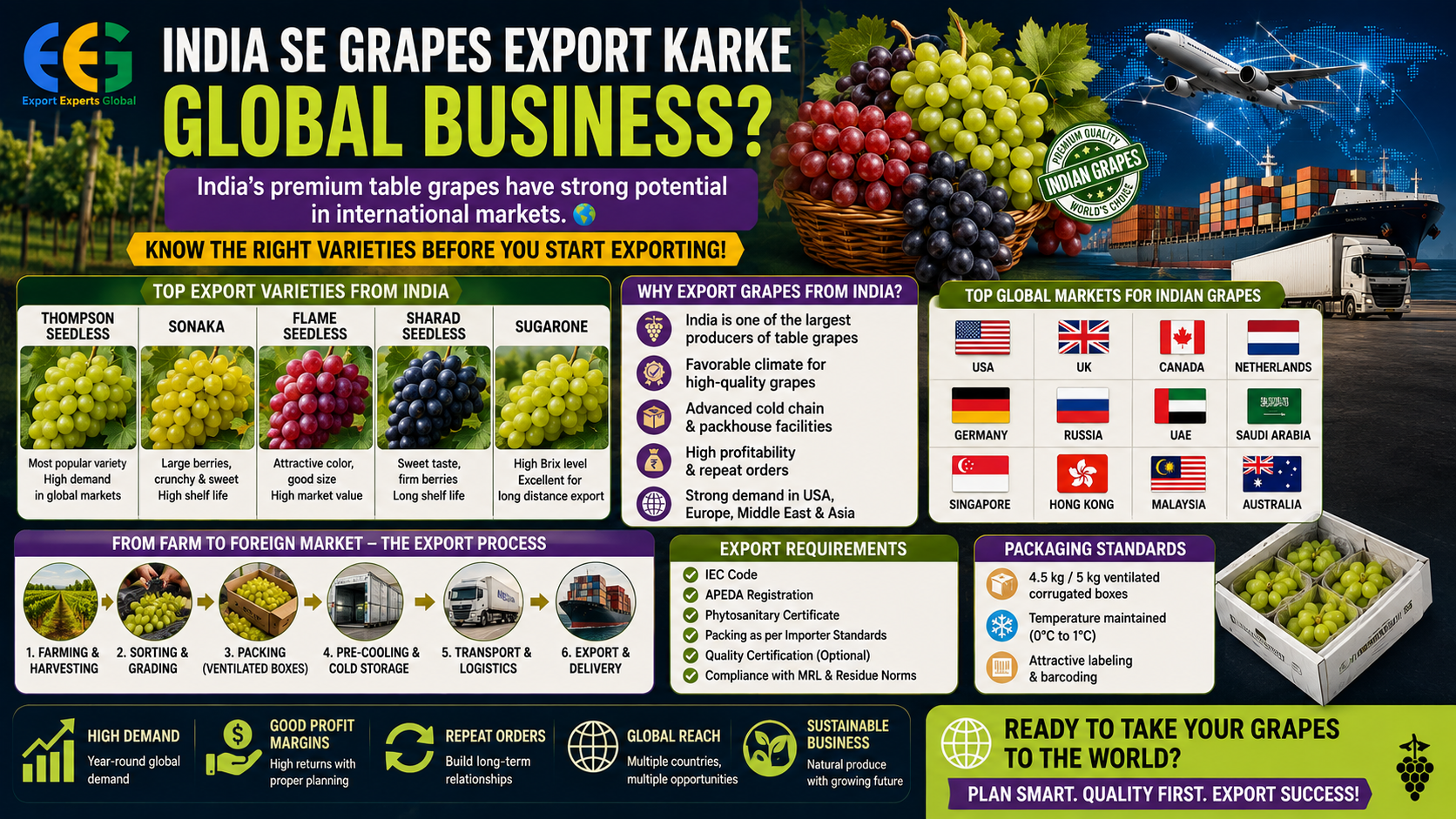
🍇 Top Grape Varieties for Export
Different international buyers look for different characteristics such as berry size, colour, sweetness, crunchiness, seedlessness, shelf life and appearance.
1️⃣ Thompson Seedless
Thompson Seedless is one of the most widely recognised seedless table-grape varieties.
Its major advantages include:
✅ Seedless berries
✅ Attractive green colour
✅ Sweet flavour
✅ Good consumer acceptance
✅ Suitable for international retail markets
For an exporter, Thompson Seedless can be an important variety to study when developing a green-grape export portfolio.
2️⃣ Sonaka Grapes
🍇 Sonaka is another important Indian table-grape variety.
It is known for its elongated berry appearance and attractive presentation.
Potential advantages include:
✔ Seedless characteristics
✔ Long berries
✔ Sweet taste
✔ Attractive appearance
✔ Premium positioning
Exporters should still evaluate individual lots according to the exact specifications provided by their overseas buyers.
3️⃣ Sharad Seedless
🖤 Sharad Seedless is a dark-coloured seedless grape variety.
Its distinctive colour can make it useful for exporters targeting consumers looking for alternatives to traditional green grapes.
Potential selling points include:
🍇 Dark colour
🍇 Seedless format
🍇 Sweet flavour
🍇 Premium presentation
The key is to identify buyers who specifically demand coloured grapes rather than assuming every market will accept the same product.
4️⃣ Flame Seedless
❤️ Flame Seedless belongs to the red seedless grape category.
Red grapes can offer exporters an opportunity to diversify their product range.
Potential advantages:
✨ Attractive red colour
✨ Seedless
✨ Consumer-friendly presentation
✨ Suitable for premium fruit segments
5️⃣ Crimson Seedless
🍇 Crimson Seedless is another red seedless variety that can be considered for international trade.
The variety can appeal to buyers looking for:
🔴 Red table grapes
🔴 Seedless products
🔴 Attractive retail presentation
🔴 Premium fruit assortments
6️⃣ Red Globe
❤️ Red Globe is recognised for its large berries and visually appealing appearance.
Large-sized grapes can be attractive in premium fruit retail, although exporters must carefully match the required berry size and quality specifications of each buyer.
7️⃣ Autumn Crisp
💎 Autumn Crisp represents the premium end of the seedless green grape category.
Its crisp texture and attractive presentation can make it interesting for premium-market positioning.
For an exporter, premium varieties can potentially generate better selling prices—but they also require stronger quality control and reliable sourcing.
📍 Where Can You Source Grapes in India?
When entering the grape export business, sourcing is one of the most important decisions.
🇮🇳 Maharashtra is a major grape-producing region in India, with important production clusters including:
📍 Nashik
📍 Sangli
📍 Solapur
📍 Ahmednagar
Nashik is particularly well known for its grape-growing ecosystem.
But remember:
Production location ≠ export-ready supplier.
A farmer may grow excellent grapes but may not have the infrastructure required for export.
Therefore, exporters should evaluate:
🧪 Quality testing capability
📦 Packing facilities
❄️ Pre-cooling facilities
🌡️ Cold-chain management
📑 Documentation capability
🚢 Previous export experience
🍇 Variety availability
🌍 Potential International Markets
Indian grapes can be explored for multiple international markets depending on market access, seasonality, buyer requirements, logistics and commercial viability.
Potential destinations may include:
🇦🇪 UAE
🇸🇦 Saudi Arabia
🇧🇩 Bangladesh
🇳🇱 Netherlands
🇬🇧 United Kingdom
🇩🇪 Germany
🇲🇾 Malaysia
🇸🇬 Singapore
🇷🇺 Russia
However, exporters should never select a country only because it appears on a general export list.
Instead, conduct proper market research.
Ask:
🔎 What varieties are imported?
🔎 What berry size does the buyer require?
🔎 What colour is preferred?
🔎 What packaging format is used?
🔎 What is the import season?
🔎 What are the MRL requirements?
🔎 What are the import procedures?
🔎 What are the current freight costs?
💰 How Does the Grape Export Business Make Money?
The basic business equation is:
Buying Price + Processing + Packaging + Testing + Logistics + Documentation + Freight + Other Costs = Export Cost
Then:
Export Selling Price – Total Export Cost = Gross Trading Margin
For example, imagine an exporter sources grapes at one price and sells them to an overseas buyer at a higher price.
The difference is not automatically profit.
The exporter must account for:
📦 Packaging
🧪 Laboratory testing
❄️ Cold storage
🚛 Inland transportation
🚢 Ocean/air freight
📑 Documentation
🏦 Banking charges
🛡️ Insurance
⚠️ Rejection or quality risks
Therefore, exporters should calculate the complete landed/export cost before quoting a buyer.
📦 Grape Export Packaging
Fresh grapes are highly sensitive to handling and transportation.
Packaging therefore becomes a major part of the export strategy.
Depending on buyer requirements, exporters may deal with:
📦 Corrugated cartons
📦 Plastic punnets
📦 Clamshell packaging
📦 Bags
📦 Retail-ready packaging
📦 Bulk export cartons
Packaging should protect the grapes while also meeting:
✔ Buyer specifications
✔ Destination-market requirements
✔ Handling requirements
✔ Branding requirements
✔ Weight specifications
A professional exporter should never select packaging merely because it is cheap.
The objective is to protect product quality throughout the supply chain.
❄️ Why Cold Chain Matters
Fresh grapes are a perishable commodity.
Unlike non-perishable products, grapes cannot simply remain at ambient temperature throughout the export journey.
The export supply chain may involve:
🍇 Harvesting
⬇️
📦 Sorting & packing
⬇️
❄️ Pre-cooling
⬇️
🚛 Reefer transportation
⬇️
⚓ Port handling
⬇️
🚢 International transportation
⬇️
🌍 Importer
⬇️
🏪 Retail market
Temperature management, handling and transit time can significantly influence product quality.
A cold-chain failure can turn a profitable shipment into a loss.
🧪 Residue & Quality Compliance
One of the most important areas in fresh-fruit exports is food safety compliance.
International buyers may impose strict requirements relating to:
🧪 Pesticide residues
🧪 Maximum Residue Limits (MRLs)
🧪 Microbiological parameters where applicable
🧪 Traceability
🧪 Product quality
🧪 Packaging
🧪 Labelling
A buyer may reject a shipment if it does not meet the agreed specification or destination-country requirements.
Therefore, exporters should work with competent suppliers and testing facilities and understand the requirements applicable to the destination market.
📑 Documents & Compliance
Before shipping grapes internationally, an exporter must understand the applicable export documentation.
Depending on the transaction and destination, documentation can include:
📄 Commercial Invoice
📄 Packing List
📄 Shipping Bill
📄 Bill of Lading/Air Waybill
📄 Certificate of Origin
📄 Phytosanitary Certificate
📄 Laboratory/Test Reports
📄 Insurance documents where applicable
📄 Other buyer- or destination-specific certificates
An exporter should also understand the role of:
🏢 IEC
🏢 GST
🏢 APEDA
🏢 RCMC, where applicable
🏢 Customs
🏢 Plant quarantine authorities
Requirements can differ according to product, destination and shipment structure, so compliance should be verified before every export program.
🔎 How to Find International Grape Buyers?
Finding buyers is often harder than finding the product.
Potential buyer categories include:
🌍 Importers
🏪 Supermarket suppliers
🍇 Fresh-fruit wholesalers
📦 Food distributors
🏢 Trading companies
🍽️ Hospitality suppliers
🛒 Retail procurement companies
Use a structured buyer-search strategy.
Step 1: Select a Country
For example:
🇦🇪 UAE
Step 2: Identify Buyer Type
Search for:
“Fresh fruit importer UAE”
or
“Grape importer UAE”
Step 3: Study the Company
Check:
✔ Website
✔ Product portfolio
✔ Import activity
✔ Contact details
✔ Procurement team
✔ Business history
Step 4: Send a Professional Offer
Include:
🍇 Variety
📏 Berry size
📦 Packing
⚖️ Quantity
💰 Price basis
🚢 Incoterm
📅 Availability
🧪 Quality specifications
🚢 Choosing the Right Incoterm
An exporter must understand the commercial responsibilities associated with the chosen Incoterm.
Common terms encountered in international trade include:
🔹 FOB
🔹 CFR
🔹 CIF
🔹 FCA
🔹 DAP
🔹 DDP
For fresh produce, the choice of Incoterm should be made after considering:
🚢 Freight
🛡️ Insurance
📍 Delivery location
💰 Cost responsibility
⚠️ Risk transfer
Never quote an international buyer without understanding exactly which costs are included in your price.
⚠️ Major Risks in Grape Export
Every business has risks.
Grape exporters should particularly monitor:
❌ Quality deterioration
❌ MRL problems
❌ Shipment delays
❌ Cold-chain breakdown
❌ Packaging damage
❌ Buyer rejection
❌ Freight-rate changes
❌ Currency fluctuations
❌ Payment default
❌ Market-price volatility
💡 Risk Management Tip
Don’t depend on one farmer, one buyer or one destination.
Build a diversified network:
Multiple Suppliers + Multiple Buyers + Multiple Markets = Better Business Resilience
🚀 How Beginners Can Start
If you are new to export business, don’t rush into buying large quantities.
Start with a structured approach.
STEP 1️⃣ — Select the Variety
Choose green, red or black grapes according to buyer demand.
STEP 2️⃣ — Find Export-Ready Suppliers
Visit farms and packhouses.
STEP 3️⃣ — Understand Quality
Learn about:
🍇 Berry size
🍇 Brix/sweetness
🍇 Colour
🍇 Firmness
🍇 Stem condition
🍇 Shelf life
🍇 Residue compliance
STEP 4️⃣ — Find Buyers
Build a verified international buyer database.
STEP 5️⃣ — Calculate Export Cost
Include every expense before giving a quotation.
STEP 6️⃣ — Negotiate Payment Terms
Reduce payment risk through appropriate commercial and banking arrangements.
STEP 7️⃣ — Execute a Trial Shipment
Start carefully instead of immediately committing to large volumes.
STEP 8️⃣ — Build Repeat Orders
The real objective is not one shipment.
The real objective is repeat international business. 🔄🌍
📈 The Future of Grape Export Business
Global consumers increasingly look for fresh fruits with:
🍇 Better taste
🌱 Responsible production
📦 Convenient packaging
✨ Attractive appearance
🧪 Food-safety assurance
♻️ Sustainable packaging
This creates opportunities for Indian exporters who can combine agricultural sourcing with professional international trade practices.
The future exporter will not simply be a trader.
They will need to become a:
SOURCING + QUALITY + LOGISTICS + COMPLIANCE + MARKETING PROFESSIONAL.
Overall Analysis
The grape varieties export business from India can be an interesting opportunity for entrepreneurs who understand sourcing, quality, compliance and international buyer requirements.
From Thompson Seedless and Sonaka to Sharad Seedless, Flame Seedless, Crimson Seedless, Red Globe and premium green varieties, exporters have multiple products to explore.
But remember:
🍇 Right Variety
- 🧪 Right Quality
- 📦 Right Packaging
- ❄️ Right Cold Chain
- 🌍 Right Market
- 🤝 Right Buyer
- 📑 Right Documentation
= 🚀 STRONG EXPORT BUSINESS