🚢 What Is a Shipping Container Number?
A shipping container number is a unique identification code assigned to an intermodal freight container. It is used to identify the physical container as it moves through different stages of the international supply chain.
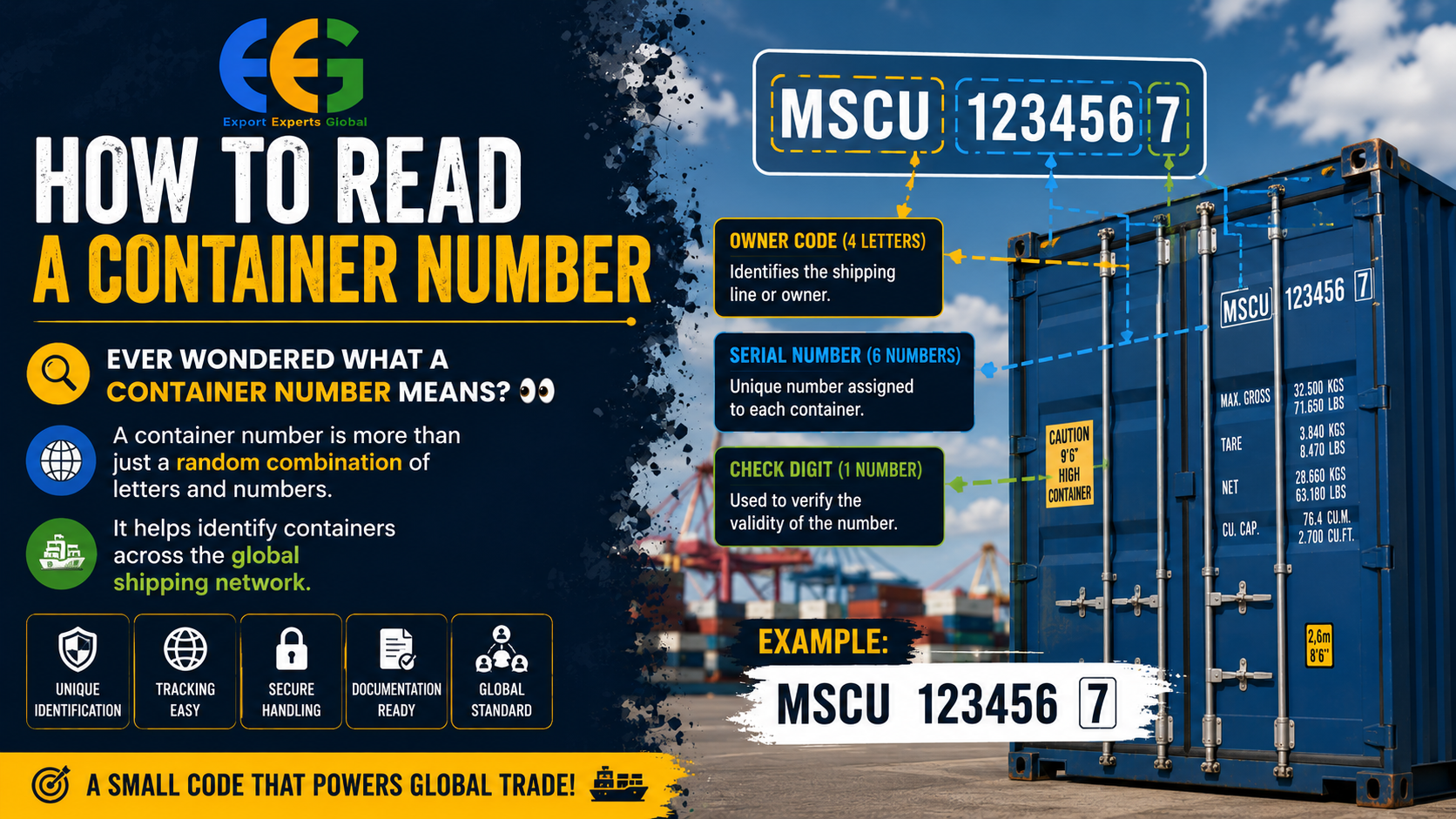
A typical ISO container identification number consists of:
🔤 3-letter owner/operator code
🚢 1 equipment category identifier
🔢 6-digit serial number
✔️ 1 check digit
For example:
MSCU 123456 7
The number can be divided into:
MSC | U | 123456 | 7
Each section provides information that helps logistics systems identify and validate the container.
🔍 Understanding the Container Number Structure
Let’s break down the example step by step.
1️⃣ The First Three Letters — Owner Code
The first three letters represent the registered owner or principal operator code associated with the container.
In our example:
MSC
This is the owner/operator identifier.
These codes are registered within the international container identification system. They allow parties involved in transportation and logistics to associate the container with the relevant registered entity.
📌 Important: The first three letters are not simply an informal abbreviation. They form part of a standardized container identification system.
For exporters, recognizing the owner/operator code can be useful when communicating with:
🚢 Shipping lines
📦 Freight forwarders
🏗️ Container terminals
🚛 Transport companies
🧾 Documentation teams
2️⃣ The Letter “U” — Equipment Category
The fourth character identifies the category of equipment.
For standard freight containers, the letter:
U
is used to identify freight containers.
Therefore, in:
MSCU
MSC represents the registered owner/operator code, while U identifies the equipment category.
This distinction is useful when learning how international container identification works.
3️⃣ Six-Digit Serial Number 🔢
After the four letters comes a six-digit serial number.
Example:
123456
This number forms the unique serial portion of the container identification.
So:
MSCU 123456
represents the owner/operator code plus the equipment’s serial identification.
The serial number is extremely important because logistics systems need to distinguish one container from another.
For example:
📦 MSCU 123456
📦 MSCU 123457
📦 MSCU 123458
These are different container identifiers.
Even though the numbers appear almost identical, they refer to different containers.
4️⃣ The Final Number — Check Digit ✔️
The final digit is called the check digit.
In our example:
7
The check digit is calculated using a standardized mathematical process based on the preceding characters.
Its primary purpose is verification.
It helps detect errors when a container number is entered into a system, copied into documentation, or transmitted between different parties.
For example, if an exporter accidentally enters:
❌ MSCU 123456 7
as:
❌ MSCU 123465 7
the check-digit validation process may indicate that the identification number is inconsistent.
This is one reason why understanding container numbers is useful for export documentation teams.
🌍 Why Are Container Numbers Important?
International shipping involves thousands of containers moving between countries every day.
A single export shipment can involve multiple parties.
For example:
Exporter → Transporter → Port → Shipping Line → Transshipment Port → Destination Port → Importer
Every participant needs accurate shipment information.
The container number provides a common reference point.
It helps with:
✅ Container identification
✅ Shipment coordination
✅ Documentation
✅ Terminal handling
✅ Cargo tracking
✅ Transport planning
✅ Supply-chain visibility
📄 Container Number & Export Documentation
If you are an exporter, you will encounter container-related information in various stages of your shipment.
Depending on the shipment and documentation process, container details may appear in or be associated with:
📄 Bill of Lading
📋 Shipping Bill
📦 Packing information
🚢 Terminal records
🧾 Shipping instructions
🚛 Transport documentation
💻 Logistics management systems
The exact documentation requirements can vary according to the shipment, country, carrier, and customs process.
That is why exporters should always coordinate with their freight forwarder, customs broker, shipping line, or logistics partner when finalizing shipment details.
⚠️ What Happens If You Enter the Wrong Container Number?
A container number is a critical operational reference.
An incorrect number can create confusion between the physical container and the information stored in documentation or logistics systems.
Potential consequences can include:
⚠️ Documentation discrepancies
⚠️ Difficulty matching shipment records
⚠️ Communication problems with logistics providers
⚠️ Delays in resolving shipment issues
⚠️ Additional verification requirements
⚠️ Problems during cargo coordination
Not every incorrect entry will automatically cause a shipment delay, but unnecessary discrepancies can create avoidable operational work.
That’s why accuracy matters.
🔎 How Should an Exporter Verify a Container Number?
Before submitting or confirming shipment-related information, develop a simple verification habit.
STEP 1️⃣ — Read the physical container
Check the identification number printed on the container.
Look carefully at:
🔤 Letters
🔢 Serial digits
✔️ Check digit
STEP 2️⃣ — Compare With Shipping Documents
Cross-check the number against the relevant shipping documentation.
Look for differences such as:
❌ Missing digit
❌ Extra digit
❌ Wrong letter
❌ Transposed numbers
❌ Incorrect check digit
STEP 3️⃣ — Confirm With Your Logistics Partner
If there is any uncertainty, contact the relevant:
🚢 Shipping line
📦 Freight forwarder
🚛 Transporter
🏗️ Terminal
🧾 Documentation team
Do not assume that a similar-looking number is correct.
STEP 4️⃣ — Maintain a Shipment Record
For professional export operations, maintain organized records of important shipment references.
A simple shipment tracker can contain:
📌 Buyer name
📌 Invoice number
📌 Container number
📌 Seal number
📌 Vessel name
📌 Port of loading
📌 Destination port
📌 ETD
📌 ETA
📌 Bill of Lading number
This can make shipment coordination significantly easier.
🔐 Container Number vs. Seal Number
Many beginners confuse the container number with the container seal number.
They are not the same.
📦 Container Number
Identifies the container itself.
Example:
MSCU 123456 7
🔒 Seal Number
Identifies the security seal attached to the container after loading.
The seal helps indicate whether the container has been opened or tampered with during transit.
Therefore, an export shipment may have both:
🚢 Container Number: MSCU 123456 7
🔒 Seal Number: ABC123456
Both can be important for shipment documentation and cargo control.
📦 Container Number vs. Booking Number
Another common beginner mistake is confusing a container number with a booking number.
Container Number 🚢
Identifies the physical container.
Booking Number 📑
Relates to the shipping reservation or booking made with the carrier.
They serve different purposes.
A shipment can have a booking reference before the physical container is assigned.
Once the container is allocated and loaded, its container number becomes an important physical-equipment reference.
🌐 Container Number & Global Supply Chain
One of the biggest advantages of standardized container identification is that it creates a common language for international logistics.
Imagine an Indian exporter shipping goods to Germany.
The shipment may travel through:
🇮🇳 India
⬇️
🚢 Port of Loading
⬇️
🌊 International Sea Route
⬇️
🚢 Transshipment Port
⬇️
🇩🇪 European Port
⬇️
🚛 Inland Transport
⬇️
🏭 German Importer
Different companies and systems may handle different parts of this journey.
The container number provides a consistent identification reference for the physical equipment.
💻 Container Tracking & Digital Logistics
Modern logistics is increasingly digital.
Shipping companies, freight forwarders, terminals, customs authorities, transport companies, and importers use digital systems to exchange shipment information.
Container numbers can therefore become important search and reference fields.
An exporter may use container-related information when communicating about:
📍 Shipment status
🚢 Vessel movement
🏗️ Terminal handling
📦 Container pickup
🚛 Inland transportation
📄 Documentation
However, remember that a container number itself is not necessarily a live GPS tracker.
Actual tracking functionality depends on the carrier, equipment, tracking technology, and logistics platform being used.
🧠 Why Import-Export Students Should Learn This
Many beginners focus only on:
💰 Product selection
🌍 Finding buyers
📧 Sending quotations
📦 Finding suppliers
But successful exporting requires much more.
You should also understand:
📄 Export documentation
🚢 Shipping procedures
📦 Containerization
🧾 Commercial invoices
📋 Packing lists
🌐 Incoterms
💳 Payment terms
🏗️ Port operations
🚛 Inland transportation
🛃 Customs procedures
Container identification is one small but practical part of this larger export ecosystem.
📌 Container Number Checklist for Exporters
Before confirming your shipment, check:
☑️ Container number
☑️ Container type
☑️ Seal number
☑️ Shipping line/carrier
☑️ Vessel details
☑️ Port of loading
☑️ Destination port
☑️ Bill of Lading information
☑️ Shipping instructions
☑️ Relevant customs documentation
Keep your records consistent and communicate promptly whenever there is a discrepancy.
Overall Analysis
A shipping container number may look like a simple code, but it is an important part of modern international logistics.
MSCU 123456 7
can be understood as:
🔤 MSC → Owner/operator code
🚢 U → Freight-container equipment category
🔢 123456 → Serial number
✔️ 7 → Check digit
For an aspiring exporter, understanding this structure is a practical step toward mastering shipping documentation, freight forwarding, container logistics, and international trade operations.
🌍 Whether you are exporting textiles, spices, agricultural products, engineering goods, handicrafts, chemicals, machinery, or consumer products, understanding logistics terminology can help you communicate more effectively with your supply-chain partners.
🚢 Learn the system.
📄 Check the documents.
📦 Verify the container.
🌍 Export with confidence.