🧩 What Is EVA Foam?
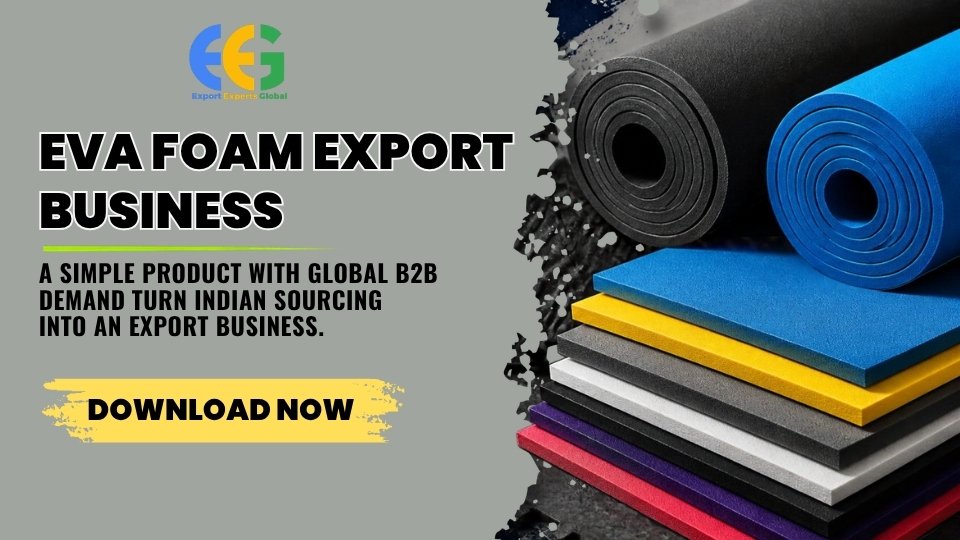
EVA foam is produced using ethylene-vinyl acetate copolymer and can be manufactured in different densities, thicknesses, colors, hardness levels and formats.
Depending on the manufacturing process and intended application, EVA foam may be available as:
🔹 Sheets
🔹 Rolls
🔹 Blocks
🔹 Mats
🔹 Profiles
🔹 Insoles
🔹 Inserts
🔹 Gaskets
🔹 Customized components
🔹 Protective packaging pieces
The exact characteristics of the material depend on its formulation and intended end use.
For exporters, understanding the technical specification is extremely important because an international buyer may not simply ask for “EVA foam.” They may specify density, thickness, hardness, dimensions, color, compression performance, surface characteristics and other technical requirements.
📦 EVA FOAM PRODUCTS THAT CAN BE EXPLORED FOR EXPORT
There are several product categories that an Indian exporter can investigate.
1️⃣ EVA Foam Sheets
EVA foam sheets are widely used for cutting, fabrication, packaging, craft applications and industrial purposes.
Different buyers may require different:
📏 Thicknesses
📐 Dimensions
🎨 Colors
⚖️ Densities
💪 Hardness levels
Instead of maintaining a generic product catalogue, exporters can develop separate product offerings according to the application.
2️⃣ EVA Foam Rolls
Roll-form EVA foam can be useful for buyers who require continuous material for converting or manufacturing.
Potential applications include:
📦 Packaging
🛡️ Protective lining
🏭 Industrial fabrication
🎨 Craft applications
👟 Footwear-related manufacturing
The buyer’s required roll width, thickness, length and material properties should be confirmed before quotation.
3️⃣ EVA Foam Mats
EVA foam is commonly associated with sports and fitness products.
Potential products include:
🏋️ Exercise mats
🧘 Yoga mats
🥋 Martial arts mats
👶 Play mats
🧩 Interlocking floor mats
For these products, exporters should pay attention to dimensions, surface design, thickness, density, durability and packaging.
4️⃣ EVA Foam Insoles
The footwear industry provides another potential application.
EVA is used in various footwear components because of its cushioning and lightweight characteristics. Indian exporters can explore buyers involved in:
👟 Footwear manufacturing
👞 Insoles
🥾 Sports shoes
🥿 Casual footwear
🏭 Footwear components
For footwear-related products, buyer specifications can be highly application-specific.
5️⃣ EVA Packaging Components
EVA foam can also be converted into protective inserts and cushioning components.
Potential applications include:
📱 Electronics packaging
🔧 Tool packaging
🎧 Product protection
📷 Equipment packaging
🧰 Industrial packaging
Customized die-cut or molded inserts can potentially offer higher value than generic foam sheets because the exporter is supplying a finished packaging solution rather than only raw material.
🏭 WHY EVA FOAM CAN BE AN INTERESTING EXPORT PRODUCT
The major advantage of EVA foam is its wide range of applications.
A product that serves multiple industries can provide exporters with several buyer segments to investigate.
For example:
Footwear → Packaging → Sports → Toys → Automotive → Industrial Applications
This diversification can help exporters avoid depending entirely on one customer category.
Another advantage is that many EVA foam products can be customized according to the buyer’s requirements.
Customization can include:
🎨 Color
📏 Thickness
📐 Size
🧩 Shape
🏷️ Branding
📦 Packaging
✂️ Die-cutting
🔧 Application-specific design
However, customization should only be offered after confirming the manufacturer’s technical capabilities and production economics.
🎯 WHO CAN BUY EVA FOAM?
An exporter should focus on B2B customers rather than trying to sell to everyone.
Potential buyer categories include:
👟 Footwear manufacturers
📦 Packaging companies
🏋️ Sports equipment companies
🧸 Toy manufacturers
🚗 Automotive component suppliers
🏭 Industrial product manufacturers
🛠️ Hardware and tool companies
🛍️ Product distributors
📦 Packaging distributors
🌎 Foam importers and wholesalers
A buyer’s industry gives you a starting point for determining which EVA product and specification to offer.
🌎 POTENTIAL INTERNATIONAL MARKETS
Indian exporters can research EVA foam demand in various regions.
Potential markets may include:
🇦🇪 UAE
🇸🇦 Saudi Arabia
🇧🇩 Bangladesh
🇱🇰 Sri Lanka
🇻🇳 Vietnam
🇮🇩 Indonesia
🇹🇷 Turkey
🇰🇪 Kenya
🇿🇦 South Africa
🇬🇧 United Kingdom
These should be treated as markets to research, not guaranteed sales destinations.
Before entering any market, study:
🔎 Import volumes
🔎 Existing suppliers
🔎 Competitor pricing
🔎 Buyer requirements
🔎 Tariffs and duties
🔎 Product standards
🔎 Freight costs
🔎 Payment practices
🔎 Market competition
A country with high imports is not automatically the best market for your business. The ideal market is one where your product specification, price, quality and logistics create a competitive proposition.
🔍 WHAT SHOULD YOU KNOW BEFORE APPROACHING BUYERS?
One of the biggest mistakes new exporters make is approaching buyers without knowing their own product specifications.
Before contacting international customers, prepare a proper product sheet.
Include:
📌 Product name
📌 Material
📌 Density
📌 Thickness
📌 Length and width
📌 Roll dimensions, where applicable
📌 Hardness
📌 Color options
📌 Surface finish
📌 Packaging
📌 MOQ
📌 Production capacity
📌 Lead time
📌 Available customization
📌 Test reports, where applicable
📌 Payment terms
📌 Incoterms
This makes your communication more professional.
💼 HOW TO START EVA FOAM EXPORT WITHOUT A FACTORY
One of the attractive models for a beginner is the merchant exporter model.
You do not necessarily have to manufacture EVA foam yourself.
Instead:
STEP 1 — FIND MANUFACTURERS 🏭
Search for established Indian EVA foam manufacturers and converters.
Shortlist multiple suppliers rather than depending on one factory.
Compare:
✅ Product quality
✅ Price
✅ Production capacity
✅ MOQ
✅ Lead time
✅ Customization
✅ Packaging
✅ Export experience
✅ Quality consistency
STEP 2 — COLLECT SAMPLES 📦
Samples are extremely important for industrial products.
Ask suppliers for representative samples and technical specifications.
Study:
🔬 Material quality
📏 Dimensions
💪 Hardness
⚖️ Density
🎨 Finish
📦 Packaging
If a potential buyer requests a sample, you should be able to respond quickly.
STEP 3 — BUILD A PRODUCT CATALOGUE 📑
Create a professional catalogue instead of sending random photographs.
Your catalogue can contain:
Product → Application → Specification → Size → MOQ → Packaging → Customization
Professional documentation creates confidence during B2B negotiations.
STEP 4 — IDENTIFY INTERNATIONAL BUYERS 🌍
Search for companies importing or using EVA foam.
Useful buyer categories include:
“EVA foam importer”
“EVA sheet distributor”
“EVA foam manufacturer”
“footwear component importer”
“foam packaging distributor”
The objective is not to collect thousands of random contacts.
The objective is to identify relevant, verified buyers.
🤝 HOW TO FIND EVA FOAM BUYERS
Buyer research should be systematic.
🔎 Method 1: Trade Data
Study import records where legally and commercially available.
Look for:
📊 Importing companies
📊 Product descriptions
📊 Shipment frequency
📊 Supplier countries
📊 Import quantities
This can help identify companies already purchasing similar products.
🌐 Method 2: B2B Platforms
International B2B platforms can help identify potential customers.
But simply finding a buyer profile is not enough.
Check:
✔️ Company website
✔️ Business activity
✔️ Product range
✔️ Location
✔️ Contact details
✔️ Importing history where available
✔️ Decision-maker information
🔗 Method 3: Industry Directories
Industry-specific directories can be useful for identifying:
👟 Footwear manufacturers
📦 Packaging companies
🏋️ Sports-product companies
🏭 Industrial manufacturers
Targeted prospecting generally produces better results than sending the same message to thousands of companies.
💰 EVA FOAM EXPORT PRICING
There is no single universal export price for EVA foam.
Pricing can vary considerably based on:
⚖️ Density
📏 Thickness
📐 Size
💪 Hardness
🎨 Color
🧪 Material formulation
✂️ Processing
📦 Packaging
📊 Order quantity
🚢 Destination
🛠️ Customization
Therefore, exporters should avoid using a fixed online price as their final quotation.
Calculate your actual cost.
BASIC EXPORT COST STRUCTURE
Product Cost
- Packaging
- Local Transportation
- Documentation
- Testing, if applicable
- Customs/clearing charges
- Port-related expenses
- Freight
- Insurance, where applicable
- Bank/payment charges
- Marketing & other overheads
= Total Export Cost
Then determine your target margin.
🚢 EXPORT LOGISTICS
EVA foam can occupy considerable volume depending on its format and packaging.
Therefore, logistics planning matters.
An exporter should compare:
🚢 Sea Freight
✈️ Air Freight
📦 LCL
🚢 FCL
For large B2B orders, sea freight may be more practical depending on destination, volume and delivery requirements.
Your quotation should clearly mention the agreed Incoterm.
Examples include:
EXW
FOB
CFR
CIF
Choose the appropriate term based on the transaction structure and buyer requirements.
📑 DOCUMENTATION FOR EVA FOAM EXPORT
Export documentation depends on the transaction and destination, but an exporter may commonly encounter:
📄 Import Export Code (IEC)
📄 GST-related documentation
📄 Commercial Invoice
📄 Packing List
📄 Shipping Bill
📄 Bill of Lading / Air Waybill
📄 Certificate of Origin, where required
📄 Product test documents, where applicable
📄 Other destination-specific certificates or declarations
The exact documentation should be verified for the product and destination before shipment.
🧪 QUALITY CONTROL IS CRITICAL
One rejected shipment can damage a new export relationship.
Before shipping, establish a quality-control process.
Check:
🔬 Material specification
⚖️ Density
📏 Thickness
📐 Dimensions
🎨 Color consistency
💪 Hardness
📦 Packaging
🏷️ Labelling
📋 Quantity
For application-specific products, additional testing may be required.
Always confirm the buyer’s technical specifications before production, rather than after the goods are manufactured.
⚠️ COMMON MISTAKES NEW EVA FOAM EXPORTERS MAKE
❌ Mistake 1: Selling Without Understanding Specifications
A buyer asking for a particular density or hardness cannot be served with a generic product.
❌ Mistake 2: Choosing a Market Only Because It Looks Large
Large import volumes do not guarantee easy entry.
❌ Mistake 3: Ignoring Freight Costs
Foam products can have significant volume, making logistics an important part of the landed cost.
❌ Mistake 4: Depending on One Supplier
Always develop backup suppliers.
❌ Mistake 5: Quoting Too Quickly
Calculate the complete export cost before sending a final quotation.
❌ Mistake 6: Not Verifying Buyers
A professional-looking inquiry is not automatically a genuine purchase opportunity.
❌ Mistake 7: Competing Only on Price
Quality consistency, customization, packaging, communication and reliability can also influence B2B purchasing decisions.
🚀 HOW TO BUILD A STRONG EVA FOAM EXPORT BRAND
Instead of positioning yourself as another generic foam supplier, create a specialized export proposition.
For example:
OPTION 1
EVA Foam Solutions for Footwear Manufacturers
OPTION 2
Customized EVA Packaging Components
OPTION 3
EVA Sports & Fitness Products
OPTION 4
Industrial EVA Foam Components
OPTION 5
EVA Foam Sheets & Rolls for International Distributors
Specialization can make your marketing message clearer.
📱 DIGITAL MARKETING FOR EVA FOAM EXPORTERS
Your website and social media should clearly communicate what you sell.
Create content around:
📌 EVA foam applications
📌 Product specifications
📌 Manufacturing process
📌 Quality testing
📌 Packaging
📌 Export capabilities
📌 Product customization
📌 Industry applications
📌 Case studies
📌 Frequently asked buyer questions
Use professional product photographs and technical information.
A B2B buyer should be able to understand your product within a few minutes of visiting your website.
📈 REPEAT ORDERS ARE THE REAL OPPORTUNITY
Export business should not be viewed as simply finding one customer and completing one shipment.
The bigger opportunity is repeat purchasing.
For industrial products, a buyer who regularly uses EVA foam may require material every month or quarter.
Therefore, focus on:
🤝 Consistent quality
📦 Reliable supply
⏱️ On-time delivery
💬 Fast communication
📋 Accurate documentation
💰 Competitive total cost
A satisfied B2B customer can become a long-term international account.
🧠 MENTOR’S STRATEGY BY HARSH DHAWAN
If you are starting an EVA foam export business, don’t begin by asking:
“Which country should I export to?”
Start with:
1️⃣ What exact EVA product can I supply?
2️⃣ Which industry uses it?
3️⃣ What specifications does that industry require?
4️⃣ Which Indian manufacturers can supply it consistently?
5️⃣ Which international companies already purchase it?
6️⃣ Can I offer competitive landed pricing?
7️⃣ Can I maintain quality for repeat orders?
This changes your approach from product selling to solution selling.
🌍 THE EVA FOAM EXPORT BUSINESS FORMULA
Product Research
➕
Reliable Indian Manufacturer
➕
Correct Product Specification
➕
Verified International Buyers
➕
Competitive Export Pricing
➕
Quality Control
➕
Proper Documentation
➕
Smart Logistics
=
🚀 SUCCESSFUL EVA FOAM EXPORT BUSINESS
The biggest lesson for a new exporter is simple:
Don’t try to sell everything to everyone.
Choose a specific EVA foam product, identify the industries that need it, understand their specifications and then build a targeted international buyer list.
India has a strong manufacturing ecosystem, and entrepreneurs can explore the merchant-export model by sourcing from capable manufacturers instead of immediately investing in their own production facility. 🏭🇮🇳
But sourcing alone does not create an export business.
Research → Source → Verify → Connect → Quote → Sample → Negotiate → Ship → Repeat.
That is the process.
If you can execute these steps systematically, EVA foam can become more than just another product in an export catalogue—it can become a focused B2B export opportunity.
Overall Analysis
EVA foam has applications across multiple industries and can be explored as an export business from India. The opportunity becomes stronger when exporters move beyond generic foam and focus on specialized applications such as footwear, packaging, sports products and industrial components.
Study the product.
Understand the specifications.
Find reliable manufacturers.
Research the right markets.
Verify international buyers.
Calculate the complete export cost.
Maintain quality.
Build long-term relationships. 🌍🤝
Research → Source → Connect → Export