🩺 1. What Are Medical Uniforms?
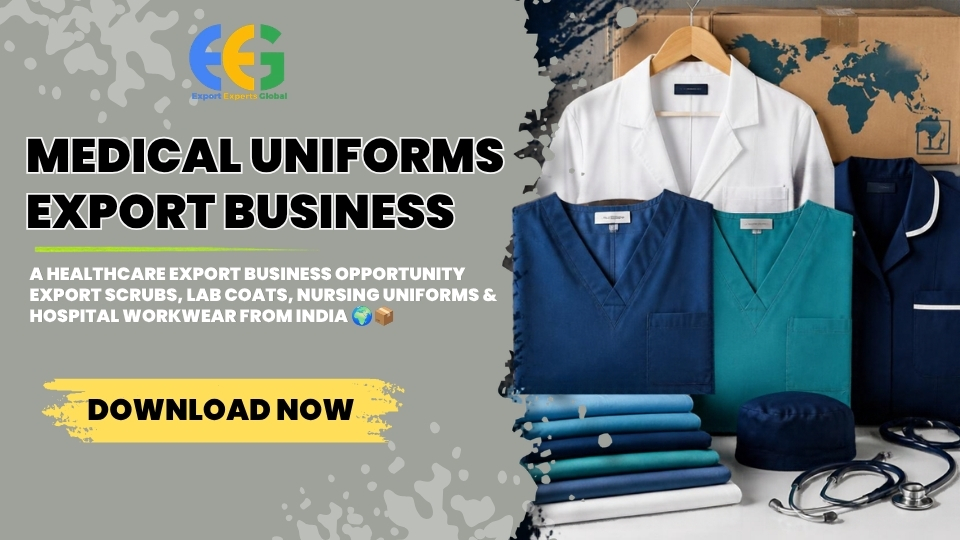
Medical uniforms are specialized garments designed for professionals working in healthcare and related environments.
These garments are generally designed around three major requirements:
👕 Comfort
Healthcare professionals may wear uniforms for long working hours, so fabric feel, fit and breathability are important.
🧵 Durability
Uniforms can experience frequent washing and repeated use. Buyers therefore look for reliable stitching and fabric performance.
🏥 Professional Appearance
Uniforms can help healthcare organizations maintain a consistent and professional appearance among employees.
Depending on the customer, the uniform may also include department-specific colors, embroidered logos, employee names, identification details and customized designs.
📦 2. Products You Can Export
An exporter can develop several product categories instead of depending on a single uniform.
👕 Medical Scrubs
Scrub sets are among the most recognizable healthcare workwear products.
Possible variations include:
- V-neck scrubs
- Round-neck scrubs
- Two-piece scrub sets
- Jogger-style scrubs
- Unisex scrubs
- Women’s fitted scrubs
- Premium healthcare uniforms
🥼 Doctor Lab Coats
Lab coats can be supplied to:
👨⚕️ Doctors
🧑🔬 Laboratory professionals
💊 Pharmacists
🎓 Medical students
🧪 Research institutions
Customization can include embroidery, logos, names and department identification.
👩⚕️ Nursing Uniforms
Nursing uniforms can include:
- Tunics
- Trousers
- Dresses
- Scrub sets
- Department-specific uniforms
🏥 Hospital Staff Uniforms
Healthcare organizations require uniforms for more than doctors and nurses.
Potential categories include:
🧹 Housekeeping uniforms
🧑💼 Reception uniforms
🧑🔧 Maintenance uniforms
🍽️ Catering staff uniforms
🚑 Emergency staff workwear
This creates opportunities for exporters to offer complete institutional uniform programs.
🌍 3. Why Consider Medical Uniform Exports?
The medical uniform business can be attractive because it operates within the broader healthcare supply chain.
A hospital may require uniforms for hundreds or thousands of employees. Medical distributors may also purchase products in bulk and supply multiple healthcare facilities.
This creates several potential advantages:
📦 Bulk procurement
🏥 Institutional customers
🔄 Repeat purchasing
🎨 Customization opportunities
🏷️ Private-label possibilities
🌍 International market potential
Instead of relying entirely on individual consumers, an exporter can focus on B2B customers that purchase according to institutional requirements.
🎯 4. Who Can Buy Medical Uniforms?
One of the most important parts of the export business is identifying the correct buyer.
Potential customers include:
🏥 Hospitals
🏨 Private healthcare groups
🩺 Clinics
🦷 Dental centers
🧪 Laboratories
🎓 Nursing colleges
💊 Healthcare distributors
📦 Medical supply companies
🏢 Healthcare procurement companies
🚑 Emergency-care organizations
You can also target uniform distributors and wholesalers instead of approaching hospitals directly.
For a new exporter, distributors can sometimes be an easier starting point because one established buyer may already serve multiple healthcare institutions.
🌎 5. Which Countries Can Be Explored?
Medical uniform exporters can research markets across different regions.
Potential markets to investigate include:
🇦🇪 UAE
🇸🇦 Saudi Arabia
🇶🇦 Qatar
🇴🇲 Oman
🇬🇧 United Kingdom
🇺🇸 United States
🇦🇺 Australia
🇩🇪 Germany
🇿🇦 South Africa
🇰🇪 Kenya
However, a country should not be selected simply because it imports healthcare apparel.
Before approaching buyers, conduct market research covering:
🔎 Import demand
💰 Price levels
🏷️ Product specifications
📑 Import regulations
🧪 Testing requirements
📦 Packaging rules
🚢 Shipping costs
🏢 Local competitors
💳 Buyer payment practices
Market research should come before investment.
🇮🇳 6. Why Source Medical Uniforms from India?
India has a broad textile and apparel manufacturing base.
An exporter can potentially source:
🧵 Fabrics
✂️ Cut-and-sew manufacturing
🪡 Embroidery
🎨 Printing
🏷️ Labels
📦 Packaging
🔍 Quality inspection
This allows an entrepreneur to operate as a merchant exporter.
You don’t necessarily have to purchase expensive machinery or establish your own production facility at the beginning.
Instead:
Find Manufacturer → Negotiate Price → Develop Sample → Inspect Quality → Find Buyer → Receive Order → Manufacture → Export
The exporter manages the commercial relationship and supply chain.
🏭 7. How to Find Indian Manufacturers
Don’t select a supplier only because they offer the lowest price.
Shortlist multiple manufacturers and compare:
✅ Production capacity
✅ Fabric sourcing
✅ Stitching quality
✅ MOQ
✅ Sample quality
✅ Lead time
✅ Customization capability
✅ Embroidery facilities
✅ Packaging options
✅ Quality-control system
✅ Previous export experience
Ideally, maintain relationships with multiple suppliers rather than becoming completely dependent on one factory.
For example, if a buyer orders 5,000 scrub sets, your supplier should have sufficient capacity to meet the agreed production schedule.
🧵 8. Choosing the Right Fabric
Fabric selection can significantly affect the commercial success of medical uniforms.
Depending on the application and buyer requirement, exporters may research fabrics such as:
👕 Cotton blends
🧵 Polyester-cotton blends
🌬️ Breathable blended fabrics
🩺 Performance fabrics
♻️ Recycled-fiber options
The correct choice depends on factors such as:
- Climate
- End use
- Washing frequency
- Desired durability
- Comfort
- Price
- Buyer specification
- Destination-market requirements
Never promise a particular fabric performance without validating it through appropriate specifications or testing.
🎨 9. Customization Can Increase Business Value
One major opportunity is customized healthcare uniforms.
Instead of selling a generic scrub set, you can offer:
🏥 Hospital logo embroidery
👤 Employee name embroidery
🎨 Department colors
🏷️ Custom labels
📦 Customized packaging
👕 Different size ranges
🎨 Custom designs
🌍 Private-label manufacturing
For example, a hospital group may require:
Blue → Nursing Department
Green → Surgical Team
White → Doctors
Grey → Support Staff
The exact color system would depend on the organization’s internal policy.
Customization can turn a basic garment order into a longer-term institutional supply relationship.
💰 10. How Does the Business Make Money?
The basic model is straightforward.
Suppose an overseas distributor wants 2,000 customized scrub sets.
The exporter obtains quotations from Indian manufacturers and calculates:
🧵 Product cost
🏷️ Customization cost
📦 Packaging
🔍 Quality inspection
🚚 Inland transportation
📄 Documentation
🚢 Freight
💰 Other applicable export costs
📈 Desired margin
The exporter then provides an international quotation based on the agreed Incoterm and commercial conditions.
The final profitability depends on sourcing price, order volume, freight, customization, payment terms, rejection levels, currency movements and other transaction costs.
Never calculate profit using only the factory purchase price.
📊 11. Start With Samples
Before accepting a large order, samples are extremely important.
A professional sample process can include:
Step 1
Understand the buyer’s specifications.
Step 2
Select fabric.
Step 3
Create the garment sample.
Step 4
Add embroidery or branding if required.
Step 5
Check measurements.
Step 6
Review stitching and finishing.
Step 7
Send the approved sample to the buyer.
Step 8
Manufacture bulk quantities according to the approved specification.
A clearly approved sample can reduce misunderstandings during bulk production.
🔍 12. Quality Control Is Critical
Medical uniforms may be washed frequently, so quality consistency matters.
Your inspection checklist can include:
🔎 Fabric composition
📏 Measurements
🧵 Stitching
🎨 Color consistency
🪡 Embroidery
✂️ Cutting accuracy
👕 Finishing
📦 Packaging
🏷️ Labels
🧺 Wash-performance requirements where applicable
For large orders, consider independent or structured pre-shipment inspection procedures according to the buyer’s requirements.
A single defective batch can damage a new exporter’s reputation.
📄 13. Export Documentation
The exact documentation depends on the transaction, product classification and destination.
Common export documentation may include:
📑 Import Export Code (IEC)
📑 Commercial Invoice
📑 Packing List
📑 Shipping Bill
📑 Bill of Lading / Air Waybill
📑 Certificate of Origin, where applicable
📑 Product specifications
📑 Test reports, when requested
📑 Buyer-specific compliance documents
The exporter should verify the applicable requirements for the specific HS classification and destination country before shipping.
Medical uniforms are generally textile/apparel products, but the precise classification should be confirmed rather than assumed.
🔎 14. How to Find International Buyers
Buyer research is one of the most valuable skills in export business.
Potential search terms include:
🔍 “Medical uniform importer UAE”
🔍 “Scrub uniform distributor Saudi Arabia”
🔍 “Healthcare apparel wholesaler UK”
🔍 “Medical clothing distributor Australia”
🔍 “Hospital uniform supplier Africa”
🔍 “Medical scrubs wholesale distributor”
You can research buyers through:
🌐 B2B platforms
📊 Trade databases
🏢 Company directories
💼 LinkedIn
🌍 Industry exhibitions
🏥 Healthcare supplier directories
📧 Direct company outreach
But don’t send the same generic message to every company.
Study the buyer first.
📧 15. Create a Professional Export Offer
Your buyer should quickly understand what you sell.
Your catalogue can include:
📸 Product photographs
🧵 Fabric details
📏 Size chart
🎨 Available colors
🏷️ Customization options
📦 MOQ
🚚 Production lead time
🌍 Export markets served
🧪 Available testing documentation
📞 Contact information
A professional catalogue can make your company appear more credible during initial buyer discussions.
💳 16. Payment Terms Matter
International transactions involve commercial risk.
Depending on the buyer and transaction, exporters may encounter payment methods such as:
💵 Advance Payment
🏦 Letter of Credit
💳 Documentary Collections
🌍 Other agreed trade-payment arrangements
New exporters should perform buyer due diligence before extending credit.
Don’t accept a large order simply because the buyer promises future business.
Verify:
🏢 Company identity
📍 Business address
🌐 Website
📞 Contact information
📊 Business history
💳 Payment credibility
📦 Previous import activity where available
🚢 17. Logistics Planning
Medical uniforms are relatively suitable for international shipping because garments can be packed efficiently.
Depending on order size and urgency, exporters can evaluate:
✈️ Air freight
🚢 Sea freight
📦 Courier for samples
For commercial bulk shipments, sea freight may be considered when transit time and volume make it economical.
The final decision depends on:
Order volume + destination + urgency + freight rate + Incoterm
Always calculate logistics before quoting the buyer.
🚀 18. A Smart Way to Start
You don’t need to launch with 50 different products.
Start with a focused range:
3–5 Core Products
👕 Scrub Set
🥼 Lab Coat
👩⚕️ Nursing Uniform
🏥 Hospital Staff Uniform
🧪 Laboratory Workwear
Create professional samples.
Then approach a specific buyer segment.
For example:
Indian Manufacturer → Exporter → UAE Medical Uniform Distributor
Once you understand the market, expand into additional products and countries.
💡 19. Build a Recurring B2B Business
The real opportunity isn’t necessarily one large order.
The stronger objective is:
First Order → Quality Delivery → Buyer Satisfaction → Repeat Order → Annual Supply Relationship
A healthcare organization may need replacement uniforms as employees join, uniforms wear out or new departments are established.
That creates potential for recurring procurement.
Your goal should therefore be to become a reliable healthcare workwear supplier, not simply another garment seller.
⚠️ 20. Common Mistakes New Exporters Make
Avoid these mistakes:
❌ Choosing suppliers only on price
❌ Sending poor-quality samples
❌ Ignoring size specifications
❌ Not calculating freight correctly
❌ Accepting unverified buyers
❌ Promising unrealistic delivery dates
❌ Ignoring destination-market requirements
❌ Skipping quality inspection
❌ Offering too many products initially
❌ Giving excessive credit to unknown buyers
Export business is built on trust, documentation, quality and consistency.
📈 21. How to Scale the Business
Once your first market becomes stable, you can expand through:
🌍 New countries
🏥 Hospital chains
📦 Medical distributors
🏷️ Private-label brands
🎨 Customized uniforms
🧵 Sustainable healthcare apparel
🚑 Emergency-service uniforms
🧪 Laboratory workwear
You can also create your own healthcare workwear brand and outsource manufacturing to Indian factories.
This allows you to focus on:
Brand + Buyer Acquisition + Product Development + Quality Control + International Distribution
🧠 22. The Export Business Formula
Medical Uniform Sourcing
➕
Quality Fabric & Manufacturing
➕
Custom Branding
➕
Verified International Buyers
➕
Professional Documentation
➕
Reliable Logistics
➕
Repeat B2B Orders
= 🌍 Medical Uniform Export Business
Overall Analysis
Medical uniforms may look like a simple garment product, but the real export opportunity lies in building a complete B2B healthcare apparel supply system.
You don’t have to start with your own factory. You can begin by identifying reliable Indian manufacturers, developing quality samples, understanding international buyer requirements and building a professional export catalogue.
The most important step is to choose a specific market and buyer segment rather than trying to sell everywhere at once.
Study the market.
Find reliable manufacturers.
Create samples.
Verify buyers.
Calculate your complete export cost.
Negotiate professionally.
Deliver consistent quality.
Build repeat orders.
🌍 Exporting is not simply about sending products to another country. It is about creating a reliable international supply chain.