

Salt Lick Export Business from India: Complete Guide to Global Market Opportunities
Beetroot Powder Export Business from India: A Complete Guide to Global Market Opportunities – Copy 🧂🐄 The salt lick..
India offers numerous opportunities for entrepreneurs who want to enter the international trade industry with value-added agricultural products. One interesting product to explore is beetroot powder, a processed ingredient made from fresh beetroot that can be used in food, beverages, bakery products, selected nutraceutical formulations and other industrial applications.
The beetroot powder export business can appeal to manufacturers, merchant exporters, food processors, agricultural entrepreneurs, traders and beginners who want to explore value-added food exports from India.
Unlike fresh beetroot, which requires careful handling during transportation, properly processed and packaged beetroot powder can be convenient for storage, distribution and industrial use. Its commercial potential depends on product quality, processing methods, buyer requirements, pricing, destination-country regulations and the ability to maintain consistent specifications.
India’s agricultural supply chain, food-processing sector and access to international logistics can provide a foundation for exploring this business. However, success requires more than simply purchasing beetroot, grinding it into powder and finding a foreign customer.
Exporters must understand product specifications, target markets, quality testing, packaging, documentation, shipping costs and buyer verification before entering into commercial agreements.
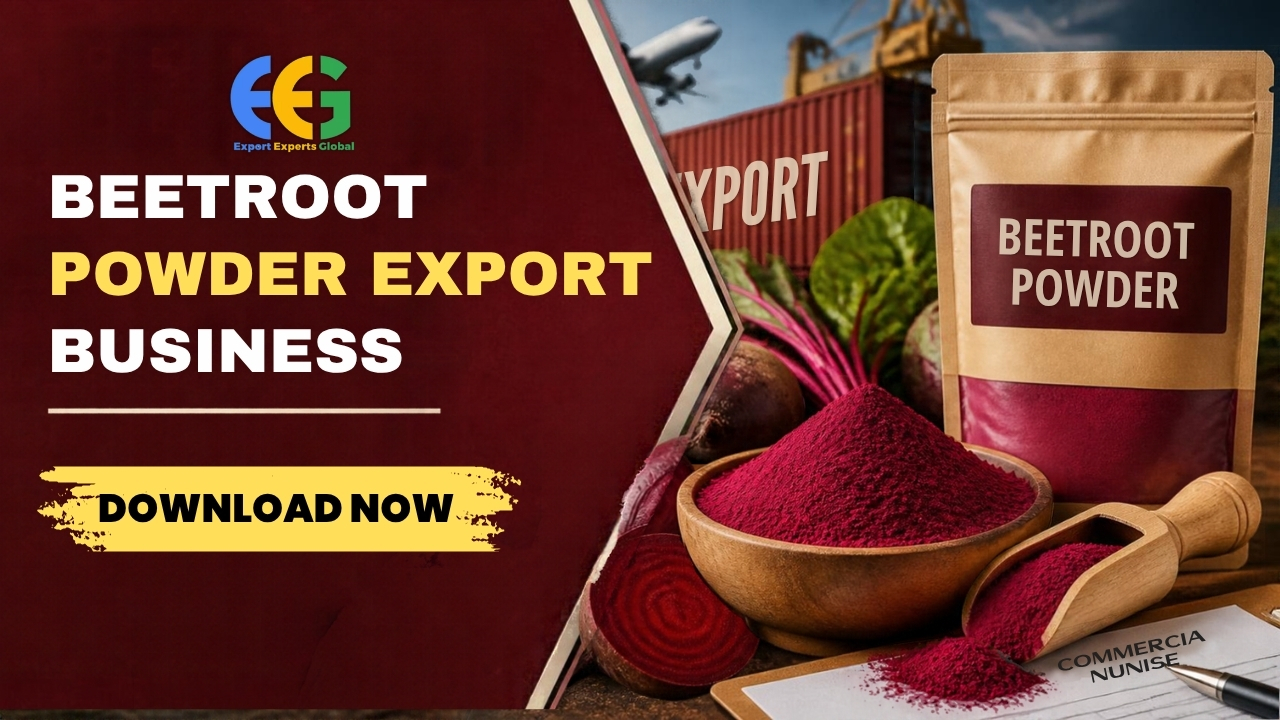
Beetroot powder is produced by processing fresh beetroot through suitable drying and grinding techniques. The resulting powder may be used as an ingredient in different food and industrial applications, depending on its quality and intended purpose.
Manufacturers may use beetroot powder in smoothie mixes, beverage preparations, soup mixes, bakery products, seasoning blends and selected health-food formulations.
Some businesses also explore beetroot-derived ingredients for natural colouring applications. However, suitability depends on the processing method, pigment stability, product composition and applicable food regulations.
Commercial beetroot powder is not a single standard product. Different buyers may require different colours, particle sizes, moisture limits, microbiological specifications and packaging formats.
For example, a beverage manufacturer may require a fine powder with good dispersion characteristics, while a food ingredient distributor may prioritise consistent colour, documentation, shelf life and competitive bulk pricing.
Therefore, exporters should identify the intended application before choosing a supplier or processing method.
Several factors make beetroot powder worth investigating as a potential export product.
Processing beetroot into powder creates a different commercial product from fresh vegetables. Exporters can investigate opportunities to supply food manufacturers that need convenient, shelf-stable ingredients.
Powdered ingredients can be easier to pack and transport than fresh produce when processed correctly. Their lower bulk volume compared with fresh beetroot can be advantageous, although actual freight efficiency depends on density, packaging and shipment size.
Potential customers include ingredient distributors, beverage manufacturers, bakeries, food-processing companies and selected nutraceutical businesses. Each segment may have different quality expectations and purchasing volumes.
Entrepreneurs do not necessarily need to establish their own processing factory. A merchant exporter may source finished beetroot powder from a qualified Indian manufacturer and sell it to verified overseas buyers.
This approach can reduce the need for investment in processing machinery, although working capital, samples, quality inspections, packaging and export expenses still need to be considered.
Exporters can investigate different grades, particle sizes, packaging options and private-label arrangements. Organic-certified products may also be an option if the supply chain and certification meet the applicable requirements.
Important: These are potential business opportunities, not a guarantee of demand, profitability or export orders.
Understanding the production process helps exporters assess supplier capability and product quality.
A typical manufacturing process may include the following steps:
Fresh Beetroot → Washing → Sorting → Slicing → Drying → Grinding → Sieving → Testing → Packaging
Manufacturers select suitable beetroot based on freshness, colour, quality and processing requirements. Raw materials should be sourced from suppliers who can maintain traceability and appropriate agricultural practices.
Beetroot is washed to remove soil and foreign matter. Damaged or unsuitable material is removed before processing.
The cleaned beetroot is cut into pieces of suitable thickness to support consistent drying.
Moisture is reduced through an appropriate drying method. Temperature, processing time and handling conditions can affect colour, aroma and other product characteristics.
The dried material is ground and sieved to achieve the required particle size.
The finished powder is checked against the agreed specifications. Depending on the product and destination, testing may cover moisture, microbiological quality, contaminants, colour and other parameters.
The powder is packed in suitable food-grade packaging that protects it from moisture, contamination and other conditions that could affect quality.
Finished products should be stored in clean, dry conditions and dispatched with appropriate batch identification and traceability.
Exporters should not assume that every drying method produces equivalent quality. Supplier audits, sample evaluation and laboratory testing can help reduce the risk of receiving inconsistent material.
International market selection should be based on evidence of actual demand, buyer requirements, competition, logistics and regulatory feasibility.
The following countries are potential markets to investigate rather than a confirmed ranking of the largest importers.
The US has a broad food manufacturing and ingredient distribution sector. Potential customers to research include natural-ingredient distributors, beverage manufacturers, bakery ingredient suppliers and private-label food businesses.
British importers and food manufacturers may be relevant prospects for powdered vegetable ingredients used in food products and beverage preparations.
Germany is worth researching for ingredient distributors and food manufacturers that purchase vegetable powders and other plant-based ingredients. Buyers may require detailed technical documentation and robust quality controls.
The Netherlands can be investigated as a potential destination for ingredient distribution and wider European supply chains. Competition and the requirements of downstream markets should be evaluated.
The UAE is a potential market to research for food ingredient distributors, food processors and suppliers serving retail and food-service businesses.
Saudi Arabia can be investigated for food manufacturing, ingredient distribution and packaged-food applications.
Australian food manufacturers and ingredient distributors may be potential prospects, subject to applicable import, food-safety and biosecurity requirements.
Use official trade statistics, customs data where available, industry directories, importer websites and direct buyer enquiries.
Search using the product description and relevant HS classification. The correct classification must be confirmed for the exact product and importing country; do not assume every beetroot powder product falls under the same code.
Identifying the correct customer segment can make your export marketing more effective.
Companies producing smoothie blends, instant drink mixes and powdered beverage preparations may be relevant prospects.
Soup manufacturers, seasoning businesses, bakery ingredient suppliers and other food processors may use vegetable powders in specific formulations.
These businesses supply ingredients to multiple manufacturing customers. They may have established procurement procedures and require product specifications, samples and supporting documents.
Some manufacturers may investigate beetroot powder for particular formulations. Their acceptance criteria and regulatory obligations can differ from those of conventional food manufacturers.
Brands selling food or beverage products under their own names may seek contract manufacturers or suppliers that can support custom packaging and consistent quality.
Ingredient wholesalers may purchase in bulk and distribute products to smaller manufacturers or retailers.
Export tip: Do not send the same generic sales message to every company. Match your offer to the buyer’s actual application, specifications, order size and procurement process.
Buyer research is one of the most important activities in the export business.
Use specific search phrases such as:
“Beetroot powder importer USA”
“Bulk beetroot powder distributor UK”
“Vegetable powder ingredient supplier Germany”
“Food ingredient importer UAE”
“Beetroot powder private label manufacturer Australia”
“Natural vegetable powder wholesale distributor”
Visit company websites and confirm that the business actually imports, distributes or manufactures relevant products.
International B2B marketplaces can help you discover potential buyers, distributors and suppliers. However, a marketplace profile is not proof that a company is genuine or financially reliable.
Check company registration, business history, domain details, contact information and purchasing requirements before proceeding.
Food ingredient exhibitions, food-processing events and international trade fairs can provide opportunities to meet distributors, importers and manufacturers.
Review exhibitor lists and arrange targeted meetings rather than relying only on walk-in networking.
Research food ingredient associations, manufacturer directories, wholesale distributors and relevant trade organisations in your target market.
Search for procurement managers, sourcing managers, ingredient buyers and purchasing directors working at relevant companies.
A professional introduction should explain your product, manufacturing source, specifications and the reason you are contacting that particular business.
Finding a potential buyer is only the first stage. Verification helps protect your business from payment fraud, false purchase orders and unnecessary expenses.
Before accepting a large order, investigate the following:
🏢 Legal company name and registration
🌐 Official website and business email
📍 Registered address and operating location
📞 Working contact details
📄 Import capability and relevant business activity
🧾 Purchase order authenticity
💳 Payment terms and credit risk
📦 Product specifications and delivery requirements
🤝 References or independent business checks, where available
Be cautious if a buyer requests unusual upfront payments, refuses reasonable verification, sends inconsistent documents or pressures you to ship before agreed payment conditions are met.
For new relationships, consider secure payment arrangements, an appropriate advance payment, a confirmed letter of credit where suitable, or another method agreed with your bank and trade adviser.
A signed contract should clearly establish product specifications, quantity, price, delivery terms, inspection arrangements, payment conditions and remedies for non-conforming goods.
Quality can influence whether a buyer accepts a sample, places a commercial order or continues purchasing from the same supplier.
Excessive moisture can contribute to caking, quality deterioration and microbial risks. Agree on a measurable specification with the buyer.
Buyers may require a consistent red or purple-red appearance, depending on the variety and processing method.
Powder fineness should match the intended application. A buyer may specify a particular mesh size or particle-size range.
Testing may cover relevant microorganisms according to the product’s intended use and destination requirements.
Depending on risk and regulations, buyers may request testing for heavy metals, pesticide residues or other contaminants.
Shelf-life claims should be supported by appropriate evidence and storage conditions. Avoid promising a fixed shelf life without validated product data.
A COA should identify the relevant product and batch and report the agreed test parameters. Ensure the testing source and methods are acceptable to the buyer.
Maintain supplier details, batch numbers, processing records, test reports and shipment documentation so that products can be traced if a quality issue arises.
Packaging must protect product quality throughout storage, handling and international transport.
Possible formats include:
100 g or 250 g packs for retail products
500 g or 1 kg packs for smaller commercial customers
5 kg or 10 kg packs for selected business customers
20 kg or 25 kg bulk packs where suitable for the product and buyer
These are illustrative formats, not universal industry standards.
Retail packs may require consumer-friendly labelling, while bulk packaging may prioritise handling efficiency and protection from moisture.
Depending on the buyer’s requirements, packaging options may include food-grade pouches, sealed multilayer bags or appropriately lined bulk containers.
Check packaging suitability, food-contact compliance, sealing integrity, storage conditions and destination-country labelling rules.
If the buyer wants private-label packaging, agree on artwork approval, language, ingredient declarations, net quantity, lot coding and other mandatory information before production.
The documentation required depends on the product, shipment and destination.
Common requirements to investigate include:
Import Export Code (IEC): Obtain it where required for commercial exports from India.
GST compliance: Determine the appropriate registration, invoicing and export treatment for your business.
Commercial Invoice: Records the seller, buyer, product, quantity and transaction value.
Packing List: Describes the shipment’s packages, weights and contents.
Shipping Bill: Customs export declaration submitted through the applicable process.
Certificate of Origin: Obtain it when required by the buyer, destination or applicable trade arrangement.
Certificate of Analysis: Supports agreed quality specifications.
Food-business compliance: Determine applicable FSSAI and other regulatory requirements.
Laboratory reports: Provide required test results for relevant safety and quality parameters.
Transport documents: For example, a bill of lading or air waybill, depending on the shipping method.
Additional documentation may be necessary depending on destination-country rules, product classification, claims and the buyer’s requirements.
Before quoting a price, confirm the applicable HS classification with a qualified customs professional and check current official requirements. Requirements for food ingredients may differ across countries.
Export pricing should cover all costs required to fulfil the order, not merely the cost of purchasing the powder.
A basic costing framework is:
Total Export Cost = Product Cost + Packaging + Testing + Inland Transport + Documentation + Customs/Handling Charges + Freight + Insurance + Other Applicable Costs
The exact components depend on the agreed Incoterm and the shipment structure.
For example, under EXW, the seller’s responsibilities differ from those under FOB or CIF. Make sure the quotation clearly identifies the delivery point and the edition of the applicable Incoterms rules.
Assume a hypothetical shipment of 1,000 kg of beetroot powder.
Cost component | Illustrative amount |
|---|---|
Product purchase | ₹1,20,000 |
Packaging | ₹10,000 |
Testing and quality checks | ₹5,000 |
Inland transport and handling | ₹8,000 |
Documentation and other charges | ₹7,000 |
Illustrative subtotal | ₹1,50,000 |
In this example, the subtotal equals ₹150 per kg before any additional costs not listed, such as applicable taxes, international freight, insurance, financing, sales commissions or unexpected expenses.
These figures are hypothetical and are not current market quotations.
If a buyer’s offer does not cover the full cost of fulfilling the order, the transaction may be commercially unattractive even if the sales value looks large.
Always prepare a shipment-specific costing sheet and calculate the expected gross contribution before confirming an order.
Shipping decisions depend on order quantity, destination, urgency, product packaging and the buyer’s delivery terms.
Air freight may be appropriate for samples, urgent deliveries or relatively small shipments where speed justifies the higher transportation cost.
Sea freight may be more economical for larger commercial orders, but transit time, port charges, customs clearance and handling must be considered.
Courier services can be convenient for samples and small consignments, subject to carrier rules, customs requirements and destination restrictions.
For every shipment, assess moisture protection, package strength, palletisation where relevant, transport insurance and the buyer’s receiving arrangements.
A freight forwarder and customs professional can help confirm shipment documentation and logistics options.
Every export business involves commercial and operational risks.
Different batches may vary in colour, moisture or particle size. Work with suppliers that follow documented quality procedures and maintain batch traceability.
Incorrect classification, incomplete documentation, unsuitable labelling or failure to meet food-safety rules may lead to delays or rejected shipments.
A foreign buyer may delay payment or fail to pay. Verify the buyer and select payment terms that reflect the commercial risk.
Other suppliers may offer lower prices. Compete through reliable quality, documentation, technical support and consistent delivery rather than price alone.
Poor drying or unsuitable packaging can damage product quality. Review packaging specifications and storage conditions before shipment.
Freight rates and exchange rates can change between quotation and payment. Include suitable validity periods in quotations and assess currency exposure.
Claims about disease treatment or guaranteed health benefits may breach advertising and product regulations. Ensure marketing statements are evidence-based and permitted in the destination market.
Do not sell a product as certified organic unless the relevant certification and supply-chain requirements are satisfied.
Risk-management principle: Start with a manageable order, confirm specifications in writing, test samples, verify the buyer and document every important commercial agreement.
An aspiring merchant exporter can explore the business by sourcing finished beetroot powder from an established Indian manufacturer.
A practical approach is to:
Step 1: Research potential buyers and identify their applications.
Step 2: Obtain quotations from multiple qualified suppliers.
Step 3: Request samples and compare colour, taste, aroma, particle size and laboratory results.
Step 4: Confirm the buyer’s product specifications and required documents.
Step 5: Calculate a complete export quotation, including applicable logistics and compliance costs.
Step 6: Verify the buyer and agree on payment, delivery and inspection terms.
Step 7: Arrange packaging, quality checks and shipping documentation.
Step 8: Collect feedback after delivery and work towards repeat orders.
A merchant exporter should not commit to a large quantity merely because a prospective buyer has expressed interest. Confirm the buyer’s purchasing authority, commercial terms and payment arrangements first.
Professional marketing materials help overseas buyers assess whether your product meets their requirements.
Prepare a product catalogue that includes:
Product name and intended application
Country of origin
Ingredient declaration
Product specifications
Available packaging sizes
Minimum order quantity
COA and relevant test reports
Shelf-life and storage information
Sample availability
Indicative pricing and delivery terms
Business contact information
A professional website and LinkedIn profile can support credibility, while targeted email outreach can introduce your product to relevant procurement teams.
Avoid sending bulk, generic messages. Research each company and explain why your product may suit its business.
Follow up professionally and maintain a record of enquiries, samples, quotations and buyer feedback.
Once the core business is established, exporters can explore related opportunities such as:
Mixed vegetable powder ingredients
Custom particle-size specifications
Private-label packaging
Contract manufacturing
Organic-certified products, where feasible
Supply agreements with ingredient distributors
Additional food-processing ingredients
Expansion should follow verified customer demand, supplier capability and regulatory assessment.
It is generally more sustainable to build a reputation around one consistently supplied product than to offer numerous products without adequate quality control.
The beetroot powder export business offers a potential route for Indian entrepreneurs to explore value-added agricultural exports. Its applications across food processing, beverages and ingredient distribution create several customer segments worth researching.
However, the business should begin with market validation rather than assumptions about global demand or profit margins.
Identify the right buyers, understand their technical specifications, compare qualified suppliers, confirm regulatory requirements and calculate the full shipment cost before making commercial commitments.
For beginners, merchant exporting may offer a way to test the market without investing in a processing facility. The approach still requires careful supplier selection, buyer verification, quality assurance and sound financial planning.
Remember, successful exporting is not simply about finding a product that appears promising. It is about supplying the right product, at the required quality, with compliant documentation and reliable delivery.
Beetroot Powder Export Business from India: A Complete Guide to Global Market Opportunities – Copy 🧂🐄 The salt lick..
Beetroot Powder Export Business from India: A Complete Guide to Global Market Opportunities 🌍 Introduction: Explore the Beetroot Powder..
Handicraft Product Export Business: A Complete Guide to Starting an Export Business from India India is known worldwide for..

