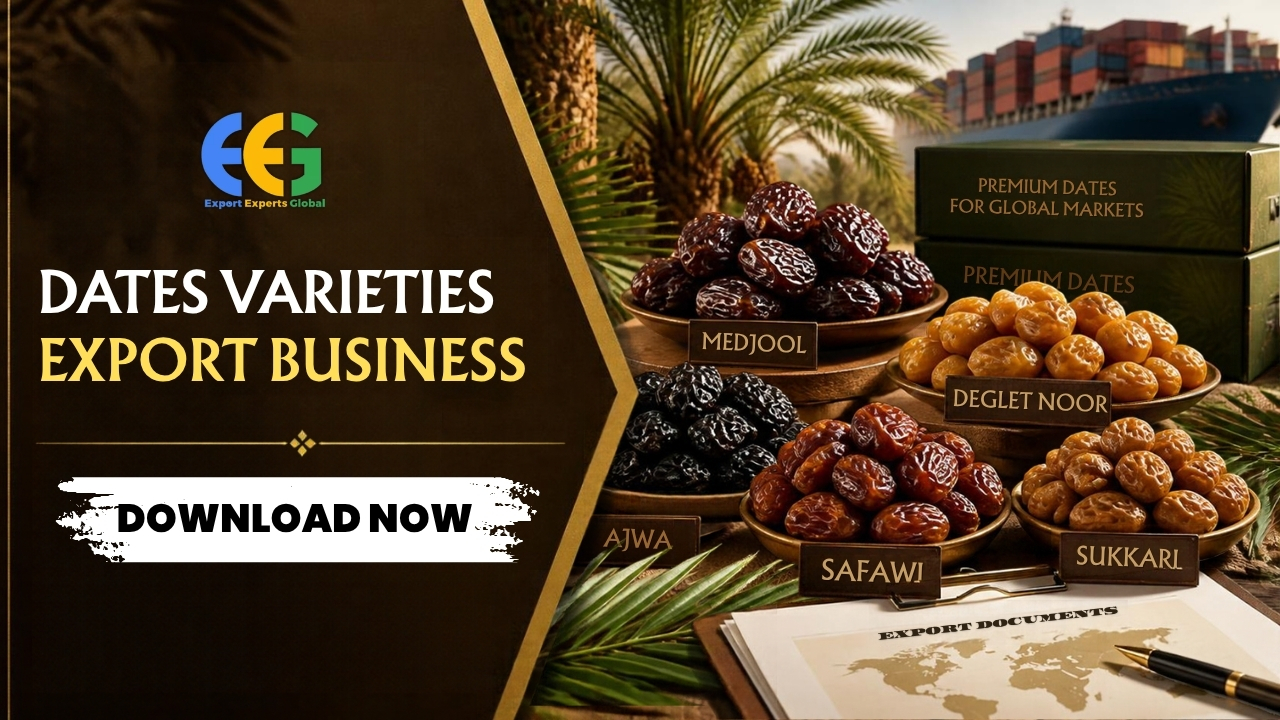
🌴 1. Understanding the Main Varieties of Dates
Not all dates serve the same market. Some are positioned as premium fruit, some are suitable for everyday consumption, and others are purchased by food manufacturers for processing or ingredient use. Understanding these differences helps an exporter develop a more focused product strategy.
🟤 Medjool Dates: A Premium Market Opportunity
Medjool dates are known for their large size, soft texture and rich flavour. They are often positioned as a premium product, making them suitable for specialty grocery stores, premium supermarkets, gift boxes and selected food-service customers.
Exporters can research different commercial grades based on size, appearance, moisture, defect tolerance and customer specifications. Buyers may request whole dates, pitted dates or specially packed products.
Potential business models: Premium retail packaging, bulk wholesale, private-label supply and corporate gift packs.
Markets to research: The United States, United Kingdom, Germany, the UAE and other markets with established demand for premium dried fruit.
⚫ Ajwa Dates: Specialty and Origin-Based Trading
Ajwa dates are strongly associated with Madinah in Saudi Arabia. Their distinctive dark appearance and origin-based identity make them relevant to specialty retailers and consumers seeking particular varieties.
A trader should verify the actual country of origin, supplier documentation, product authenticity and labelling claims. Do not describe another variety as Ajwa or claim a Saudi origin without adequate evidence.
Potential business models: Specialty grocery distribution, premium gift packaging and wholesale supply to retailers.
Markets to research: India, Gulf countries, the United Kingdom and other destinations where importers sell Saudi-origin dates.
🟠 Deglet Noor Dates: Retail and Food Manufacturing
Deglet Noor dates are commonly associated with Tunisia and Algeria and are known for their amber colour and semi-dry characteristics. They can serve retail customers as well as businesses purchasing dates for baking, confectionery and other food applications.
Importers may evaluate consistency, size, moisture, cleanliness, packaging format and suitability for processing.
Potential business models: Bulk trading, retail packs, ingredient supply and private-label products.
Markets to research: France, Germany, the United Kingdom and North American markets.
🟡 Sukkari Dates: Sweetness and Specialty Retail
Sukkari dates are associated with Saudi Arabia and are known for their sweet flavour and characteristic soft-to-firm textures, depending on maturity and handling.
Entrepreneurs can investigate demand from specialty food shops, dates wholesalers, online retailers and distributors supplying consumers who already recognise the variety.
Potential business models: Premium consumer packs, assorted date boxes and wholesale distribution.
Markets to research: Saudi Arabia’s trading network, other Gulf markets and selected international specialty-food channels.
🌴 Barhi Dates: Fresh Fruit and Seasonal Trading
Barhi dates are commercially interesting because they can be marketed at different maturity stages. Fresh yellow Barhi dates differ considerably from softer, fully ripe fruit in handling requirements.
Fresh-fruit exports require careful planning around harvesting, packaging, temperature management, transit duration and shelf life. Entrepreneurs should confirm the buyer’s desired maturity stage and delivery specifications before sourcing.
Potential business models: Seasonal fresh-fruit supply, specialty produce distribution and selected premium retail channels.
Markets to research: Nearby Gulf markets and other destinations where transport time, cold-chain infrastructure and import regulations make the shipment commercially feasible.
Other varieties worth researching include Mabroom, Khalas, Zahidi, Mazafati, Piarom and Aseel. Each has its own sourcing profile, quality characteristics and commercial applications.
Agriculture & Fisheries Dept
+2
📦 2. Which Dates Export Business Model Should You Choose?
There is no single business model suitable for every entrepreneur. Your choice should depend on available capital, access to suppliers, customer demand and your ability to manage inventory.
Model A — Merchant exporter: Source dates from an eligible supplier, confirm an overseas order, conduct quality checks and coordinate the shipment. This model can reduce the need to establish a processing facility, although working capital and shipment-related expenses remain important.
Model B — Private-label exporter: Purchase dates from a qualified packer and sell them under your own brand. This can offer greater control over branding and packaging, but requires investment in design, compliant labels, packaging materials and customer acquisition.
Model C — Bulk ingredient supplier: Supply dates to bakeries, confectionery manufacturers, food processors and ingredient distributors. These buyers may prioritise consistent specifications, reliable volumes and competitive delivered costs over decorative packaging.
Model D — Importer and domestic distributor: Import varieties that are not readily available from suitable domestic sources and supply Indian wholesalers, retailers or food-service businesses. This is an import business, not an export from India, and requires separate assessment of Indian import rules and duties.
Model E — Value-added products: Explore date paste, date syrup, chopped dates and other processed products. These products have different processing, labelling, shelf-life and tariff considerations from whole dates.
🌍 3. Where Can You Source Dates?
International sourcing is an important part of the business. Different producing countries offer different varieties, growing conditions, commercial grades and supplier networks.
🇸🇦 Saudi Arabia: Research Ajwa, Sukkari, Mabroom and other Saudi-origin varieties.
🇹🇳 Tunisia: Research Deglet Noor and commercial dried-date suppliers.
🇩🇿 Algeria: Explore Deglet Noor and other regional varieties.
🇪🇬 Egypt: Investigate different date varieties and bulk trading opportunities.
🇮🇷 Iran: Research varieties such as Mazafati and Piarom, subject to current sanctions, payment, shipping and destination-country restrictions.
🇦🇪 United Arab Emirates: Investigate established traders, processors, packers and re-exporters. Verify the actual country of origin rather than assuming UAE trading means UAE-grown fruit.
Before choosing a supplier, request samples, a detailed product specification, recent quality documentation, packing details, minimum order quantity, production or packing capacity, lead time and payment terms.
Important: Country of origin, shipment origin and country of dispatch are not always the same. These details must be declared accurately in the relevant commercial and customs documents.
🔎 4. How to Find International Dates Buyers
Finding a buyer requires more than sending generic messages to companies. An exporter needs to identify businesses that purchase the correct variety, grade, volume and packaging format.
Practical buyer-finding methods
1. Official trade data: Research dates under HS heading 0804.10, which covers dates. Use official trade databases to identify importing countries, annual import values, quantities and changes in demand. Confirm the applicable national tariff code before preparing a shipment.
2. Importer directories: Search for dried-fruit importers, date wholesalers, grocery distributors, ingredient suppliers and food manufacturers. Record company websites, locations, product ranges and publicly available business contact details.
3. B2B platforms: Explore international trade marketplaces to identify prospective buyers and compare product specifications. Treat marketplace listings as leads rather than proof that a company is reliable or ready to purchase.
4. Trade fairs: Attend food and beverage exhibitions, dried-fruit events and international food-trading fairs to meet distributors and procurement teams.
5. Direct outreach: Send a professional product catalogue with variety, origin, grade, available sizes, packaging, MOQ, supply capacity and quotation terms. Follow up with a sample offer when appropriate.
6. Buyer verification: Confirm the legal business name, registration details, company domain, references, import capability and payment arrangements. Be cautious of unexpected advance-fee requests, false purchase orders and pressure to ship before payment terms are secured.
A qualified buyer should be assessed against your product and commercial capabilities, not merely the number of messages exchanged.
🧾 5. Export Documentation and Compliance
Food exports require accurate documentation and compliance with the rules applicable to the product, origin and destination. Requirements may differ for fresh dates, dried dates and processed date products.
Key areas to check include:
Importer Exporter Code (IEC): Obtain an IEC through the Directorate General of Foreign Trade (DGFT), as applicable to your export activity.
GST and business records: Establish the appropriate business and tax arrangements for your trading model.
Food-safety compliance: Verify applicable Indian food-business requirements and the importing country’s food-safety regulations.
Commercial invoice: Record the product description, quantity, price, currency and agreed trade terms.
Packing list: Specify carton count, net weight, gross weight and packaging details.
Shipping bill: Complete the required customs export declaration.
Certificate of origin: Arrange it when required by the buyer, destination rules or applicable trade agreement.
Transport documents: Obtain the relevant bill of lading or air waybill.
Additional certificates: Check whether phytosanitary certificates, laboratory reports, treatment records or other documents are required for the particular shipment.
APEDA’s export resources provide information on export procedures, IEC and relevant export-promotion services. Confirm the latest requirements with the competent authorities and your customs broker before shipment.
📊 6. How to Calculate Dates Export Costs
A common mistake is comparing the local purchase price with the overseas selling price without calculating all the costs in between.
An exporter should include procurement, sorting, grading, packing, testing, inland transport, customs-clearance expenses, freight, insurance where applicable, bank charges, commissions and other transaction-specific expenses.
Here is an illustrative example, not a current market quotation.
Cost component | Example amount |
|---|
Dates procurement | ₹1,00,000 |
Sorting and grading | ₹5,000 |
Packaging and labelling | ₹10,000 |
Testing and documentation | ₹5,000 |
Inland transport and handling | ₹10,000 |
Freight and other shipment expenses | ₹15,000 |
Illustrative total cost | ₹1,45,000 |
If the total sales revenue for the shipment is ₹1,70,000, the difference is ₹25,000 before any omitted expenses, financing costs, applicable taxes or other adjustments.
This example does not establish a typical dates-export profit. Actual profitability depends on the variety, grade, origin, order size, selling price and destination.
🛡️ 7. Quality Control, Packaging and Storage
Dates are food products, so maintaining consistent quality is essential for repeat orders.
Before shipment, agree on written specifications covering:
Variety and country of origin.
Moisture level and texture.
Permitted defects and appearance.
Pitted or unpitted format.
Food-safety and pesticide-residue requirements.
Net weight, packaging type and shelf-life expectations.
Packaging may include food-grade pouches, trays, cartons, bulk liners or premium gift boxes. The appropriate choice depends on the product’s moisture characteristics, distribution conditions and customer requirements.
Storage conditions should follow the supplier’s validated recommendations and the destination buyer’s specifications. Fresh Barhi dates may require a different handling system from semi-dry or dried dates. Do not promise a particular shelf life without adequate product evidence.
⚠️ 8. Risks and Challenges in the Dates Business
Every export opportunity requires risk assessment. Important challenges include:
Price fluctuations: Procurement prices, freight rates and currency movements can affect margins.
Quality inconsistency: Differences between samples and bulk shipments can cause disputes.
Spoilage and infestation: Poor handling or unsuitable storage can reduce product quality.
Regulatory barriers: Food-safety rules, labelling standards and import permits vary by destination.
Supplier fraud: Incorrect origin claims, fake certificates and unreliable suppliers can create financial losses.
Buyer-payment risk: Unsecured credit and fraudulent orders can expose exporters to non-payment.
Competition: Established international suppliers may have stronger distribution networks and lower unit costs.
The best approach is to validate demand, check samples, confirm specifications in writing and agree on secure payment and inspection arrangements before committing to a large shipment.
🚀 9. A Practical Roadmap for Beginners
Entrepreneurs can follow a structured process rather than investing in inventory first.
Research two or three date varieties and compare their customer segments.
Select one target market using official import statistics and buyer research.
Contact multiple suppliers and compare samples, prices, grades and documentation.
Identify prospective buyers and establish their precise requirements.
Calculate the complete shipment cost and determine whether the proposed selling price is commercially viable.
Confirm export and destination-country compliance.
Negotiate payment, inspection, delivery and dispute-resolution terms.
Ship only after the order, documentation and logistics arrangements have been properly verified.
Review the shipment’s actual costs and buyer feedback before expanding.
Overall Analysis
The global dates trade offers several potential business models, from premium Medjool and Ajwa retail packs to Deglet Noor ingredient supply, Sukkari specialty products and seasonal Barhi trading. Each model requires its own sourcing strategy, buyer profile and quality-control process.
For Indian entrepreneurs, the first step is to identify a specific product-market opportunity and verify it with current trade data. Research suppliers, calculate the complete cost, confirm the applicable regulations and develop relationships with credible importers before scaling up.
Learn the fundamentals of international trade, conduct structured research and build your dates business around reliable execution rather than assumptions.