🏗️ Why Steel Pipe Export is a Growing Business
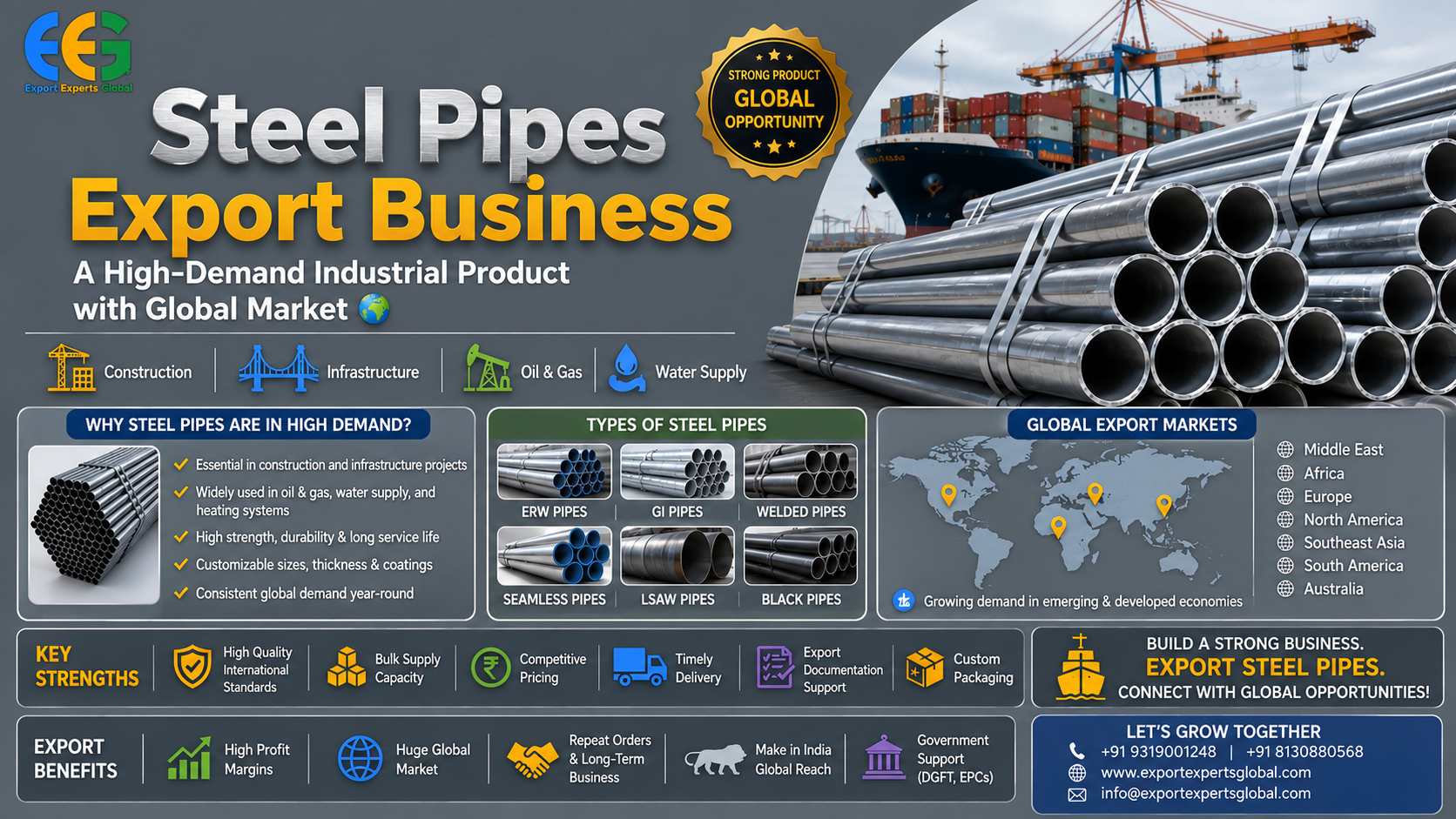
The construction and infrastructure sectors are expanding worldwide. Governments are investing heavily in highways, airports, railways, oil pipelines, renewable energy, and urban water systems. These developments require enormous quantities of steel pipes.
Major industries purchasing steel pipes include:
✔️ Construction Companies
✔️ Oil & Gas Industry
✔️ Water Supply Projects
✔️ Fire Fighting Systems
✔️ Infrastructure Developers
✔️ Power Plants
✔️ Automobile Industry
✔️ Engineering Companies
✔️ Chemical Industries
✔️ Renewable Energy Projects
Because steel pipes are required across multiple sectors, exporters benefit from a diverse customer base rather than relying on a single industry.
🌍 Why Buy Steel Pipes from India?
India offers several advantages in the global steel market.
🇮🇳 Competitive Manufacturing Cost
Indian manufacturers produce quality steel pipes at competitive prices, allowing exporters to remain attractive in international markets.
🏭 Large Manufacturing Capacity
India has thousands of steel manufacturing units capable of fulfilling both small and bulk export orders.
📦 Wide Product Range
Indian suppliers manufacture:
- ERW Steel Pipes
- Seamless Pipes
- Stainless Steel Pipes
- Galvanized Pipes
- Mild Steel Pipes
- Hollow Sections
- Precision Tubes
- Structural Steel Pipes
- Boiler Tubes
- API Pipes
🌎 Excellent Port Connectivity
Major export ports include:
🚢 Mundra
🚢 Nhava Sheva (JNPT)
🚢 Chennai
🚢 Visakhapatnam
🚢 Kolkata
🚢 Kandla
Fast port connectivity helps reduce shipping time and logistics costs.
📍 Major Steel Pipe Manufacturing Hubs in India
The best sourcing locations include:
🏭 Maharashtra
🏭 Gujarat
🏭 Punjab
🏭 Uttar Pradesh
🏭 Tamil Nadu
🏭 Karnataka
🏭 Telangana
🏭 Chhattisgarh
Many manufacturers offer customized sizes, coatings, and international certifications.
🔩 Types of Steel Pipes Exported
Understanding product categories helps exporters serve different industries.
1️⃣ ERW Steel Pipes
Manufactured using electric resistance welding.
Applications:
✔ Construction
✔ Water Pipelines
✔ Agriculture
✔ Furniture
2️⃣ Seamless Steel Pipes
Manufactured without welded joints.
Applications:
✔ Oil & Gas
✔ High Pressure Systems
✔ Boilers
✔ Refineries
3️⃣ Stainless Steel Pipes
Known for corrosion resistance.
Applications:
✔ Food Industry
✔ Pharmaceuticals
✔ Chemical Plants
✔ Hotels
4️⃣ Galvanized Steel Pipes
Protected with zinc coating.
Applications:
✔ Water Supply
✔ Agriculture
✔ Outdoor Construction
5️⃣ Mild Steel Pipes
Widely used in fabrication.
Applications:
✔ Gates
✔ Furniture
✔ Structural Projects
6️⃣ Square & Rectangular Hollow Sections
Popular in construction.
Applications:
✔ Warehouses
✔ Buildings
✔ Industrial Structures
🌎 Top Countries Importing Steel Pipes
Some of the biggest importers include:
🇺🇸 United States
🇦🇪 United Arab Emirates
🇸🇦 Saudi Arabia
🇶🇦 Qatar
🇴🇲 Oman
🇰🇼 Kuwait
🇬🇧 United Kingdom
🇩🇪 Germany
🇦🇺 Australia
🇿🇦 South Africa
🇰🇪 Kenya
🇳🇬 Nigeria
🇧🇩 Bangladesh
🇳🇵 Nepal
🇱🇰 Sri Lanka
Each country has different technical standards, making product specification and compliance essential.
📋 Documents Required
Exporters generally require:
📄 IEC (Importer Exporter Code)
📄 GST Registration
📄 Commercial Invoice
📄 Packing List
📄 Bill of Lading
📄 Certificate of Origin
📄 Insurance Certificate
📄 Mill Test Certificate (MTC)
📄 Quality Inspection Report (if required)
📄 Purchase Order
Always verify destination-country requirements before shipment.
✅ Quality Standards
International buyers often request compliance with standards such as:
✔ ASTM
✔ API
✔ EN
✔ ISO
✔ BIS
Providing quality certificates increases buyer confidence and improves repeat business opportunities.
📦 Export Packaging
Proper packaging reduces transit damage.
Recommended methods include:
📦 Steel Bundles
📦 Plastic End Caps
📦 Waterproof Wrapping
📦 Steel Strapping
📦 Export Labels
📦 Container Securing
🚢 Shipping Methods
Steel pipes are generally exported through:
🚢 20-Foot Containers
🚢 40-Foot Containers
🚢 Break Bulk Cargo
🚢 Project Cargo
The choice depends on pipe size, quantity, and destination.
💰 Profit Potential
Profit depends on:
✔ Supplier Price
✔ Export Quantity
✔ Freight Cost
✔ Exchange Rate
✔ Market Demand
✔ Product Grade
✔ Certification Requirements
Many exporters focus on long-term contracts rather than one-time orders to build sustainable revenue.
🔍 How to Find International Buyers
Effective buyer acquisition strategies include:
🌍 International trade fairs
🌍 B2B marketplaces
🌍 Export promotion councils
🌍 LinkedIn networking
🌍 Company websites
🌍 Overseas distributors
🌍 EPC contractors
🌍 Government trade missions
Building relationships and maintaining product quality are key to repeat business.
📈 Tips for Success
⭐ Source from reliable manufacturers.
⭐ Verify product quality before shipment.
⭐ Understand Incoterms clearly.
⭐ Offer competitive pricing.
⭐ Respond quickly to buyer inquiries.
⭐ Maintain transparent communication.
⭐ Ship orders on time.
⭐ Keep accurate export documentation.
⭐ Stay updated on global steel market trends.
⭐ Focus on customer satisfaction.
🚀 Future Opportunities
Global demand for steel pipes is expected to remain strong due to:
🏗 Infrastructure development
⚡ Renewable energy projects
🛢 Oil & gas expansion
🚰 Water pipeline modernization
🏭 Industrial manufacturing
🌉 Smart city projects
Exporters who consistently deliver quality products and dependable service can establish long-term international partnerships.
Overall Analysis
Steel pipe export is a promising business opportunity for entrepreneurs interested in industrial products and international trade. India’s manufacturing strength, competitive pricing, and broad product range provide a solid foundation for serving global markets. Success depends on selecting the right products, complying with international standards, maintaining quality, and building trustworthy buyer relationships.
By combining sound market research with reliable sourcing and efficient logistics, exporters can develop a sustainable business that serves industries around the world.