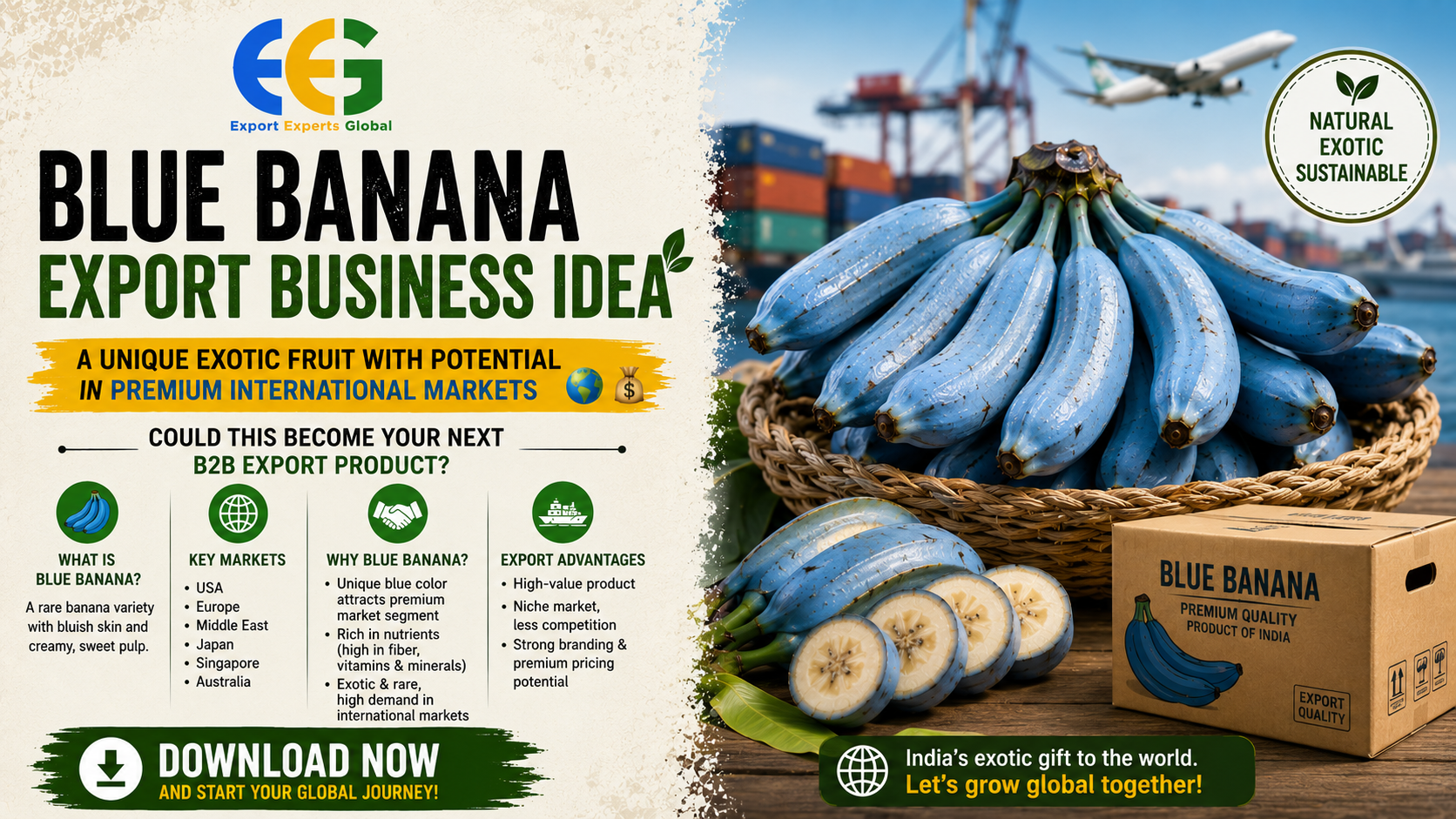
🔵🍌 What Is Blue Banana?
Blue Banana generally refers to banana varieties with a distinctive bluish or blue-purple appearance, with Blue Java Banana being one of the best-known varieties associated with this concept. The fruit has gained popularity in specialty-food circles because of its creamy consistency and unusual flavor profile. Its visual appearance also makes it attractive for premium fruit stores, restaurants, hotels and social-media-driven food businesses.
For an Indian entrepreneur, the first step should not be immediately investing in cultivation. Instead, conduct a market study to determine whether buyers in the selected destination actually want this particular variety. 📊 A product may look attractive on social media but still have limited commercial demand. Export business decisions should therefore be based on verified buyer enquiries, import data, trial orders and landed-cost calculations.
🌍 Why Can Blue Banana Become an Export Opportunity?
The global food market is continuously expanding beyond traditional commodities. Consumers in several markets are showing interest in exotic fruits, specialty produce and products that provide a different experience from conventional supermarket offerings.
This creates a potential opening for unusual banana varieties. 🔥
A Blue Banana exporter can position the product around:
🍌 Exotic fruit
✨ Premium produce
🏪 Specialty retail
🏨 Hospitality industry
🍽️ Gourmet restaurants
📦 Fruit distributors
🛒 Online premium grocery
📸 Social-media-friendly food products
The key point is positioning. Instead of competing directly with low-priced conventional bananas, the exporter can explore buyers who are interested in distinctive varieties.
However, premium positioning does not automatically mean premium profits. The exporter must calculate the complete cost from farm to overseas buyer.
Where Can Indian Exporters Source Blue Bananas?
Sourcing is one of the most important components of this business. An exporter needs farmers who can supply the correct variety consistently and according to export specifications.
Potential sourcing channels include:
👨🌾 Specialty fruit farmers
🌱 Exotic fruit growers
🚜 Commercial banana plantations
🤝 Farmer Producer Organizations
🏡 Horticulture entrepreneurs
🌿 Nursery networks
📦 Agricultural aggregators
Before entering into a supply agreement, inspect the farm and understand the farmer’s production capacity.
Ask important questions such as:
➡️ Which Blue Banana variety is being cultivated?
➡️ What is the expected harvest season?
➡️ What quantity can be supplied every week?
➡️ What fruit size is available?
➡️ What is the harvesting stage?
➡️ How is the fruit handled after harvesting?
➡️ Can the farmer maintain consistent quality?
A successful exporter needs consistency rather than occasional availability.
💰 How Does the Blue Banana Export Business Work?
The business model can be relatively simple.
Farmer → Aggregator/Exporter → Overseas Importer → Distributor → Retailer → Consumer
An entrepreneur does not necessarily need to own a farm. A beginner can explore the merchant-exporter model, where the exporter sources produce from growers and sells it to an overseas buyer.
This reduces the need for immediate investment in agricultural infrastructure.
For example:
🌱 Farmer produces the crop
📦 Exporter grades and packs the fruit
🚢 Logistics provider transports the shipment
🌍 Overseas importer receives the cargo
🏪 Distributor supplies retailers
👨👩👧 Consumers purchase the product
The exporter earns through the difference between the total procurement/export cost and the negotiated selling price.
🌎 Which Countries Could Be Explored?
Potential markets should be selected after checking actual import demand, logistics, competition and regulatory requirements.
Some markets that may be researched include:
🇦🇪 UAE – strong premium-food and expatriate consumer markets
🇸🇦 Saudi Arabia – large food-import sector
🇶🇦 Qatar – premium retail and hospitality demand
🇴🇲 Oman – established food distribution networks
🇸🇬 Singapore – premium and specialty produce segment
🇲🇾 Malaysia – developed tropical-fruit market
🇪🇺 European markets – opportunities may exist for specialty fruits, subject to strict compliance
📌 These are potential markets to investigate, not guaranteed destinations. Before shipping, verify current import regulations, phytosanitary conditions, residue standards, labeling requirements and buyer specifications.
🏪 Who Are Your Ideal Buyers?
Finding the right buyer is more important than simply finding a country.
Potential buyers include:
🍎 Exotic fruit importers
🏪 Premium supermarket chains
📦 Fruit wholesalers
🍽️ Gourmet restaurants
🏨 Hotels and resorts
🛒 Specialty grocery businesses
🥗 Healthy-food retailers
🍹 Foodservice companies
📲 Online premium grocery platforms
Your sales presentation should explain why the buyer should purchase your Blue Banana instead of an ordinary banana.
A professional export catalogue can include:
📸 High-quality product photographs
🍌 Variety information
📏 Fruit size
⚖️ Average weight
📦 Packing configuration
🌱 Country of origin
🚢 Available shipment quantity
📅 Harvest availability
📋 Certifications
💰 Commercial terms
📋 Export Documentation
Fresh-fruit exports require proper documentation and compliance.
Depending on the destination and shipment structure, an exporter may need:
✅ Import Export Code (IEC)
✅ GST-related registrations/compliance
✅ APEDA registration/RCMC, where applicable
✅ Commercial Invoice
✅ Packing List
✅ Certificate of Origin
✅ Phytosanitary Certificate
✅ Shipping Bill
✅ Bill of Lading or Air Waybill
✅ Other destination-specific certificates
⚠️ Documentation requirements can vary according to the importing country, commodity and buyer. Therefore, never rely on a generic checklist for an actual shipment.
The exporter should verify the requirements before accepting the order.
🌿 Why Phytosanitary Compliance Matters
Fresh agricultural products are closely regulated because importing countries want to prevent the introduction of pests and plant diseases.
A phytosanitary certificate may be required to confirm that the consignment meets applicable plant-health requirements.
This means an exporter cannot simply purchase bananas from a local market and send them overseas.
The supply chain needs to be designed around:
🌱 Approved sourcing
🔍 Quality inspection
🐛 Pest-risk management
📋 Required certification
📦 Correct packaging
🚢 Compliant transportation
For certain destinations, additional treatment, inspection or specific production conditions may apply.
📦 Packaging Strategy
Packaging plays a major role in fresh-fruit exports.
Blue Bananas can be vulnerable to:
⚠️ Bruising
⚠️ Temperature fluctuations
⚠️ Rough handling
⚠️ Premature ripening
⚠️ Moisture issues
⚠️ Physical damage
Export packaging should therefore be selected according to the fruit’s characteristics and the destination journey.
Possible considerations include:
📦 Strong export cartons
🌬️ Ventilation openings
🛡️ Protective packaging
🏷️ Correct labeling
⚖️ Standardized weight
🔍 Quality grading
The packaging should protect the product while also making the shipment efficient for transportation and handling.
❄️ Cold Chain & Logistics
Fresh produce logistics can determine whether an export order makes money or creates a loss.
The exporter should evaluate:
🌡️ Temperature requirements
⏱️ Transit duration
🚢 Shipping route
✈️ Air-freight feasibility
❄️ Cold-chain availability
📦 Pre-cooling requirements
🍌 Ripening stage
🏪 Buyer receiving conditions
A product that arrives late or overripe can lose most of its commercial value.
Therefore, logistics should be planned before quoting the buyer, not after receiving the order.
💵 How to Calculate Export Profit?
Never calculate profit simply as:
Selling Price – Farm Price = Profit ❌
A professional exporter calculates the complete export cost.
For example:
🍌 Product procurement
📦 Sorting & grading
📦 Packaging
🧪 Testing/certification
🚚 Inland transportation
🏭 Warehouse/handling
❄️ Cold-chain expenses
🚢 Freight
🛃 Customs-related expenses
🏦 Banking charges
📄 Documentation
🛡️ Insurance, where applicable
⚠️ Expected wastage/rejection
Then calculate the final landed cost and compare it with the buyer’s acceptable purchase price.
This is essential for determining the actual gross margin.
📈 How Can You Find Overseas Buyers?
One of the biggest challenges for new exporters is buyer acquisition.
You can explore multiple B2B channels:
🌐 B2B marketplaces
🔎 Importer databases
📧 Direct email outreach
💼 LinkedIn prospecting
📱 Business WhatsApp
🏪 Supermarket supplier networks
🌍 Trade fairs
🤝 Distributor partnerships
📊 Trade-data research
Your first objective should not be to find hundreds of buyers.
Instead, identify 10–20 highly relevant importers and understand their requirements.
A targeted buyer list is more valuable than thousands of random contacts.
📲 Create a Professional Buyer Pitch
Your message should be short and commercial.
Explain:
🍌 What product you supply
🇮🇳 Where it comes from
📦 Available quantity
📏 Product specifications
📅 Supply period
🚢 Preferred shipment method
📋 Certifications available
💰 Indicative commercial terms
Avoid sending a generic message such as:
“Dear Sir, we are exporter. Please give order.”
Instead, demonstrate that you understand the buyer’s product requirements.
🚨 Major Risks in Blue Banana Export
Every export business has risks, and exotic fresh fruit can have additional challenges.
1️⃣ Limited Supply
Specialty varieties may not be available in large commercial volumes.
2️⃣ Quality Variation
Different farms may produce different sizes and quality levels.
3️⃣ Short Shelf Life
Fresh fruit can deteriorate quickly.
4️⃣ Logistics Cost
Fast or temperature-controlled transportation can increase expenses.
5️⃣ Buyer Rejection
Quality that appears acceptable at the farm may not meet the importer’s specifications.
6️⃣ Regulatory Issues
Plant-quarantine or food-safety requirements can vary by destination.
7️⃣ Market Risk
Consumers may not be familiar with the product.
8️⃣ Payment Risk
New exporters must carefully evaluate overseas buyers and payment terms.
🚀 Beginner’s Roadmap
If you are new to export, don’t begin with a huge shipment.
Follow a structured approach:
STEP 1: Research the product 🔎
STEP 2: Identify genuine growers 🌱
STEP 3: Study destination markets 🌍
STEP 4: Find potential importers 📧
STEP 5: Understand buyer specifications 📋
STEP 6: Calculate export costing 💰
STEP 7: Verify regulatory requirements ⚖️
STEP 8: Conduct a sample/trial shipment 📦
STEP 9: Evaluate buyer feedback ⭐
STEP 10: Scale after repeat orders 🚀
This approach reduces the risk of investing heavily before confirming demand.
Overall Analysis
🍌 Blue Banana is an example of how an exporter can look beyond traditional commodities and explore niche international markets.
But remember one important principle:
“Unique product does not automatically mean profitable export business.”
The real business opportunity exists when you can combine product availability + verified buyer demand + competitive costing + export compliance + reliable logistics.
If you want to build a Blue Banana export business, don’t start by asking, “How much can I earn?”
Start by asking:
🔎 Who will buy it?
🌍 Which country has demand?
📦 What specification does the buyer require?
🚢 How will I transport it?
📋 What certificates are required?
💰 What will be my actual landed cost?
🤝 Can I supply consistently?
Once these questions are answered, you can make an informed business decision.
The biggest lesson for new exporters is simple:
Find the buyer → understand the specification → calculate the cost → test the shipment → then scale. 🌍📦
The international market rewards exporters who solve procurement, quality and delivery problems—not merely those who find an unusual product.




Source of planing materials and address of consultant for this business.