🌍 What Is a Food Container Export Business?
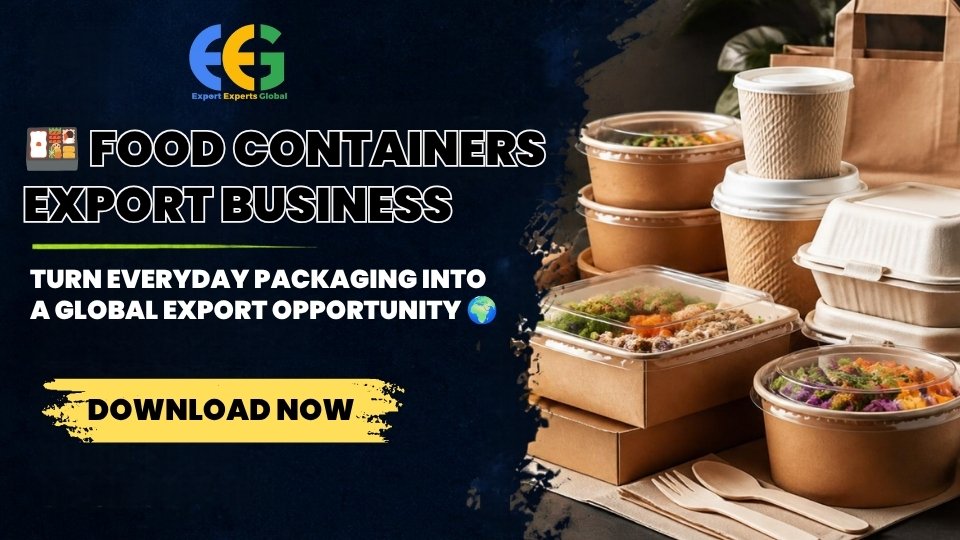
A food container export business involves sourcing food-packaging products from Indian manufacturers and selling them to international buyers.
Depending on the target market, an exporter may deal in:
🍱 Plastic food containers
🌱 Bagasse food containers
📦 Kraft paper food boxes
🥡 Paper takeaway containers
🥗 Meal-preparation containers
🍜 Microwave-safe containers
🍽️ Compartment food containers
📦 Clamshell containers
🧊 Food storage containers
🥤 Containers with lids
The right product depends on buyer demand, material requirements, shipping economics and regulations in the destination country.
Rather than trying to export every type of container, beginners can start with a focused range of products and gradually expand their catalogue.
🔥 Why Consider Food Container Exports?
Food packaging is connected to several large business sectors.
🍔 Restaurants require takeaway packaging.
🚚 Food-delivery businesses need containers suitable for transportation.
🏪 Cloud kitchens need packaging in regular quantities.
🍽️ Catering companies purchase packaging for events and bulk orders.
🥗 Meal-preparation companies require containers in standardized sizes.
🏭 Food manufacturers may need packaging for specific food products.
This means the potential customer base is not limited to one industry.
Another interesting characteristic is repeat purchasing. A restaurant or distributor that regularly consumes packaging may reorder when its inventory reaches a certain level.
For exporters, repeat B2B orders can be more valuable than constantly searching for completely new customers.
📦 Types of Food Containers You Can Explore
1. PP Food Containers
Polypropylene containers are widely used for different food-service applications.
Possible applications include:
🍛 Curries
🍚 Rice
🥗 Salads
🍜 Noodles
🍲 Ready-to-eat meals
Exporters should carefully check the manufacturer’s material specifications and the requirements applicable to the destination market.
2. Bagasse Food Containers 🌱
Bagasse packaging is made from sugarcane-fibre material and is often positioned as an alternative to conventional plastic packaging.
Products may include:
🍱 Meal trays
🥡 Takeaway boxes
🍽️ Plates
🥣 Bowls
📦 Clamshell containers
Eco-friendly packaging can attract buyers looking for alternatives to conventional packaging, but exporters should avoid making environmental claims without appropriate supporting documentation.
3. Kraft Paper Food Boxes 📦
Kraft packaging is commonly used for takeaway and food-service applications.
Potential products include:
🍔 Burger boxes
🍟 Fries boxes
🍕 Food boxes
🥡 Takeaway cartons
🍰 Bakery packaging
Design, paper quality, printing, grease resistance and construction can significantly influence buyer requirements.
🎯 Who Can Buy Indian Food Containers?
A successful exporter should identify the correct buyer category rather than simply searching for “food container buyers.”
Potential B2B customers include:
🏢 Importers
📦 Packaging distributors
🏪 Packaging wholesalers
🍽️ Restaurant-supply companies
🏭 Food manufacturers
🚚 Catering suppliers
🍱 Meal-prep businesses
🛒 Supermarket suppliers
🌍 Regional distributors
A distributor may be particularly interesting because one buyer could potentially supply multiple restaurants and food-service businesses in its market.
🌍 Which Countries Can Be Researched?
Indian exporters can research markets such as:
🇦🇪 UAE
🇸🇦 Saudi Arabia
🇶🇦 Qatar
🇴🇲 Oman
🇬🇧 United Kingdom
🇺🇸 United States
🇨🇦 Canada
🇦🇺 Australia
🇿🇦 South Africa
🇳🇱 Netherlands
However, a country should never be selected only because it appears to have high demand.
Before approaching buyers, study:
🔎 Existing imports
🔎 Local competitors
🔎 Product pricing
🔎 Import duties
🔎 Food-contact requirements
🔎 Packaging regulations
🔎 Shipping costs
🔎 Buyer preferences
🔎 Minimum order quantities
Market research should come before aggressive selling.
🇮🇳 Where Can You Source Food Containers in India?
A merchant exporter can search for manufacturers in established packaging and industrial clusters.
Potential sourcing regions include:
📍 Gujarat
📍 Maharashtra
📍 Delhi-NCR
📍 Tamil Nadu
📍 Telangana
📍 Karnataka
But location alone does not determine supplier quality.
When evaluating manufacturers, compare:
🏭 Production capacity
💰 Price
📦 MOQ
🔬 Material specifications
⏱️ Production lead time
🎨 Customization capability
📋 Technical documents
🌍 Previous export experience
✅ Quality-control procedures
Try to compare at least 3–5 suppliers before finalizing your sourcing partner.
🔍 What Should You Check Before Selecting a Supplier?
Finding a manufacturer is only the first step.
Ask the supplier:
1️⃣ What material is used?
2️⃣ What are the available sizes?
3️⃣ What is the container capacity?
4️⃣ What is the thickness?
5️⃣ What type of lid is supplied?
6️⃣ What is the MOQ?
7️⃣ Can they provide samples?
8️⃣ Can they provide technical specifications?
9️⃣ Can they support customized printing?
🔟 What is the production lead time?
Also ask about packaging.
A product may be inexpensive at the factory but become expensive after inefficient carton packing and international freight.
📋 Food-Contact Compliance Is Important
Food containers come into direct or indirect contact with food. Therefore, exporters must pay attention to applicable food-contact requirements.
Depending on the material and destination market, buyers may request:
📄 Material declarations
📄 Test reports
📄 Food-contact compliance documents
📄 Migration testing
📄 Product specifications
📄 Quality certificates
📄 Manufacturing information
The exact requirements can vary according to the material, intended food application and importing country.
Never simply tell a buyer that a product is “food safe” without obtaining appropriate documentation from the manufacturer.
💰 How Does the Export Pricing Work?
One of the biggest mistakes beginners make is calculating export profit using only the factory price.
For example:
Manufacturing Cost
➕ Export Packaging
➕ Local Transportation
➕ Documentation Expenses
➕ Handling Charges
➕ Port Expenses
➕ Freight
➕ Insurance, where applicable
➕ Bank/transaction costs
➕ Other export expenses
➕ Profit Margin
= Final Export Price
Your quotation may then be structured according to the agreed Incoterm, such as EXW, FOB or CIF.
The exporter must understand exactly which costs are included in the quotation.
🚢 Why Packaging and CBM Matter
Food containers are often lightweight but can occupy substantial volume.
This makes carton dimensions and CBM extremely important.
Imagine two products have almost the same factory price.
Product A:
📦 Compact packaging
🚢 Efficient container utilization
Product B:
📦 Bulky packaging
🚢 Poor container utilization
Product B could become significantly more expensive to ship internationally.
Therefore, exporters should calculate:
📏 Carton dimensions
⚖️ Gross weight
⚖️ Net weight
📦 Units per carton
📦 Cartons per pallet
🚢 Total CBM
Good packaging can improve export economics.
🚀 Can You Start Without a Factory?
Yes, the merchant-exporter model can be considered.
You can work as an intermediary between Indian manufacturers and overseas buyers.
Basic model:
Indian Manufacturer 🏭
↓
Merchant Exporter 📋
↓
International Distributor 🌍
↓
Restaurants / Food-Service Businesses 🍽️
Your responsibility can include:
🔎 Product research
🏭 Supplier identification
📦 Sample coordination
💰 Price negotiation
📋 Documentation
🌍 Buyer identification
🤝 Buyer communication
🚢 Shipment coordination
💳 Payment management
The key is to add value through supplier verification, product selection, communication, compliance coordination and export execution.
📲 How to Find International Buyers?
Buyer research should be systematic.
Potential methods include:
🌐 B2B marketplaces
🔎 Google search
💼 LinkedIn
📊 Trade-data platforms
🏢 Importer directories
📦 Packaging-distributor websites
🍽️ Restaurant-supply directories
🏭 Food-industry databases
🤝 Trade exhibitions
Instead of sending the same message to hundreds of companies, research the buyer first.
Find out:
✅ What products they already sell
✅ Which markets they serve
✅ Whether they import
✅ Their packaging segment
✅ Their approximate company size
✅ Their contact person
✅ Their purchasing requirements
Then prepare a relevant business proposal.
✉️ What Should Your Buyer Pitch Include?
A professional export introduction should be short and specific.
Include:
👋 Company introduction
📦 Product category
🇮🇳 Manufacturing/sourcing location
📋 Key specifications
📸 Product catalogue
📦 MOQ
💰 Indicative pricing
🚢 Shipping terms
🧪 Sample availability
📞 Contact information
Avoid sending huge product lists without context.
A buyer is more likely to respond when you clearly explain what you offer and why it could be relevant to their business.
🧪 Why Samples Matter
For food packaging, photographs are not always enough.
A serious buyer may want to evaluate:
📦 Size
🔒 Lid fit
💧 Leakage resistance
🔥 Heat resistance
🧱 Strength
📏 Dimensions
🎨 Printing quality
📋 Material specifications
Sending samples can help the buyer assess the product before placing a larger order.
But remember to calculate sample, courier and documentation costs properly.
📈 How Can You Build a Product Catalogue?
Instead of listing hundreds of SKUs, create a structured catalogue.
Category 1
🍱 Plastic Food Containers
Category 2
🌱 Bagasse Containers
Category 3
📦 Kraft Food Boxes
Category 4
🥗 Meal-Prep Containers
Category 5
🍽️ Compartment Containers
For every product, show:
📸 Product image
📏 Dimensions
🧮 Capacity
⚖️ Weight
🧱 Material
📦 Packing quantity
📋 Technical details
🎨 Customization options
This makes it easier for buyers to compare products.
⚠️ Common Mistakes New Exporters Make
❌ Choosing products only because they look profitable
Demand, competition and logistics matter.
❌ Selecting the cheapest supplier
Low price does not automatically mean export-quality production.
❌ Ignoring compliance
Food-contact packaging requires careful documentation.
❌ Quoting without freight calculation
Bulky products can have significant logistics costs.
❌ Sending catalogues without researching buyers
Targeted communication is more effective.
❌ Accepting unknown payment terms
Understand payment risk before accepting an international order.
❌ Ignoring quality consistency
A buyer may accept the first shipment but reject future orders if quality changes.
🧠 A Better Export Strategy
Instead of trying to sell everything everywhere, follow a focused approach.
Step 1 — Select a Product
🍱 Choose 5–10 promising food-container SKUs.
Step 2 — Find Suppliers
🏭 Identify 3–5 Indian manufacturers.
Step 3 — Compare
📊 Compare price, quality, MOQ, documents and capacity.
Step 4 — Collect Samples
🧪 Check actual product quality.
Step 5 — Research Markets
🌍 Identify countries where your selected products have commercial potential.
Step 6 — Build Buyer Lists
📋 Find importers and distributors.
Step 7 — Contact Buyers
📧 Send personalized business proposals.
Step 8 — Negotiate
🤝 Discuss specifications, MOQ, price and payment terms.
Step 9 — Confirm Order
📄 Finalize commercial and shipping terms.
Step 10 — Execute Shipment
🚢 Coordinate documentation, logistics and delivery.
💡 The Real Opportunity Is Not Just the Container
A beginner may think:
“I will buy containers cheaply and sell them at a higher price.”
A professional exporter thinks differently.
The business is actually about:
Product Selection + Supplier Network + Compliance + Buyer Research + Pricing + Logistics + Relationship Management
That is what turns a simple packaging product into an export business.
🧮 Food Container Export Business Formula
Product Research
➕ Reliable Indian Manufacturers
➕ Food-Contact Compliance
➕ Verified International Buyers
➕ Competitive Pricing
➕ Efficient Packaging
➕ Smart Logistics
➕ Consistent Quality
🌍 Sustainable Food Container Export Business
Overall Analysis
The food container export business can be an interesting opportunity for Indian entrepreneurs because packaging is required across restaurants, food delivery, catering, food manufacturing and takeaway businesses.
However, exporting food containers is not simply about finding a manufacturer and sending products overseas.
A successful exporter needs to understand product specifications, buyer requirements, food-contact compliance, export pricing, packaging, CBM calculations, international payment terms, documentation and logistics.
For beginners, starting as a merchant exporter can reduce the need for heavy manufacturing investment. Instead, the focus can be on building a strong supplier network and developing international B2B relationships.
Start small. Select a focused product range. Test samples. Research one or two markets properly. Build a verified buyer database. Quote carefully. Maintain consistent quality.
🌍 Don’t just look for a product to export. Build a complete export system around the product.