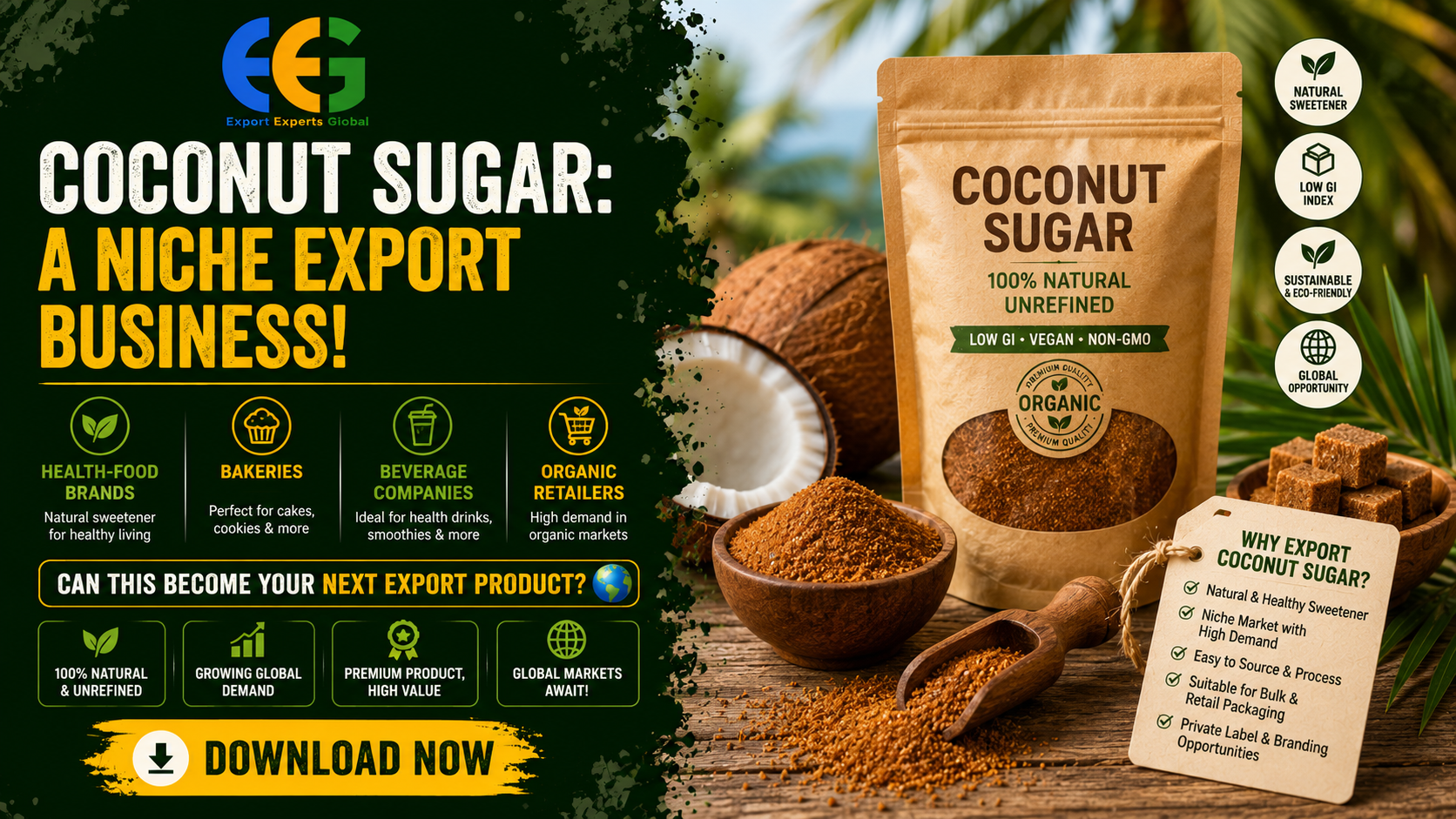
🥥 What Is Coconut Sugar?
Coconut sugar is produced from the sap collected from coconut flower blossoms. The sap is processed and converted into a sweetener that can be supplied in different forms, including granules, crystals, powder and blocks.
🌴 Coconut sugar is particularly interesting for exporters because it can be positioned as a specialty natural sweetener rather than competing directly with conventional refined sugar.
It can be used in:
🍪 Bakery products
🍰 Desserts
🥤 Beverages
☕ Coffee and tea applications
🍫 Confectionery
🥣 Breakfast products
🌱 Specialty and natural-food products
🏭 Food manufacturing
For an exporter, the opportunity lies in identifying buyers who specifically want specialty sweeteners and natural food ingredients.
🌍 Why Consider Coconut Sugar for Export?
The international food industry is constantly developing new product categories around natural ingredients, clean-label positioning and specialty foods.
This creates an opportunity for Indian exporters who can supply a consistent-quality coconut sugar product.
🚀 Key opportunities include:
✅ Natural-food distributors
✅ Organic product companies
✅ Health-focused brands
✅ Vegan and plant-based product companies
✅ Bakeries
✅ Food manufacturers
✅ Specialty grocery distributors
✅ Private-label brands
Instead of trying to sell large quantities to everyone, a new exporter can focus on specific B2B buyer segments.
🎯 The objective should be targeted selling rather than random buyer hunting.
🇮🇳 Why India Can Be a Sourcing Base
India has a large coconut-growing and coconut-processing ecosystem. States such as:
📍 Kerala
📍 Karnataka
📍 Tamil Nadu
📍 Andhra Pradesh
have significant coconut-related agricultural and processing activity.
However, exporters should not assume that every coconut producer is capable of supplying export-grade coconut sugar.
Before selecting a supplier, evaluate:
🔍 Product specifications
🔍 Manufacturing process
🔍 Food-safety systems
🔍 Batch consistency
🔍 Packaging capability
🔍 Laboratory testing
🔍 Production capacity
🔍 Certifications
🔍 Export experience
A reliable supplier can become one of the most important assets in your export business.
🏭 How to Find Coconut Sugar Suppliers
You can identify suppliers through several channels.
🔎 1. Manufacturer Search
Search for coconut sugar manufacturers and processors in major coconut-producing regions.
🤝 2. B2B Networks
Use B2B platforms to identify manufacturers, but verify every supplier independently.
🏢 3. Trade Associations
Industry associations and trade organizations can help identify established businesses.
🌐 4. Exhibitions
Food and natural-product exhibitions can provide direct access to manufacturers and international buyers.
📦 5. Local Industrial Visits
Visiting the processing facility can help you understand production, packaging and quality-control practices.
📦 Different Coconut Sugar Products You Can Export
An exporter can develop multiple product formats depending on buyer requirements.
🥥 Coconut Sugar Granules
Suitable for retail and food-service applications.
🌾 Coconut Sugar Powder
Useful for food manufacturers and certain bakery applications.
🧱 Coconut Sugar Blocks
Can be offered in markets where traditional or alternative formats have demand.
🌱 Organic Coconut Sugar
A premium segment where appropriate certification and documentation are available.
🏭 Bulk Coconut Sugar
Bulk packs can target food manufacturers and distributors.
🏷️ Private-Label Coconut Sugar
One of the interesting business models is supplying coconut sugar under the overseas buyer’s brand.
🎯 Who Are Your Potential Buyers?
A common mistake made by new exporters is searching only for the product name.
Instead, identify industries that consume the product.
Potential buyers include:
🏪 Organic food distributors
🌱 Natural-food companies
🍪 Bakery ingredient distributors
🥤 Beverage manufacturers
🍫 Confectionery manufacturers
🛒 Specialty retailers
📦 Food importers
🏷️ Private-label brands
🏭 Ingredient distributors
For example, instead of searching only for:
❌ “Coconut sugar importer”
you can build buyer lists around:
✅ Natural sweetener importer
✅ Organic ingredient distributor
✅ Specialty food distributor
✅ Bakery ingredient importer
✅ Private-label sweetener company
This can dramatically expand your prospecting strategy.
🌎 Potential International Markets
Coconut sugar exporters can investigate markets where natural and specialty food products have established distribution channels.
Potential markets may include:
🇺🇸 United States
🇬🇧 United Kingdom
🇩🇪 Germany
🇨🇦 Canada
🇦🇺 Australia
🇦🇪 United Arab Emirates
🇯🇵 Japan
However, market selection should never be based simply on population or perceived purchasing power.
You should evaluate:
📊 Import demand
💰 Market prices
🚢 Freight costs
📋 Regulatory requirements
🏷️ Labeling rules
🥥 Existing competition
📦 Buyer MOQ
💳 Payment practices
A smaller market with reliable buyers can sometimes be more attractive than a huge market with intense competition.
🔬 Quality Control Is Critical
Food exports require serious attention to quality.
Before shipping commercial quantities, obtain a clear product specification from your supplier.
Important parameters may include:
🧪 Moisture
🧪 Microbiological parameters
🧪 Foreign matter
🧪 Colour
🧪 Taste and aroma
🧪 Packaging integrity
🧪 Shelf-life information
The exact testing requirements depend on the product and destination market.
📌 Never make health or nutritional claims on packaging without verifying that those claims comply with the destination country’s regulations.
📋 Coconut Sugar Export Documentation
An exporter needs to understand the documentation associated with international shipments.
Depending on the transaction and destination, documentation may include:
📄 Import Export Code (IEC)
📄 GST-related documentation
📄 Food-business registrations/requirements
📄 Commercial Invoice
📄 Packing List
📄 Shipping Bill
📄 Bill of Lading
📄 Certificate of Origin
📄 Product test reports
📄 Insurance documentation, where applicable
📄 Buyer-specific compliance documents
Additional documents may be required depending on the importing country and buyer.
🌱 If you sell the product as organic, the relevant certification and destination-market requirements must be properly verified.
🔢 Understanding the HS Code
One of the most important steps before quoting a buyer is determining the correct tariff classification.
Do not simply copy an HS code from another exporter’s website.
The classification can depend on the product’s:
⚙️ Composition
⚙️ Processing
⚙️ Form
⚙️ Intended use
⚙️ Destination-country tariff schedule
Therefore, verify the applicable HS classification with a qualified customs professional or relevant tariff authority before commercial shipment.
📌 Correct HS classification affects customs treatment, documentation and potentially the buyer’s landed cost.
💰 How to Calculate Coconut Sugar Export Pricing
Your export price should not be based only on the supplier’s factory price.
Consider the complete export cost.
Example Cost Structure:
🏭 Supplier Price
➕ Processing/packing
➕ Export packaging
➕ Inland transportation
➕ Documentation
➕ Testing
➕ Customs/clearing expenses
➕ Freight
➕ Insurance, where applicable
➕ Bank/payment costs
➕ Marketing & buyer acquisition
➕ Your profit margin
Then determine the appropriate quotation under the agreed Incoterm.
For example:
EXW → FCA → FOB → CFR → CIF
Each Incoterm changes the responsibilities and costs between buyer and seller.
💡 Never quote a CIF or FOB price without calculating the actual logistics cost.
🚢 Choosing the Right Export Packaging
Packaging is not just about appearance.
For food exports, packaging needs to protect the product throughout:
🏭 Manufacturing
🚚 Inland transport
📦 Warehousing
🚢 Ocean transportation
🏪 Distribution
🛒 Retail
Possible formats can include:
📦 Bulk food-grade bags
📦 Multi-layer packaging
🏷️ Retail pouches
🫙 Jars
📦 Private-label cartons
The exact packaging material and labeling must comply with both product requirements and destination-country regulations.
🏷️ Private Label: A Powerful Opportunity
One interesting model for coconut sugar exporters is private labeling.
Imagine an overseas company already has:
🌱 A natural-food brand
🛒 An online store
🏪 A retail network
🥗 A health-food business
but doesn’t manufacture coconut sugar.
You can source the product in India and supply it under the buyer’s brand.
Business Flow:
🇮🇳 Indian Manufacturer
⬇️
📦 Exporter
⬇️
🏷️ Overseas Private Label
⬇️
🛒 Retail / E-commerce
⬇️
👨👩👧👦 Final Consumer
This model can create opportunities for repeat B2B orders if you maintain quality and supply consistency.
🔎 How to Find International Buyers
Buyer research should be systematic.
Step 1 — Select a Market 🌍
Choose one or two countries rather than trying to target the entire world.
Step 2 — Define Buyer Type 🎯
Choose distributors, importers, manufacturers or private-label companies.
Step 3 — Build a Buyer Database 📊
Record:
✔️ Company name
✔️ Website
✔️ Country
✔️ Contact person
✔️ Email
✔️ Product category
✔️ Import requirements
✔️ MOQ
✔️ Follow-up status
Step 4 — Contact Professionally 📧
Send a short introduction containing:
🥥 Product
📋 Specifications
📦 Packaging options
📊 MOQ
🚢 Shipping terms
🧪 Certifications/test reports
💰 Indicative pricing
Step 5 — Follow Up 🔄
One email is rarely enough.
Professional follow-up is an essential part of international B2B sales.
💻 Use Digital Marketing for Export Sales
Modern exporters don’t have to depend exclusively on traditional agents.
You can build an online presence through:
🌐 Website
💼 LinkedIn
📧 Email marketing
📱 Instagram
📊 B2B platforms
🎥 Product videos
📝 SEO content
Create content around keywords such as:
🔎 Coconut sugar supplier India
🔎 Coconut sugar exporter India
🔎 Organic coconut sugar bulk
🔎 Coconut sugar manufacturer
🔎 Natural sweetener supplier
🔎 Coconut sugar private label
The objective is to make your company visible when international buyers are actively searching for suppliers.
📈 How to Start With Low Investment
You don’t necessarily need to build a manufacturing facility to start.
A beginner can explore a merchant-export model.
Basic Model:
💰 Find manufacturer
⬇️
🧪 Collect samples
⬇️
🔬 Verify specifications
⬇️
🌍 Find buyer
⬇️
📄 Negotiate contract
⬇️
📦 Source goods
⬇️
🚢 Export shipment
This model allows you to focus on:
🎯 Buyer acquisition
🤝 Supplier management
📋 Documentation
💰 Pricing
🚢 Logistics
📈 Business development
⚠️ Risks in Coconut Sugar Export
Every export business carries risks.
1️⃣ Quality Variation
Different batches may have different characteristics.
2️⃣ Moisture Issues
Improper storage or packaging can affect product quality.
3️⃣ Regulatory Problems
Food regulations differ from country to country.
4️⃣ Payment Risk
New buyers should be evaluated carefully before accepting unsecured payment terms.
5️⃣ Freight Fluctuation
International shipping rates can change.
6️⃣ Supplier Dependency
Depending on one supplier can create supply problems.
7️⃣ Price Competition
Other producing countries may offer competitive pricing.
8️⃣ Incorrect Claims
Unverified organic, health or nutritional claims can create compliance problems.
🧠 Risk management should be part of your export strategy from day one.
💳 Payment Terms
When dealing with international buyers, carefully evaluate payment terms.
Possible structures can include:
💵 Advance payment
🏦 Letter of Credit
📄 Documentary collections
💳 Other agreed commercial payment arrangements
For new relationships, don’t automatically accept long credit periods simply to win an order.
Before agreeing to payment terms, evaluate:
🔍 Buyer history
🔍 Company background
🔍 Creditworthiness
🔍 Country risk
🔍 Order size
🔍 Contract terms
A large order is not a good order if the payment never arrives.
🚢 Logistics Strategy
Coconut sugar can be shipped by sea for larger commercial quantities.
Your logistics planning should consider:
📦 Shipment volume
⚖️ Gross/net weight
🚢 Port of loading
🌍 Destination port
📅 Transit time
💰 Freight cost
📋 Export documentation
For smaller trial shipments, air freight may sometimes be considered, but the economics should be calculated carefully.
📊 How to Scale the Business
Once you receive repeat orders, don’t simply increase sales.
Build systems.
Phase 1 — Research 🔎
Identify product, suppliers and target markets.
Phase 2 — Validation 🧪
Test samples and validate buyer interest.
Phase 3 — First Order 📦
Execute a small commercial shipment.
Phase 4 — Repeat Orders 🔄
Focus on consistent supply and customer service.
Phase 5 — Private Label 🏷️
Develop customized packaging for selected customers.
Phase 6 — Scale 🌍
Expand into additional markets and buyer segments.
💡 The Biggest Lesson for New Exporters
Many beginners believe export success means finding a product with a huge profit margin.
That is only part of the equation.
A sustainable export business requires:
PRODUCT + BUYER + QUALITY + PRICE + COMPLIANCE + LOGISTICS + PAYMENT
If one part fails, the entire transaction can become difficult.
🥥 Coconut sugar is therefore best approached as a specialty food export business, not simply another commodity-selling opportunity.
Overall Analysis
🥥 Coconut Sugar Export Business can be explored as a niche opportunity for Indian exporters targeting natural-food distributors, specialty ingredient companies, bakeries, beverage manufacturers and private-label brands.
The biggest opportunities may come from value-added positioning, consistent quality, professional documentation, private labeling and repeat B2B relationships.
If you are serious about entering the export industry, don’t think only like a trader.
Think like an international supplier. 🌍
Research → Source → Test → Quote → Sell → Ship → Repeat.
That is the foundation of a scalable export business.