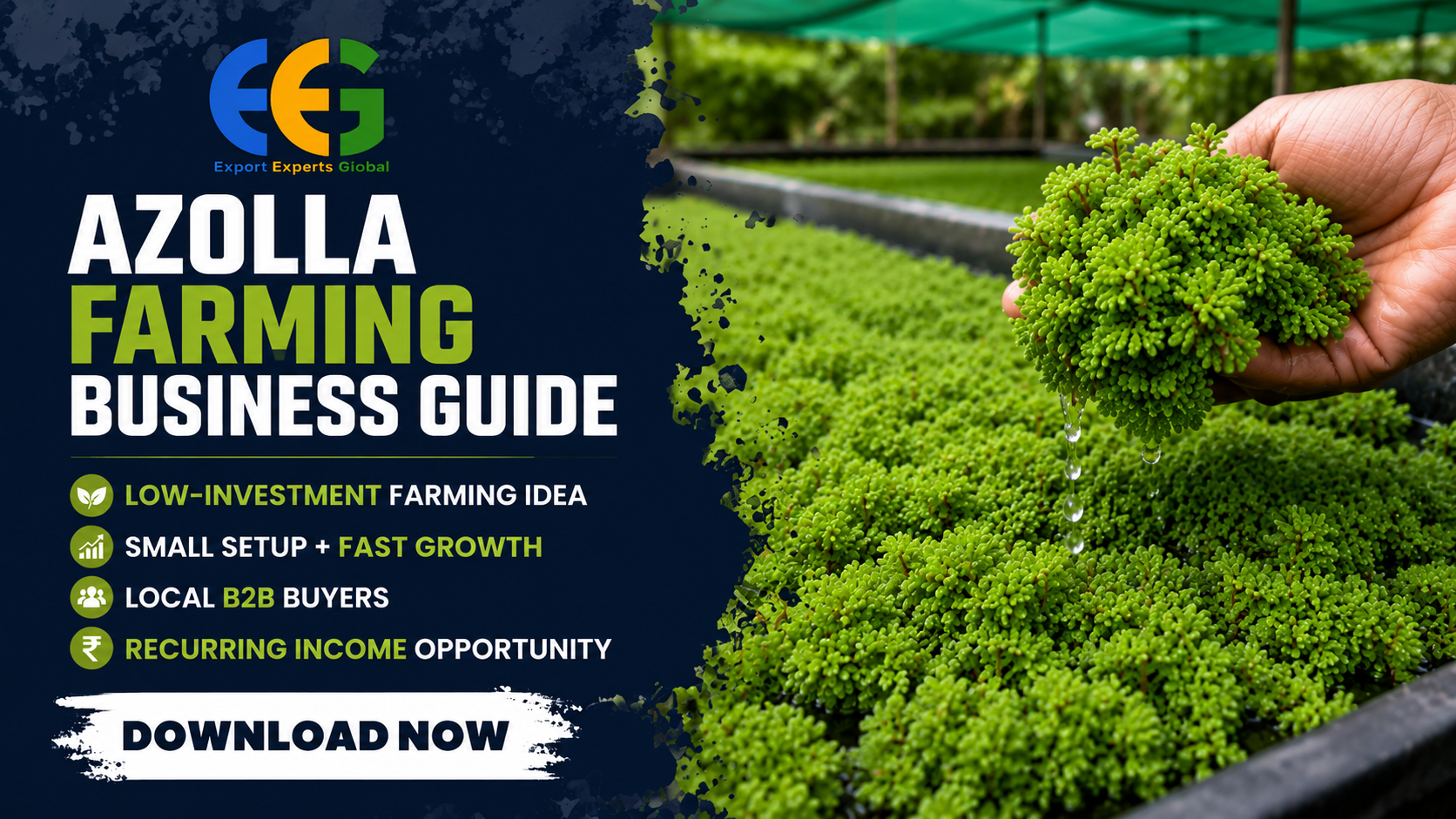
🌿 What Is Azolla Farming?
Azolla is a fast-growing aquatic fern that floats on the surface of water under suitable environmental conditions. It has attracted attention in agriculture because of its nutritional characteristics and its potential role as a supplementary feed resource.
Azolla is generally cultivated in shallow beds or suitable containers where water, nutrients, temperature, sunlight and hygiene can be managed. With appropriate cultivation practices, the crop can multiply rapidly, allowing farmers to harvest fresh material regularly.
However, one important point should be understood: Azolla should not automatically be treated as a complete replacement for conventional animal feed. Its usefulness depends on the animal species, feeding system, nutritional composition and local farming practices.
Therefore, an Azolla entrepreneur should focus on responsible positioning and educate customers about appropriate use rather than making exaggerated nutritional or income claims. 🧠
💰 Why Consider Azolla Farming as a Business?
The biggest attraction of Azolla farming is its potential to operate on a relatively small footprint. A beginner does not necessarily need a huge agricultural property to experiment with the business.
A properly planned unit can potentially be established using:
🏗️ Cultivation beds
💧 Water supply
🌱 Azolla starter culture
☀️ Shade/protection arrangements
🪣 Harvesting equipment
📦 Suitable handling and packaging facilities
This makes the concept interesting for entrepreneurs who want to explore small-scale agriculture businesses.
The business opportunity becomes more attractive when cultivation is located close to potential buyers. Fresh agricultural products can involve transportation and storage challenges, so being close to dairy farms, poultry operations, fish farms and livestock owners can help reduce logistical complexity.
The fundamental business equation is simple:
Cultivate → Harvest → Supply → Build Repeat Customers → Expand
But successful execution requires much more than simply growing Azolla.
🐄 Who Can Buy Azolla?
Before investing money into cultivation infrastructure, entrepreneurs should identify potential customers.
Potential customer segments may include:
🐄 Dairy Farmers
Dairy farmers may explore Azolla as a supplementary feed resource within their feeding practices.
🐔 Poultry Farmers
Some poultry operations may investigate Azolla-based supplementation depending on their feeding system and technical requirements.
🐟 Fish Farmers
Aquaculture businesses can be another potential customer segment, although suitability depends on the species, production system and feeding strategy.
🐐 Livestock Farmers
Goat and other livestock farmers may also be potential buyers where Azolla supplementation is locally accepted and appropriately managed.
🏪 Agricultural Input Dealers
Local farm-supply businesses could potentially become distribution partners.
🌾 Farmer Groups & Cooperatives
Organized farmer networks can provide access to multiple customers rather than relying on individual buyers.
The most important principle is:
Don’t produce first and search for buyers later. Find your buyers first. 🎯
📈 How to Start an Azolla Farming Business
Starting small is generally a more sensible approach for a new entrepreneur.
Step 1 — Study Your Local Market 🔍
Start by identifying dairy farms, poultry farms, fish farms and livestock businesses in your surrounding area.
Make a list of potential customers.
Ask them:
- Do they currently use Azolla?
- Would they consider buying fresh Azolla?
- How much could they potentially purchase?
- How frequently would they require supply?
- What quality expectations do they have?
- Would they prefer fresh or processed material?
- What delivery distance is practical?
This market survey can prevent unnecessary investment.
Begin With a Pilot Unit 🌱
Instead of immediately establishing a large cultivation facility, start with a manageable pilot.
The purpose of a pilot is to understand:
🌱 Growth performance
💧 Water management
🌡️ Environmental requirements
🦠 Contamination risks
⚖️ Harvest quantity
💰 Production cost
🚚 Delivery challenges
Once the entrepreneur understands the production cycle and has repeat customers, expansion becomes easier to evaluate.
🏗️ Azolla Farming Infrastructure
A commercial Azolla unit needs an appropriate cultivation environment.
Depending on the scale, the setup may involve shallow beds or tanks, protective arrangements, water management facilities and harvesting equipment.
Important considerations include:
💧 Water Quality: Water should be suitable for the intended cultivation system.
☀️ Light Management: Azolla requires appropriate environmental conditions, and excessive heat can create problems.
🌡️ Temperature: Growth is influenced by environmental temperature.
🧹 Hygiene: Contamination and unwanted organisms can negatively affect cultivation.
🌱 Starter Culture: Good-quality starter material is important for establishing a healthy production system.
📦 Post-Harvest Handling: Fresh Azolla needs appropriate handling because it is a perishable biological material.
Entrepreneurs should learn practical cultivation methods from qualified agricultural professionals or reliable agricultural training resources before commercial production.
💵 Understanding the Azolla Business Model
Many new entrepreneurs make the mistake of focusing only on the selling price.
A proper business calculation should include:
Production Cost + Labour + Water + Nutrient Inputs + Infrastructure + Packaging + Transportation + Wastage + Marketing = Total Cost
Then:
Selling Revenue − Total Cost = Operating Profit
This calculation should be performed on a per-unit basis, such as cost per kilogram or cost per batch, depending on the business model.
Don’t assume that a high selling price automatically means high profit.
For example, if your production cost is low but transportation costs are extremely high, your final margin may become unattractive.
Therefore:
📊 Calculate production cost
🚚 Calculate delivery cost
📦 Calculate packaging/handling cost
👨🌾 Calculate labour cost
🔄 Calculate repeat-order frequency
💰 Calculate actual contribution margin
This is how an agriculture idea becomes a real business plan.
🔄 Recurring Revenue Opportunity
One of the interesting aspects of Azolla is the possibility of repeat local sales.
Unlike businesses where customers purchase only once, agricultural feed customers may require supplies repeatedly if the product fits their feeding practices.
For example:
🐄 Dairy farm → Regular requirement
🐟 Fish farm → Recurring production cycle
🐐 Livestock farm → Repeated supplementation
🏪 Farm dealer → Multiple downstream customers
This creates the possibility of building a subscription-style or scheduled supply model, subject to customer requirements and product shelf life.
Instead of chasing new customers every day, the entrepreneur can focus on developing a smaller network of dependable repeat buyers.
That can make the business more predictable.
🚚 Local Supply Can Be a Competitive Advantage
Fresh Azolla is not necessarily a product that should be transported across extremely long distances without considering handling and shelf-life requirements.
This creates an opportunity for hyperlocal agriculture businesses.
Imagine establishing production close to a dairy cluster.
Instead of competing with distant suppliers, your advantage could be:
📍 Faster delivery
🚚 Lower transportation distance
🌱 Fresher product
🤝 Direct farmer relationships
🔄 Regular supply
📞 Quick customer support
This is an important lesson for agricultural entrepreneurs:
Sometimes your biggest competitive advantage is not price—it is proximity.
⚠️ Challenges in Azolla Farming
Every business opportunity has risks.
Azolla farming is no exception.
💧 1. Water Management
Poor water quality or improper water management can affect production.
🌡️ 2. Weather Conditions
Temperature and environmental fluctuations can influence growth.
🦠 3. Contamination
Unwanted organisms or contamination can reduce the quality of the cultivation system.
🚚 4. Transportation
Fresh biological material can create logistical challenges, especially when customers are located far away.
📦 5. Shelf Life
Fresh products need appropriate post-harvest handling and timely delivery.
📉 6. Demand Risk
A farmer may successfully produce Azolla but struggle to sell it consistently.
📊 7. Incorrect Profit Expectations
Social media often shows attractive farming-business numbers without explaining actual operating costs.
Entrepreneurs should therefore prepare a realistic financial model before investing.
🧠 The Biggest Business Lesson
Production is not the business. Sales are the business.
This principle applies to almost every agricultural product.
You can grow:
🌱 Azolla
🥥 Coconut products
🌾 Agricultural waste products
🍄 Mushrooms
🌿 Herbs
🥬 Vegetables
But if there is no reliable market, production alone does not create a sustainable business.
For Azolla farming, entrepreneurs should therefore follow this sequence:
Market Research → Buyer Identification → Pilot Production → Quality Validation → Cost Calculation → Repeat Orders → Expansion
This approach reduces unnecessary risk.
📣 How to Find Azolla Buyers
Digital marketing can support a local agricultural business.
Entrepreneurs can use:
📱 WhatsApp Business
📸 Instagram
🎥 Short-form videos
📍 Google Business Profile
👥 Farmer communities
🤝 Local agricultural networks
🏪 Farm-input dealers
📞 Direct calling
Create simple educational content explaining:
🌱 What Azolla is
🐄 How farmers use it as a supplementary feed resource
📦 How it is supplied
🚚 Your delivery area
🤝 How customers can contact you
Instead of posting only:
“BUY AZOLLA!”
Create educational content that answers customer questions.
This can build trust.
⚠️ Major Challenges in Particle Board Export
Every export business has risks.
🚢 1. Freight Cost
Because particle board occupies considerable volume, shipping costs can influence the final landed price.
💧 2. Moisture Damage
Poor packaging or unsuitable storage conditions can create problems during transportation.
📦 3. Edge Damage
Panels must be packed and handled carefully to minimize chipping and damage.
🪵 4. Quality Variation
Different production batches should maintain the agreed specifications.
💳 5. Payment Risk
A profitable order can become a loss if the buyer fails to pay.
🌍 6. Market Competition
You may compete with suppliers from several manufacturing countries.
📋 7. Regulatory Compliance
Some destinations can impose specific standards, labeling, environmental, or emissions requirements.
🌱 Can Azolla Farming Become a Scalable Business?
Yes, it can potentially be developed into a larger operation, but scaling should happen after market validation.
A possible growth path could be:
LEVEL 1 — Small Pilot 🌱
Test cultivation and identify local buyers.
LEVEL 2 — Local B2B Supply 🚚
Build relationships with nearby farms.
LEVEL 3 — Production Expansion 📈
Increase cultivation capacity according to confirmed demand.
LEVEL 4 — Distribution Network 🤝
Partner with agricultural retailers and farmer networks.
LEVEL 5 — Value-Added Products 🏭
Explore suitable processed or packaged formats where technically and commercially viable.
The entrepreneur should scale according to actual demand, not simply according to production capacity.
🎯 Is Azolla Farming Suitable for Beginners?
Azolla farming may be worth investigating for beginners who have:
🌱 Access to suitable cultivation space
💧 Reliable water management
👨🌾 Interest in agricultural production
📍 Nearby farming customers
🚚 Ability to provide regular delivery
📊 Willingness to maintain production records
However, it should not be promoted as a guaranteed-income business.
The right question is not:
“How quickly can I make money from Azolla?”
Instead ask:
“Can I produce consistently, sell consistently and maintain a healthy margin?”
That mindset separates a business entrepreneur from someone simply experimenting with a farming trend.
Overall Analysis
Azolla farming can be explored as a low-space agricultural business opportunity with potential applications in supplementary feed systems. Its biggest advantage for a small entrepreneur may be the possibility of developing a local recurring B2B customer base.
However, success depends on several factors:
🌱 Consistent cultivation
💧 Proper water management
🧹 Hygiene and quality
📊 Accurate costing
🚚 Efficient local delivery
🤝 Strong customer relationships
🔄 Repeat orders
📈 Controlled expansion
Don’t follow farming trends blindly.
Research the market. Test the model. Calculate the numbers. Build customers. Then scale. 🚀
For entrepreneurs searching for low-investment farming business ideas, Azolla cultivation, agricultural startup ideas, dairy farm business opportunities, livestock feed businesses and rural entrepreneurship opportunities, Azolla can be an interesting concept to investigate—but only after validating local demand and technical feasibility.