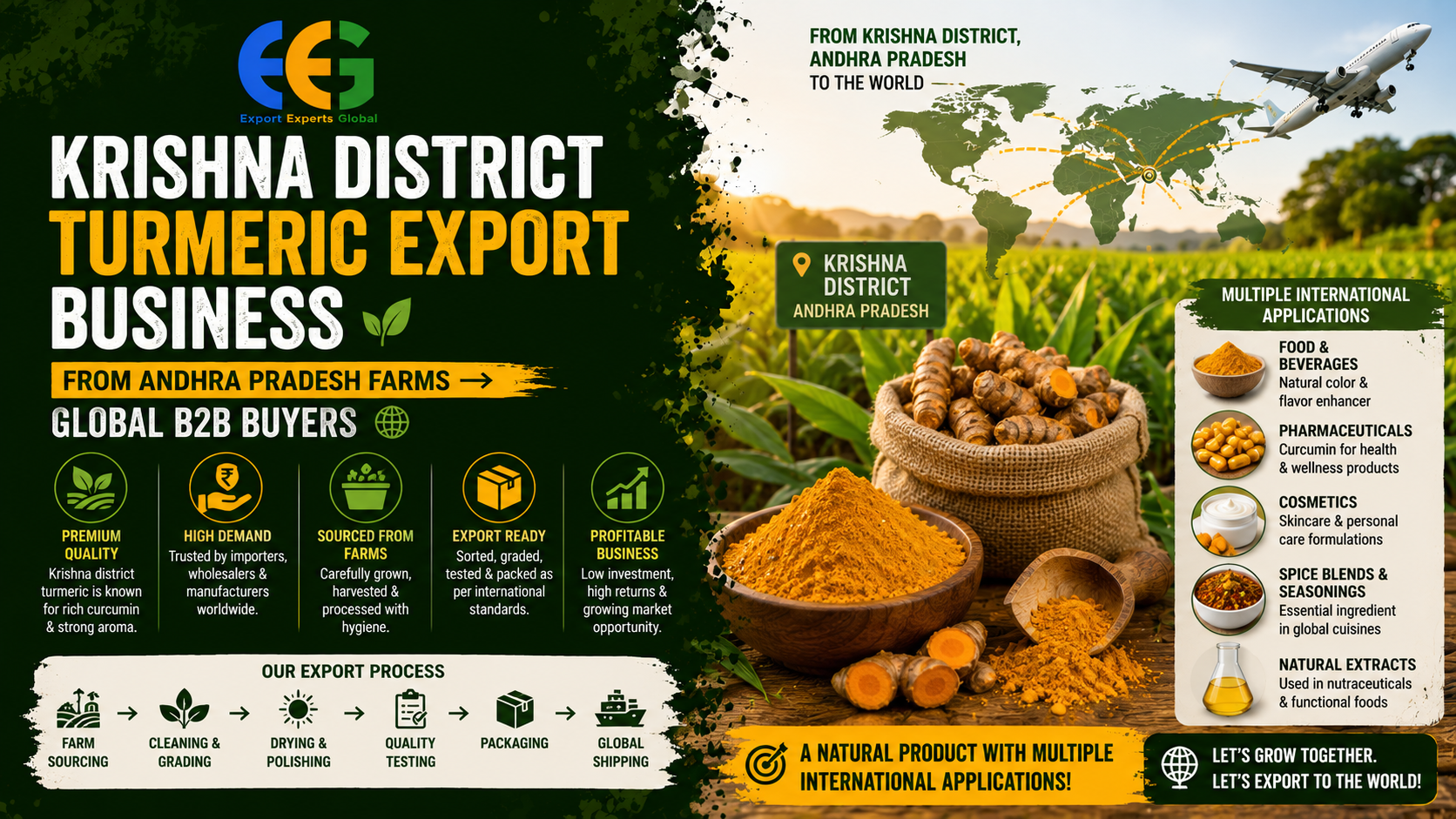
🌿 Why Consider Turmeric for Export?
Turmeric has a diverse range of commercial applications. International buyers may purchase turmeric as whole fingers, dried turmeric, powder, or as an ingredient for further processing.
Its applications include:
🍛 Spice blends
🥫 Processed foods
🥘 Seasonings
💊 Nutraceutical formulations
🧴 Cosmetic formulations
🌿 Wellness products
🏭 Food manufacturing
🧪 Ingredient processing
This diversity gives exporters an opportunity to target different categories of buyers rather than depending exclusively on retail consumers.
For example, a spice importer may be interested in dried turmeric fingers, while a food manufacturer could require standardized turmeric powder with specific quality parameters. A nutraceutical buyer may have completely different specifications.
Therefore, the buyer’s requirement should determine the product specification you source.
📍 Why Krishna District Can Be a Sourcing Opportunity
Krishna District in Andhra Pradesh can be explored as a regional sourcing base for agricultural products because of its farming ecosystem, trading activity, connectivity, and access to broader supply chains.
For an exporter, proximity to production and trading clusters can potentially provide several advantages:
🌱 Easier supplier identification
🤝 Direct farmer/trader relationships
📦 Bulk procurement possibilities
🚛 Regional transportation access
🏭 Processing and packing opportunities
🚢 Connectivity to export logistics
However, exporters should not assume that every supplier will automatically meet international standards.
The objective should be to build a verified supplier network.
Instead of depending on one supplier, develop relationships with multiple farmers, aggregators, traders, processors, and wholesalers. This can improve procurement flexibility when prices, availability, or quality conditions change.
📦 What Turmeric Products Can You Export?
There is more than one way to build a turmeric export business.
🟡 1. Turmeric Fingers
Dried turmeric fingers can be supplied to international importers, spice processors, grinders, and wholesalers.
Buyers may evaluate:
✔️ Size
✔️ Colour
✔️ Moisture
✔️ Curcumin
✔️ Foreign matter
✔️ Cleanliness
✔️ Residue compliance
🟡 2. Turmeric Powder
Turmeric powder can offer value addition compared with exporting raw agricultural material.
The exporter can focus on:
🏭 Cleaning
⚙️ Grinding
🔬 Testing
📦 Packaging
🌍 International distribution
However, powder products require careful attention to contamination, adulteration, microbial parameters, and destination-market regulations.
🟡 3. High-Curcumin Turmeric
Some buyers specifically seek turmeric with higher curcumin content.
This can create an opportunity for exporters who can provide laboratory-tested specifications rather than simply making verbal quality claims.
A certificate of analysis can become an important part of your B2B sales process.
🟡 4. Organic Turmeric
Organic products can target specialized buyers, but exporters must understand that simply purchasing turmeric from a farmer who does not use chemicals does not automatically make the product officially organic.
Organic certification and destination-specific requirements must be properly verified before making organic claims.
🌍 Which Countries Can Be Targeted?
Indian turmeric exporters can explore several international markets depending on product specifications, price competitiveness, regulations, and buyer demand.
Potential markets may include:
🇦🇪 UAE
🇸🇦 Saudi Arabia
🇺🇸 United States
🇬🇧 United Kingdom
🇩🇪 Germany
🇳🇱 Netherlands
🇲🇾 Malaysia
🇦🇺 Australia
But don’t make the mistake of targeting eight countries simultaneously.
🎯 Start with ONE market.
Research:
📊 Import demand
💰 Average buying prices
🚢 Freight costs
📋 Import regulations
🧪 Testing requirements
🏪 Buyer categories
📦 Packaging preferences
💳 Payment practices
Then select the market where your product has the strongest commercial fit.
🔍 What Do International Turmeric Buyers Look For?
A professional exporter must understand buyer specifications.
A buyer may ask questions such as:
➡️ What is the curcumin percentage?
➡️ What is the moisture level?
➡️ Is the product cleaned?
➡️ What is the mesh size?
➡️ What is the microbial status?
➡️ Is it suitable for food use?
➡️ What is the pesticide residue status?
➡️ What packaging is available?
➡️ What is the shelf life?
➡️ Can you provide a Certificate of Analysis?
This is why export-quality turmeric should not be evaluated only by appearance.
A product can look excellent but still fail a buyer’s laboratory requirements.
🔬 Testing is therefore critical.
Before finalizing a large shipment, understand the destination market’s applicable food-safety and residue requirements and arrange appropriate testing through a competent laboratory.
💰 How Does the Turmeric Export Business Make Money?
The basic commercial model is:
Procurement Cost
➕ Cleaning/Processing
➕ Packaging
➕ Testing
➕ Inland Transportation
➕ Documentation
➕ Port & Handling Charges
➕ Freight
➕ Insurance, where applicable
➕ Finance/Banking Costs
➕ Other Export Expenses
= Total Export Cost
Then:
Export Selling Price – Total Export Cost = Gross Commercial Margin
Do not calculate your profit using only:
❌ Local buying price vs overseas selling price.
That calculation can be dangerously misleading.
A serious exporter calculates the complete landed/export cost before quoting the buyer.
📊 Example of an Export Costing Structure
Suppose you are purchasing turmeric from a local supplier.
Your costing sheet may include:
🌿 Product purchase
🏭 Processing
🔬 Laboratory testing
📦 Packaging
🚛 Factory-to-port transportation
📑 Documentation
⚓ Port charges
🚢 Ocean freight
💳 Banking charges
🛡️ Insurance, if applicable
💰 Your margin
Only after calculating the complete cost should you finalize your export quotation.
Mentor’s Rule:
Never quote a foreign buyer before preparing a proper export costing sheet.
A ₹5–₹10 difference in procurement price can sometimes completely change your commercial margin when working with large quantities.
📋 Important Export Documentation
A turmeric exporter needs to establish the applicable regulatory and commercial documentation before shipping.
Depending on the transaction and destination, documentation can include:
📄 Import Export Code (IEC)
📄 GST-related documentation
📄 Commercial Invoice
📄 Packing List
📄 Purchase Order/Contract
📄 Certificate of Origin
📄 Shipping Bill
📄 Bill of Lading/Air Waybill
📄 Insurance document, where applicable
📄 Certificate of Analysis
📄 Product-specific certificates
📄 Phytosanitary documentation, where applicable
Food products may also require compliance with Indian and destination-country food regulations.
⚠️ Important:
Requirements can vary according to:
Product form + HS classification + destination country + buyer requirement + intended use.
Always verify the current requirements before shipment.
🧑💼 Who Can Be Your Buyer?
One of the most important parts of the business is buyer identification.
Potential B2B customers include:
🌍 Spice Importers
🏪 Food Distributors
🏭 Food Manufacturers
🍛 Spice Blending Companies
📦 Wholesale Distributors
🥫 Food Processing Companies
💊 Nutraceutical Ingredient Buyers
🧴 Cosmetic Ingredient Companies
🏪 Ethnic Grocery Distributors
Instead of randomly sending messages to thousands of companies, create a targeted buyer database.
For every potential buyer, record:
📌 Company name
📌 Country
📌 Website
📌 Contact person
📌 Product requirement
📌 Import history, where available
📌 Email
📌 Phone/WhatsApp
📌 Required quantity
📌 Packaging specification
This transforms buyer searching from guesswork into a structured sales process.
🚢 From Krishna District to International Market
A typical supply chain could look like:
🌱 Farmer / Supplier
⬇️
🏪 Aggregator / Trader
⬇️
🏭 Cleaning & Processing
⬇️
🔬 Quality Testing
⬇️
📦 Export Packaging
⬇️
🚛 Transportation
⬇️
⚓ Port
⬇️
🚢 International Shipment
⬇️
🌍 Importer
⬇️
🏪 Distributor / Manufacturer
⬇️
👨🍳 End User
Understanding this entire chain is essential for an exporter.
📦 Packaging Strategy
Packaging should be selected according to:
✅ Product form
✅ Buyer requirement
✅ Quantity
✅ Shelf-life considerations
✅ Transport conditions
✅ Destination-country regulations
Possible commercial packaging formats can include bulk food-grade bags, lined sacks, cartons, or customized packaging depending on the buyer’s specification.
For private-label or retail products, the requirements can be considerably different.
Remember:
Export packaging is not the same as local-market packaging.
International buyers may have specific requirements regarding:
🏷️ Labelling
📏 Net weight
🌍 Country of origin
📅 Batch information
📆 Best-before information
📋 Ingredient declaration
🔬 Food-safety information
Always verify the destination requirements.
⚠️ Major Risks in Turmeric Export
Every export business has risks.
1️⃣ Quality Variation
Different batches may have different characteristics.
2️⃣ Price Fluctuation
Agricultural commodity prices can change based on season, supply, demand, and market conditions.
3️⃣ Rejection Risk
A shipment may face problems if it doesn’t meet the agreed specification or regulatory requirements.
4️⃣ Payment Risk
Never treat an unknown buyer as automatically trustworthy.
5️⃣ Documentation Errors
Incorrect documentation can cause delays and additional costs.
6️⃣ Logistics Risk
Freight rates, port congestion, delays, and container availability can affect profitability.
7️⃣ Foreign Exchange Risk
Currency fluctuations can influence your final realization.
🛡️ How to Reduce Export Risk
Follow a systematic process:
🔹 Verify your buyer
🔹 Confirm product specifications in writing
🔹 Use a proper sales contract
🔹 Arrange product testing
🔹 Confirm packaging requirements
🔹 Calculate complete costs
🔹 Understand Incoterms
🔹 Select appropriate payment terms
🔹 Check destination regulations
🔹 Inspect goods before dispatch
🔹 Maintain documentation
💡 Never depend only on WhatsApp conversations.
Important commercial terms should be documented formally.
🚀 Beginner’s Roadmap
If you’re a beginner, don’t immediately attempt a 20-ton or 25-ton shipment.
Start with market research.
STEP 1
Choose your target country. 🌍
STEP 2
Identify 50–100 potential B2B buyers. 🔎
STEP 3
Understand their specifications. 📋
STEP 4
Find suppliers in Krishna District and surrounding sourcing areas. 🌱
STEP 5
Collect samples. 📦
STEP 6
Conduct appropriate laboratory testing. 🔬
STEP 7
Prepare export costing. 💰
STEP 8
Send professional quotations. 📑
STEP 9
Negotiate payment and delivery terms. 🤝
STEP 10
Execute the shipment with proper documentation. 🚢
STEP 11
Ask for feedback and convert the buyer into a repeat customer. 🔄
🌟 Why Value Addition Can Be Powerful
Exporting raw turmeric is only one business model.
You can potentially build additional value through:
🌿 Better grading
⚙️ Processing
🔬 Standardized quality
📦 Better packaging
🏷️ Private labeling
📊 Consistent specifications
🌍 Market-specific products
The objective should be to move from being just another commodity trader toward becoming a reliable international supplier.
📲 Want to Start Your Turmeric Export Business?
If you’re a student, farmer, trader, manufacturer, startup founder, or aspiring exporter, learn the practical process of:
🔎 Buyer Finding
🌱 Supplier Sourcing
📦 Product Selection
📋 Export Documentation
💰 Export Costing
🤝 Buyer Negotiation
🚢 Logistics
💳 International Payments
🌍 Market Research
Learn Import-Export Business Practically with Harsh Dhawan.
🌿 Krishna District → India → Global Markets 🌍
Your next export opportunity could begin with one product, one buyer and one shipment.
Overall Analysis
Turmeric export is not a shortcut-to-riches business. It is a process-driven international trading business.
If you are sourcing turmeric from Krishna District, your biggest advantage will not simply be finding the cheapest turmeric.
Your advantage will come from knowing:
WHO will buy → WHAT quality they need → HOW much they need → WHAT documents they require → HOW you will deliver → HOW you will protect your payment.
🌿 Product knowledge + Buyer research + Quality control + Export documentation + Costing + Logistics = Sustainable Export Business.
Start small.
Validate the buyer.
Test the product.
Calculate every cost.
Then scale.
That is how you can turn a regional agricultural commodity into a global B2B export opportunity. 🌍🚢📦