🧪 What Are LLDPE Granules?
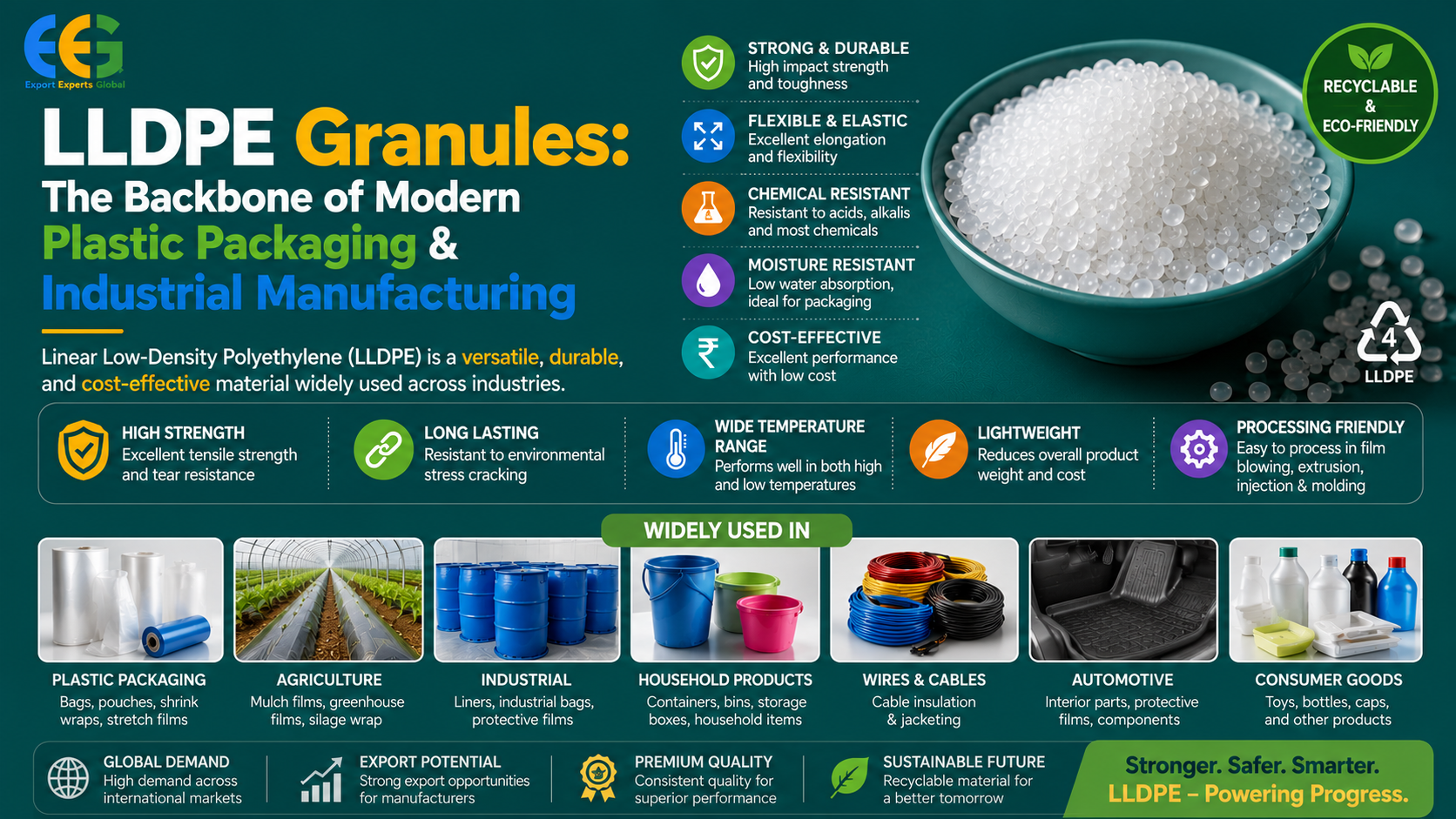
LLDPE (Linear Low-Density Polyethylene) is a thermoplastic polymer produced through the copolymerization of ethylene with alpha-olefins such as butene, hexene, or octene. This molecular structure gives LLDPE excellent flexibility while maintaining high tensile strength and impact resistance.
LLDPE is supplied in the form of small plastic granules or pellets, which are melted and processed into a variety of finished products using extrusion, injection molding, rotational molding, and other manufacturing techniques.
🌟 Key Characteristics of LLDPE Polymer
LLDPE has earned widespread acceptance because of its balanced performance characteristics.
✅ High Flexibility
The material bends without cracking, making it ideal for films and flexible packaging.
💪 Excellent Tensile Strength
LLDPE withstands pulling and stretching forces, making it suitable for industrial packaging applications.
🛡️ Superior Puncture Resistance
Compared with many conventional plastic films, LLDPE offers improved resistance to tears and punctures.
🌡️ Chemical Resistance
The polymer resists many acids, alkalis, and industrial chemicals, making it suitable for containers and liners.
❄️ Low Temperature Performance
LLDPE retains flexibility even in colder environments.
♻️ Recyclability
Many LLDPE products can be collected, processed, and recycled where suitable infrastructure exists.
🏭 How LLDPE Granules Are Manufactured
The production process begins with purified ethylene gas.
Major manufacturing stages include:
🔹 Polymerization
🔹 Pellet formation
🔹 Cooling
🔹 Drying
🔹 Quality inspection
🔹 Packaging
Each batch undergoes rigorous testing to maintain consistency in melt flow index (MFI), density, moisture content, and mechanical properties.
⚙️ Types of LLDPE Grades
Manufacturers produce different grades based on processing requirements.
🎯 Film Grade
Used for blown film and cast film production.
Applications include:
- Stretch films
- Shopping bags
- Garbage bags
- Food packaging
🧴 Rotational Molding Grade
Suitable for:
- Water tanks
- Industrial containers
- Chemical storage bins
🏗️ Injection Molding Grade
Common products include:
- Plastic caps
- Household containers
- Industrial components
📦 Extrusion Grade
Used for producing:
- Flexible sheets
- Liners
- Protective films
- Tubing
📦 Applications of LLDPE Granules
LLDPE serves numerous industries because of its adaptability.
🛍️ Flexible Packaging
Flexible packaging is one of the largest applications of LLDPE.
Products include:
✔ Food pouches
✔ Retail bags
✔ Courier bags
✔ Frozen food packaging
✔ Protective wraps
🎁 Industrial Stretch Film
Industrial stretch film manufactured from LLDPE secures products during transportation.
Benefits include:
📦 Load stability
🚚 Improved transportation safety
💰 Lower packaging cost
🛡️ Reduced product damage
🌾 Agricultural Films
LLDPE is widely used in agriculture.
Applications include:
🌱 Mulch films
🌾 Greenhouse films
💧 Irrigation liners
🌿 Silage wraps
🏗️ Construction Industry
Construction companies utilize LLDPE for:
🏢 Vapor barriers
🏠 Waterproof membranes
🧱 Protective covers
🚧 Temporary site protection
🏥 Medical Packaging
Medical-grade LLDPE is used for:
🩺 Disposable packaging
💉 Sterile wraps
🧪 Laboratory liners
🍎 Food Packaging
Food-grade LLDPE complies with applicable food-contact standards and is commonly used for:
🥛 Milk packaging
🥬 Vegetable bags
🍞 Bakery packaging
🍪 Snack pouches
🚀 Advantages of LLDPE Over Conventional Plastics
Manufacturers increasingly prefer LLDPE because it offers:
✅ Higher flexibility
✅ Better puncture resistance
✅ Excellent impact strength
✅ Lower material consumption
✅ Improved sealing performance
✅ High elongation
✅ Superior film clarity in selected grades
🌍 Importance in the Packaging Industry
The global packaging industry depends heavily on LLDPE.
Major sectors include:
📦 Logistics
🛒 Retail
🍎 Food processing
💊 Pharmaceuticals
🚗 Automotive
📱 Electronics
The combination of lightweight design and durability helps businesses reduce shipping costs while protecting products.
⚙️ Manufacturing Processes Using LLDPE
Common processing technologies include:
🔄 Blown Film Extrusion
Produces shopping bags, agricultural films, and packaging films.
📜 Cast Film Extrusion
Used for stretch films and cling films.
🏭 Injection Molding
Produces containers, caps, lids, and industrial components.
🔥 Rotational Molding
Manufactures tanks and large hollow products.
🌱 Sustainability in LLDPE Manufacturing
The plastics industry is steadily improving environmental performance.
Key initiatives include:
♻️ Mechanical recycling
🌿 Reduced material consumption
⚡ Energy-efficient production
💧 Lower process waste
🔄 Circular economy initiatives
Many manufacturers are also incorporating recycled polyethylene into suitable applications while maintaining quality standards where regulations permit.
🌎 Export Potential of LLDPE Granules
LLDPE granules are traded globally due to growing demand from packaging, construction, agriculture, healthcare, and consumer goods industries.
Export opportunities exist in regions such as:
🌍 Middle East
🌍 Africa
🌍 Southeast Asia
🌍 Europe
🌍 North America
🌍 Latin America
Reliable quality, consistent specifications, and compliance with buyer requirements are key factors in building long-term export relationships.
📊 Quality Parameters Buyers Evaluate
Industrial buyers typically assess:
✔ Melt Flow Index (MFI)
✔ Density
✔ Tensile strength
✔ Elongation at break
✔ Moisture content
✔ Color consistency
✔ Pellet uniformity
✔ Packaging quality
✔ Batch traceability
📑 Quality Certifications
Manufacturers may work toward certifications and quality systems depending on their markets, such as:
🏅 ISO Quality Management Systems
🌍 Environmental management standards
🍽️ Food-contact compliance (where applicable)
📦 Customer-specific quality requirements
Certification requirements vary depending on the destination market and end use.
🔬 Testing of LLDPE Granules
Laboratories commonly evaluate:
🧪 Melt Flow Index
⚖️ Density
💪 Tensile properties
🔥 Thermal behavior
💧 Moisture analysis
🧱 Impact resistance
📈 Processability
Consistent testing helps maintain uniform production quality.
🏭 Industries Using LLDPE
LLDPE supports numerous manufacturing sectors.
Major industries include:
🏭 Plastic packaging
🚚 Logistics
🥗 Food processing
💊 Pharmaceuticals
🚜 Agriculture
🏗️ Construction
🚗 Automotive
🧸 Consumer products
📦 E-commerce packaging
📈 Market Trends
The market continues to evolve with:
📦 Growth in e-commerce packaging
🌱 Demand for thinner, stronger films
♻️ Increased recycling initiatives
🤖 Automation in plastic processing
🌍 Expansion of export-oriented manufacturing
📊 Greater emphasis on sustainable packaging solutions
💡 Tips for Selecting the Right LLDPE Grade
Before purchasing LLDPE granules, consider:
✔ End-use application
✔ Processing method
✔ Required strength
✔ Flexibility
✔ Transparency needs
✔ Sealability
✔ Regulatory requirements
✔ Customer specifications
Selecting the correct grade helps improve productivity and reduce manufacturing defects.
🚚 Packaging and Storage
Proper storage protects polymer quality.
Recommended practices include:
📦 Store in clean, dry areas
☀️ Protect from direct sunlight
💧 Avoid excessive moisture
🏷️ Maintain batch identification
🚛 Handle bags carefully to prevent contamination
🌟 Future of LLDPE
Innovation is driving the next generation of polyethylene products.
Emerging developments include:
🌱 Recyclable mono-material packaging
♻️ Circular plastic systems
🤖 Smart manufacturing
⚡ Energy-efficient processing
🌍 Reduced carbon footprint
🧪 Advanced catalyst technologies
These improvements are expected to enhance product performance while supporting environmental goals.
Overall Analysis
LLDPE granules remain one of the most versatile and widely used polymers in the plastics industry. Their combination of flexibility, durability, puncture resistance, and processing efficiency makes them indispensable for flexible packaging, industrial stretch films, agricultural applications, and countless other products.
For manufacturers, choosing the appropriate LLDPE grade and maintaining strict quality control can improve production efficiency and customer satisfaction. For exporters, supplying consistent, specification-compliant material can strengthen competitiveness in international markets.
As packaging technology advances and sustainability becomes a greater priority, LLDPE will continue to play a significant role in meeting the evolving needs of industries worldwide.