

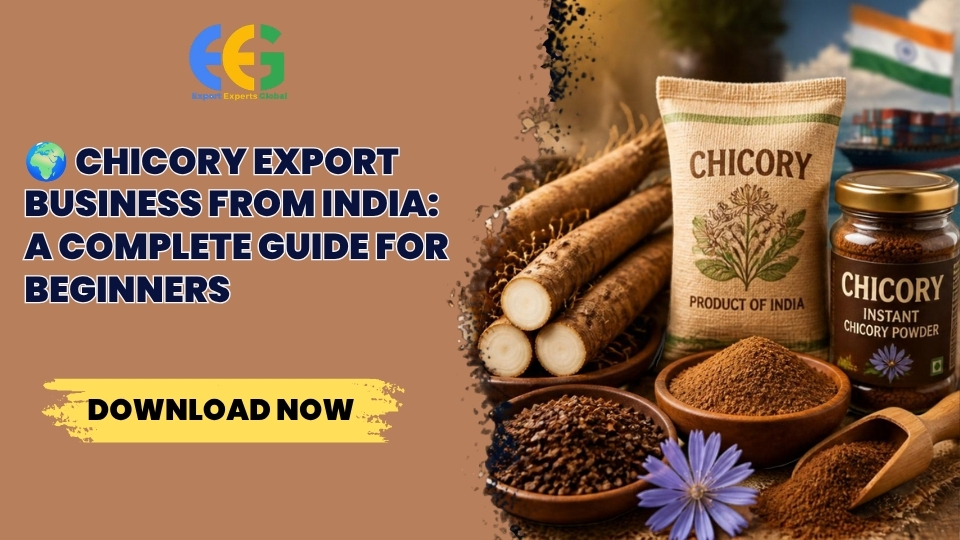
Chicory Export Business from India: A Complete Guide for Beginners
Chicory Export Business from India: A Complete Guide for Beginners The global food and beverage industry is constantly looking..
The global food and beverage industry is constantly looking for natural, versatile and cost-effective ingredients, and chicory is one product that deserves the attention of Indian exporters. 🌱☕ Chicory, scientifically known as Cichorium intybus, is a root crop that has been used for generations as a coffee substitute and as an ingredient in coffee blends. Today, its applications extend across beverages, food processing and ingredient manufacturing.
For entrepreneurs exploring new export business ideas from India, chicory can be an interesting B2B opportunity because it can be traded in several forms, including dried chicory root, roasted chicory, chicory granules, chicory powder and instant chicory. Instead of competing only in commodity trading, an exporter can explore value-added products and develop relationships with international food and beverage buyers.
Chicory is a flowering plant whose root is commonly harvested and processed for commercial applications. After harvesting, the roots can be cleaned, dried, cut and roasted before being converted into different products.
One of the best-known applications of chicory is its use in coffee blends. Roasted chicory can contribute a distinctive roasted flavor and is traditionally used with coffee in several markets. It can also be marketed as a caffeine-free beverage ingredient when processed and positioned appropriately.
For an Indian exporter, the opportunity is not necessarily limited to selling raw agricultural material. The business can move across the value chain:
🌱 Chicory Root → Dried Root → Roasted Chicory → Granules/Powder → Instant Chicory
This creates multiple possibilities for targeting different categories of buyers.
The biggest advantage of chicory is its connection with the international coffee and beverage industry.
Coffee manufacturers and beverage companies may use chicory as part of their formulations, while other businesses may purchase chicory for caffeine-free beverage products or specialized food applications.
An exporter can therefore explore several customer categories rather than depending on one buyer segment.
Some potential advantages include:
✅ Agricultural origin product
✅ Multiple processing possibilities
✅ B2B ingredient opportunity
✅ Coffee and beverage applications
✅ Scope for private-label products
✅ Potential for repeat commercial orders
✅ Possibility of value addition
✅ Indian sourcing and processing ecosystem
However, exporters should not assume that every international market automatically has strong demand. Market research, buyer validation, product testing and regulatory verification are essential before investing in inventory.
One of the most important decisions in a chicory export business is choosing the right product format.
This is a relatively basic form of the product. Buyers may further process the dried root according to their requirements.
Roasting changes the characteristics of the root and makes it suitable for beverage applications.
Granules can be supplied to industrial buyers depending on their required particle size and processing specifications.
Powdered chicory can be supplied to food and beverage manufacturers, subject to their formulation and quality requirements.
Instant chicory is a more processed product and may offer access to buyers looking for convenient beverage ingredients.
💡 Business Tip: Beginners should not automatically select the most processed product. First understand the buyer’s requirements, required specifications, MOQ, packaging, certifications and target price.
Starting a chicory export business requires more than simply finding a supplier and sending a shipment overseas.
A practical process can look like this:
Understand:
Your first objective should be to understand exactly what international buyers purchase.
Search for:
🌾 Chicory growers
🏭 Processing companies
📦 Agricultural traders
☕ Ingredient manufacturers
🏢 Established chicory suppliers
Do not select a supplier purely because they offer the lowest price.
Compare:
✔ Product quality
✔ Production capacity
✔ MOQ
✔ Processing capability
✔ Consistency
✔ Packaging
✔ Lead time
✔ Testing facilities
✔ Certifications
✔ Export experience
A supplier capable of maintaining consistent quality is often more valuable than a supplier offering the cheapest quotation.
Food ingredients sold internationally must meet the specifications expected by the buyer and destination market.
Depending on the product and destination, buyers may request information related to:
🧪 Moisture
🧪 Microbiological parameters
🧪 Foreign matter
🧪 Residue requirements
🧪 Physical characteristics
🧪 Shelf life
🧪 Packaging specifications
Some buyers may also request laboratory reports or certificates from recognized testing facilities.
Therefore, before approaching serious buyers, create a professional product specification sheet.
Your specification sheet can include:
📌 Product name
📌 Botanical name
📌 Product form
📌 Appearance
📌 Moisture
📌 Particle size
📌 Packaging
📌 Shelf life
📌 Country of origin
📌 Available certifications
📌 Minimum order quantity
Exporters can investigate markets where chicory has applications in coffee, beverages and food ingredients.
Potential markets to research include:
🇫🇷 France
🇩🇪 Germany
🇳🇱 Netherlands
🇬🇧 United Kingdom
🇺🇸 United States
🇦🇪 United Arab Emirates
🇸🇦 Saudi Arabia
These should be treated as research targets rather than guaranteed markets.
Before contacting buyers, investigate:
🔎 Import volume
🔎 Existing suppliers
🔎 Competitor pricing
🔎 Product specifications
🔎 Import duties
🔎 Food regulations
🔎 Labeling requirements
🔎 Required certifications
🔎 Buyer preferences
A country with large overall imports may not necessarily be the best market for your specific chicory product.
Instead of searching randomly for “chicory buyers”, identify the industries that actually consume the product.
Potential buyer categories include:
☕ Coffee manufacturers
🏭 Food ingredient importers
🥤 Beverage manufacturers
📦 Food distributors
🏷️ Private-label beverage companies
🌿 Functional beverage manufacturers
🛒 Specialty food brands
For B2B exports, the quality of your prospect list matters.
A database containing 1,000 unrelated companies is less useful than a carefully researched list of 50 companies that actually import or use chicory.
A systematic buyer-finding process can improve your chances of receiving genuine inquiries.
Use international trade databases to identify companies importing similar products.
Study:
📊 Import frequency
📊 Shipment quantity
📊 Supplier countries
📊 Import value
📊 Port information
📊 Product descriptions
This helps you identify companies with actual purchasing activity.
Search relevant international B2B marketplaces for:
Chicory Importer
Chicory Powder Buyer
Roasted Chicory Buyer
Food Ingredient Importer
Coffee Ingredient Distributor
Use specific searches such as:
“chicory importer Germany”
“chicory powder distributor UAE”
“roasted chicory buyer Europe”
“coffee ingredient importer Netherlands”
The goal is to identify the company’s website, product portfolio, purchasing department and business activity.
Do not send a generic message such as:
“Dear Sir, We are exporters from India. Please give us your requirement.”
Instead, create a professional B2B introduction.
Your message should communicate:
👋 Who you are
🏭 What product you supply
📦 Available specifications
🧪 Quality/testing information
📍 Country of origin
🚢 Export capability
📋 Certifications, if applicable
💰 Indicative commercial terms, when appropriate
Attach a concise product catalogue or specification sheet.
The objective of the first communication is not always to close the sale. It is to start a professional conversation and understand the buyer’s exact requirement.
The business model can work through the difference between your total procurement and export cost and the final selling price.
Your calculation should include:
Product Cost + Processing + Packaging + Testing + Documentation + Inland Transport + Freight + Insurance + Other Charges = Total Export Cost
Then compare this with the buyer’s agreed selling price.
Never calculate profit simply by subtracting the supplier’s quotation from your export quotation.
For example:
🌱 Supplier price
➕ Processing
➕ Packaging
➕ Quality testing
➕ Transport
➕ Documentation
➕ Freight
➕ Banking/transaction costs
➕ Other applicable charges
Only after calculating the complete landed/export cost can you estimate your actual margin.
Packaging depends on the product, buyer requirement and destination.
Possible B2B packaging formats can include:
🛍️ Food-grade bags
📦 Multi-layer bags
🪣 Industrial containers
📦 Cartons
🛢️ Bulk packaging
The exporter should confirm:
✔ Weight per bag
✔ Food-contact suitability
✔ Moisture protection
✔ Label requirements
✔ Palletization
✔ Container loading requirements
Do not finalize packaging before understanding the buyer’s specifications.
A typical export transaction may involve documents such as:
📄 Commercial Invoice
📄 Packing List
📄 Shipping Bill
📄 Bill of Lading/Air Waybill
📄 Certificate of Origin, where applicable
📄 Product/test certificates, where required
📄 Insurance documents, where applicable
📄 Other destination-specific compliance documents
The exact documentation depends on the product, transaction structure, destination and applicable regulations.
For food products, destination-country requirements must be checked before shipment.
Every export product has risks.
Different suppliers may produce different quality levels.
A new international buyer should be properly verified before accepting commercial terms.
Food products can be subject to strict import and labeling regulations.
Agricultural commodities can experience price changes.
Logistics disruptions can affect delivery schedules and costs.
If the shipment does not meet the agreed specifications or destination requirements, serious commercial problems can occur.
Changes in exchange rates can influence your final profitability.
This is why quality control + buyer verification + proper documentation + payment-risk management are critical.
Yes, an entrepreneur can explore a merchant-exporter model instead of establishing a processing facility immediately.
You can:
Find Buyer → Understand Specification → Find Indian Manufacturer → Arrange Production/Processing → Quality Check → Export
This reduces the need for immediate investment in manufacturing infrastructure.
However, you must have strong control over:
🏭 Supplier selection
🔬 Quality
📦 Packaging
📋 Documentation
🚢 Logistics
🤝 Buyer communication
Your reputation as an exporter depends on the shipment you deliver—not simply on the manufacturer you source from.
Instead of competing only on price, develop a professional B2B proposition.
You can position yourself around:
🌱 Consistent Indian sourcing
🔬 Tested quality
📦 Customized packaging
🏭 Reliable processing partners
🚢 Export-ready documentation
🤝 Responsive buyer support
Create:
✅ Company profile
✅ Product catalogue
✅ Specification sheet
✅ Product photographs
✅ Packaging details
✅ Certifications
✅ Website
✅ Professional email address
International buyers generally expect suppliers to present information clearly and professionally.
One of the most interesting aspects of chicory is the ability to move beyond raw agricultural material.
Instead of:
Raw Chicory → Export
Consider:
Source → Process → Roast → Grind → Test → Pack → Brand → Export
The more value you add, the more specialized your target market can become.
However, additional processing also means additional investment, quality-control responsibilities and regulatory requirements.
Therefore, start with a clear understanding of buyer demand before building infrastructure.
If you are completely new to export, follow a controlled approach.
Study the product, applications, HS classification, competitors and target markets.
Identify 3–5 reliable Indian suppliers and compare their capabilities.
Build a list of relevant importers, distributors and manufacturers.
Send samples only after understanding the buyer’s requirement and commercial seriousness.
Discuss specification, quantity, price, Incoterms, packaging, payment terms and delivery schedule.
Verify the product against the agreed specification before shipment.
Complete documentation and coordinate logistics carefully.
Your long-term objective should be repeat B2B business rather than one-time transactions.
Chicory may not be the first product that comes to mind when people discuss Indian exports, but that is exactly why entrepreneurs should study such specialized agricultural and food-ingredient opportunities.
The key is not simply finding a product that can be exported. The real business opportunity comes from identifying a product with real buyer demand, reliable Indian sourcing, consistent quality, manageable logistics and sustainable margins.
If you are considering chicory as an export product, start with research rather than inventory. Understand the product, identify credible suppliers, study international buyers, verify regulations and calculate the complete export cost before committing capital. 📊
Remember:
Research → Source → Test → Connect → Negotiate → Export → Build Repeat Orders 🌍🚢
The export business is not built by finding one buyer. It is built by developing a reliable supply chain and a repeatable international sales process.
Chicory can be explored as a niche B2B export opportunity from India—but success will depend on execution, quality, compliance and buyer relationships.
Chicory Export Business from India: A Complete Guide for Beginners The global food and beverage industry is constantly looking..
Medical Products with High Export Demand from India: Complete Export Business Guide 🌍 Introduction: Explore the Medical Products Export..

💧 Water Import Business in India: Complete Guide to Products, Global Suppliers, Investment Opportunities & Profit Potential 🌍 Introduction:..

