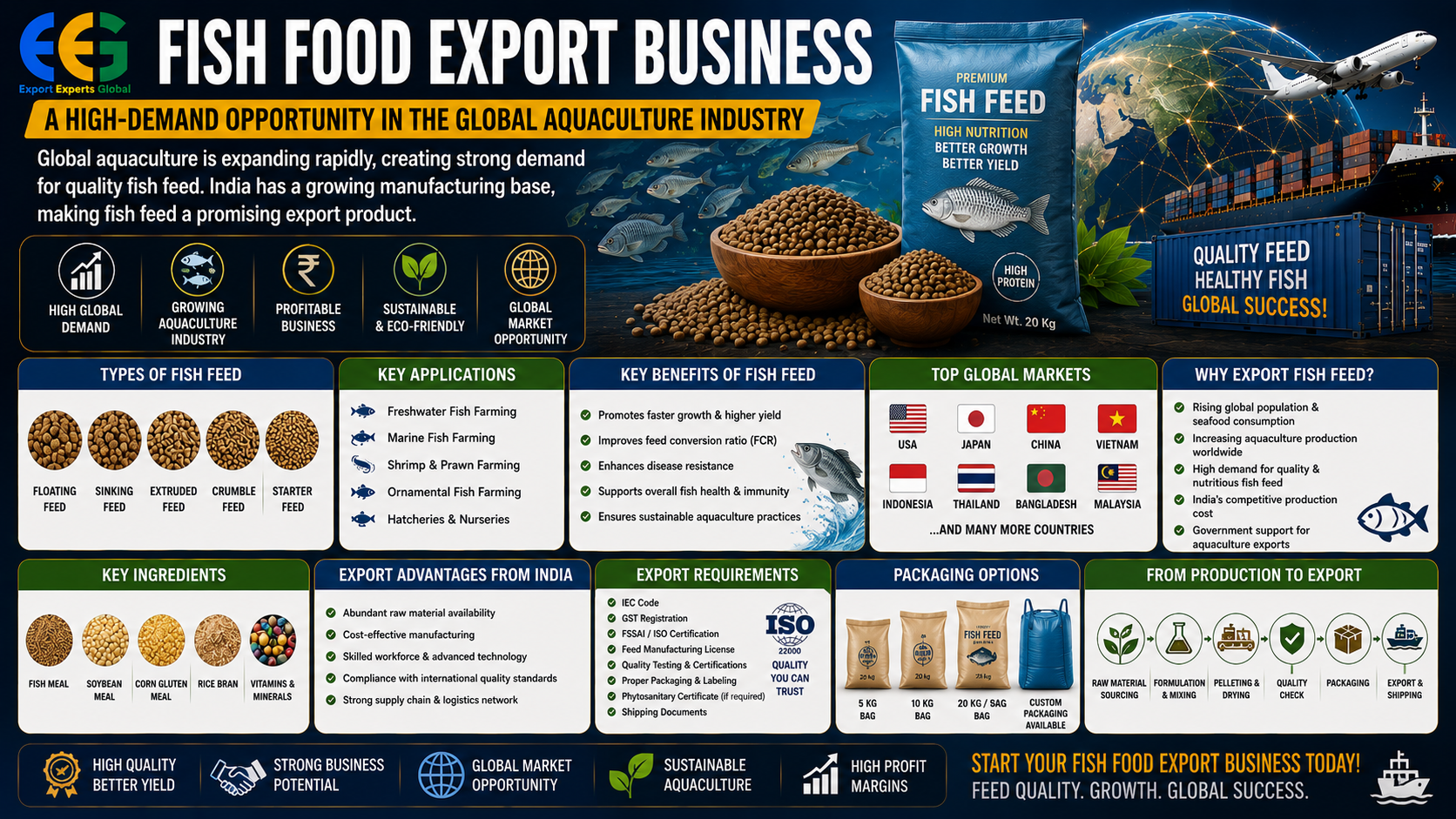
🌊 Why Fish Food Export is a Smart Business
The aquaculture industry is one of the fastest-growing food production sectors globally. Millions of fish farmers depend on scientifically formulated feed every day, making fish food a recurring-demand product rather than a one-time purchase.
✅ Key Advantages
🐟 Continuous demand throughout the year
🌍 Growing global seafood consumption
📦 Repeat orders from commercial fish farms
💰 Attractive profit margins
🏭 Strong manufacturing ecosystem in India
🚢 Suitable for containerized exports
📈 Expanding aquaculture projects worldwide
Unlike seasonal agricultural products, fish feed is required throughout the farming cycle, making it a stable export commodity.
🐠 What is Fish Food?
Fish food, commonly known as fish feed, is a nutritionally balanced product designed to support the healthy growth of fish and other aquatic species.
Quality fish feed generally contains:
🌽 Corn
🌱 Soybean Meal
🐟 Fish Meal
🛢 Fish Oil
🌾 Rice Bran
💊 Vitamins
🧪 Minerals
🌿 Amino Acids
The formulation varies depending on the species being farmed.
📦 Types of Fish Feed You Can Export
Different species require different nutritional formulations.
🐟 Floating Fish Feed
Designed to float on water, making feeding management easier.
Suitable for:
• Tilapia
• Catfish
• Pangasius
• Carp
🌊 Sinking Fish Feed
Slowly sinks to different water depths.
Suitable for:
• Freshwater species
• Bottom-feeding fish
• Specialized aquaculture farms
🦐 Shrimp Feed
High-protein feed developed specifically for shrimp farming.
Suitable for:
• Whiteleg Shrimp
• Tiger Shrimp
🦀 Crab Feed
Special formulations supporting healthy shell growth.
🐠 Ornamental Fish Feed
Premium nutrition for aquarium fish.
Available as:
✨ Flakes
✨ Pellets
✨ Granules
✨ Color-enhancing formulas
🌱 Organic Fish Feed
Growing demand among sustainable aquaculture businesses.
🌍 Global Market Opportunity
Aquaculture is expanding rapidly across Asia, Africa, Latin America, and the Middle East.
Countries are investing heavily in:
🐟 Fish farming
🦐 Shrimp farming
🐠 Inland aquaculture
🌊 Marine aquaculture
This expansion directly increases demand for quality fish feed.
🌎 Top Importing Countries
Several countries import fish feed due to expanding aquaculture industries.
Some attractive markets include:
🇻🇳 Vietnam
🇮🇩 Indonesia
🇧🇩 Bangladesh
🇪🇬 Egypt
🇳🇬 Nigeria
🇸🇦 Saudi Arabia
🇦🇪 UAE
🇰🇪 Kenya
🇵🇭 Philippines
🇲🇾 Malaysia
Each market has different product specifications and regulatory requirements, so exporters should research destination-country standards before shipping.
🇮🇳 Why Buy Fish Feed from India?
India offers several competitive advantages.
✅ Competitive Manufacturing Costs
Indian manufacturers produce quality feed at competitive prices.
✅ Skilled Workforce
Years of experience in aquaculture manufacturing.
✅ Large Production Capacity
Factories can handle both bulk and customized orders.
✅ Reliable Supply Chain
Good connectivity through ports and logistics infrastructure.
✅ Diverse Product Range
Products available for freshwater, marine, shrimp, ornamental, and specialty farming.
🏭 Best Manufacturing States in India
Some major production hubs include:
📍 Andhra Pradesh
📍 Gujarat
📍 Tamil Nadu
📍 Odisha
📍 Kerala
📍 West Bengal
These regions have well-developed aquaculture ecosystems.
📑 Documents Required for Export
Export documentation plays a critical role in international trade.
Common documents include:
📄 Importer Exporter Code (IEC)
📄 GST Registration
📄 Commercial Invoice
📄 Packing List
📄 Shipping Bill
📄 Bill of Lading or Air Waybill
📄 Certificate of Origin
📄 Insurance Documents (if applicable)
📄 Product specifications and any destination-country compliance documents required by the buyer.
Always verify the importing country’s requirements before shipment.
🚢 Shipping Options
Fish feed can be exported using:
🚢 Sea Freight
Best for:
✔ Bulk shipments
✔ Cost efficiency
✔ Container loads
✈ Air Freight
Suitable for:
✔ Small urgent consignments
✔ Product samples
Most commercial exports move through sea freight.
📦 Packaging Matters
Proper packaging protects product quality.
Popular packaging sizes include:
📦 5 KG
📦 10 KG
📦 20 KG
📦 25 KG
📦 40 KG
Packaging should include:
✔ Product Name
✔ Batch Number
✔ Manufacturing Date
✔ Net Weight
✔ Storage Instructions
✔ Feeding Guidelines
✔ Country of Origin
💰 Profit Potential
Profit depends on:
✔ Product category
✔ Order quantity
✔ Market
✔ Packaging
✔ Freight
✔ Brand positioning
Approximate trading margins:
💰 10–25%
Private label exports:
💰 20–35%
Premium formulations can achieve higher margins where buyers value quality and technical performance.
📈 How to Find International Buyers
Finding reliable buyers is the most important part of the export business.
Methods include:
🌍 International Trade Fairs
🤝 Importers
🏢 Distributors
🌐 B2B Platforms
📧 Email Outreach
💼 Export Promotion Events
📱 Professional Networking
Long-term relationships often lead to repeat business.
🎯 Marketing Strategy
Successful exporters focus on:
📷 Professional Product Images
🌐 Website
📦 Attractive Packaging
📑 Product Catalog
📊 Technical Data Sheets
📱 Social Media Presence
📧 Email Marketing
🌍 Digital Branding
⚠ Common Challenges
Every export business has challenges.
Examples include:
❌ Poor product quality
❌ Delayed shipments
❌ Documentation errors
❌ Payment risks
❌ Freight cost fluctuations
❌ Market competition
Managing these effectively improves customer satisfaction and business sustainability.
💡 Tips for Long-Term Success
✅ Maintain consistent quality
✅ Build strong buyer relationships
✅ Respond quickly to inquiries
✅ Understand destination-country regulations
✅ Offer customized packaging
✅ Focus on repeat orders
✅ Keep improving product value
🚀 Future of Fish Feed Exports
Growing seafood consumption, advances in aquaculture technology, and increasing investments in fish farming are expected to support long-term demand for quality fish feed. Exporters who prioritize product quality, compliance, and customer service will be well-positioned to benefit from this expanding market.
Overall Analysis
The fish food export business offers an excellent opportunity for entrepreneurs who want to participate in the growing global aquaculture industry. With India’s strong manufacturing capabilities, competitive costs, and increasing international demand, exporters can build a sustainable business by focusing on quality, compliance, efficient logistics, and long-term buyer relationships. Careful market research, professional branding, and reliable customer service are the foundation of success in this industry.