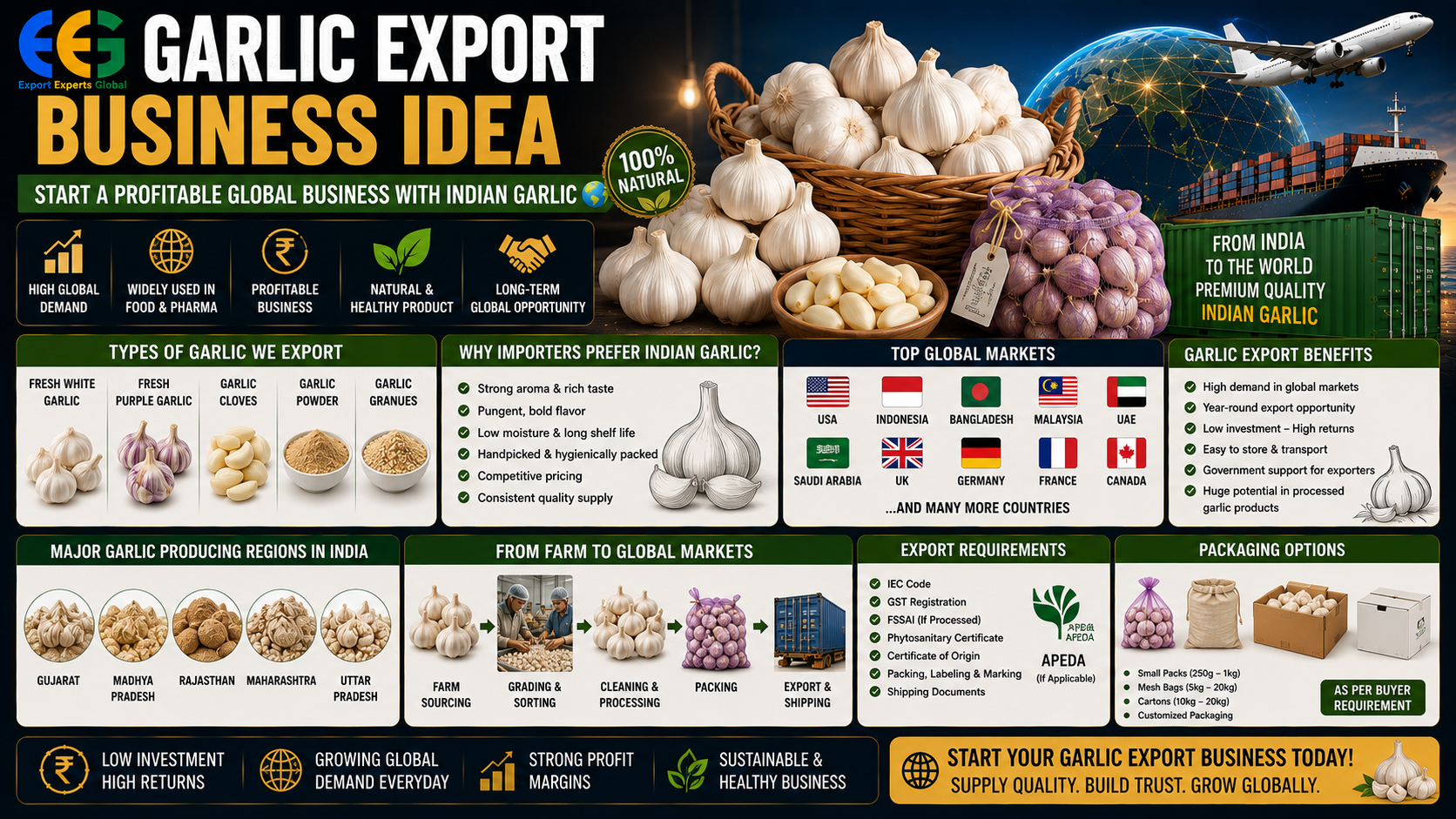
🧄 What Makes Garlic a Good Export Product?
Garlic has a unique position in the international food market because it is used across different cuisines and industries.
🍽️ Food Industry: Garlic is an essential ingredient in restaurants, hotels, catering businesses, sauces, pickles, seasonings, ready-to-eat foods, and processed products.
🏭 Food Processing: Manufacturers use garlic in spice blends, sauces, frozen foods, instant meals, snacks, and seasoning products.
🌿 Herbal & Wellness Products: Garlic is also used as an ingredient in various traditional and wellness-oriented products, subject to applicable regulations.
📦 Value Addition: Instead of exporting only fresh bulbs, exporters can explore garlic flakes, granules, powder, peeled garlic, and dehydrated garlic.
This product diversification gives exporters the opportunity to serve different categories of international buyers.
🌎 Understanding the Garlic Export Market
Before starting an export business, conduct proper market research.
Do not randomly select a country simply because you hear that it imports garlic. Study:
🔎 Import demand
💰 Average market prices
📦 Packaging requirements
🚢 Freight costs
📑 Import regulations
🧪 Quality specifications
🏪 Buyer categories
💳 Payment practices
📊 Competition from other supplying countries
Potential markets may include countries across South Asia, Southeast Asia, the Middle East, and other regions where garlic is consumed in significant quantities.
Countries such as Bangladesh, Malaysia, Indonesia, Vietnam, the UAE, Saudi Arabia, Oman, Qatar, Nepal, and Sri Lanka can be researched as potential destinations, but exporters should verify current import requirements and commercial viability before targeting any specific market.
The most important lesson is simple:
Don’t choose the market first. Choose the opportunity after studying the market.
📦 Different Garlic Products You Can Export
One of the biggest advantages of the garlic industry is the variety of products available.
1️⃣ Fresh Garlic
Fresh garlic bulbs are the most straightforward product for a new exporter to understand.
Buyers generally evaluate:
✔ Bulb size
✔ Clove size
✔ Color
✔ Cleanliness
✔ Moisture
✔ Shelf life
✔ Damage percentage
✔ Pest and disease condition
✔ Uniformity
Proper curing and grading are particularly important for maintaining quality during transportation.
2️⃣ Peeled Garlic
Peeled garlic can be supplied to:
🍴 Restaurants
🏨 Hotels
🏭 Food processors
🍱 Catering companies
🧑🍳 Commercial kitchens
Because peeling adds processing and labor, the product can have different commercial economics compared with whole bulbs.
3️⃣ Dehydrated Garlic
Dehydrated garlic is another interesting category.
The product can be supplied as:
🧄 Flakes
🧄 Slices
🧄 Minced garlic
🧄 Granules
🧄 Powder
Dehydrated products can be useful for food manufacturers because they are convenient to store, transport, and use in industrial production.
4️⃣ Garlic Powder
Garlic powder is widely used in:
🌮 Seasonings
🍕 Processed foods
🥫 Sauces
🍜 Instant foods
🥩 Meat products
🥨 Snack manufacturing
For an entrepreneur interested in value-added exports, garlic powder can be worth investigating.
🌱 Where Can You Source Garlic in India?
India has several important garlic-producing regions.
Potential sourcing areas include:
📍 Madhya Pradesh
📍 Rajasthan
📍 Gujarat
📍 Uttar Pradesh
📍 Punjab
Madhya Pradesh and Rajasthan are particularly important areas for garlic production.
However, successful exporters should not select suppliers solely based on location.
Instead, evaluate suppliers according to:
✅ Consistent supply
✅ Product quality
✅ Grading capability
✅ Storage facilities
✅ Packaging capability
✅ Pricing
✅ Traceability
✅ Ability to meet export specifications
Building relationships with farmers, farmer groups, aggregators, wholesalers, and processing units can create a stronger sourcing network.
⭐ Garlic Quality: The Most Important Factor
One of the biggest mistakes new exporters make is focusing entirely on purchase price.
International buyers are usually concerned about quality consistency.
Imagine you send one shipment containing excellent-quality garlic and the next shipment contains smaller, damaged, or poorly cured bulbs.
The buyer may lose confidence.
Therefore, establish a quality-control system.
🔍 Important Quality Parameters
🧄 Bulb Size
🧄 Color
🧄 Moisture Level
🧄 Cleanliness
🧄 Curing Quality
🧄 Physical Damage
🧄 Mold
🧄 Pest Damage
🧄 Foreign Matter
🧄 Uniformity
Your buyer should receive exactly—or as closely as possible—the specification agreed upon before the order.
📑 Documents Required for Garlic Export
Export documentation depends on the product, destination, transaction structure, and applicable regulations.
Common requirements can include:
📄 Import Export Code (IEC)
📄 GST Registration
📄 Commercial Invoice
📄 Packing List
📄 Shipping Bill
📄 Bill of Lading / Air Waybill
📄 Certificate of Origin
📄 Phytosanitary Certificate, where applicable
📄 APEDA-related registration/compliance, where applicable
📄 Buyer-specific certificates or declarations
The exact requirements should always be verified with the relevant Indian authorities and the importing country’s regulations before shipment.
Documentation is not a formality. It is part of your export product.
A high-quality shipment with incorrect paperwork can still face delays, additional costs, or rejection.
🏷️ Garlic Export Packaging
Packaging plays a major role in protecting garlic during transportation.
Depending on buyer requirements, garlic may be packed in:
📦 Corrugated cartons
🧺 Mesh bags
👜 Net bags
📦 Bulk export packaging
🧄 Retail-ready packaging
Packaging should provide adequate ventilation and protection.
The packaging design should consider:
🌡️ Temperature
💧 Humidity
🚢 Transit duration
📦 Handling conditions
🏪 Final market
🧄 Product type
For retail markets, buyers may also require attractive consumer packaging, barcode information, labeling, country-of-origin details, weight declarations, and other market-specific information.
🚢 Logistics for Garlic Export
Garlic can be transported by sea or air depending on the product, urgency, destination, and economics.
🚢 Sea Freight
Sea freight is generally more suitable for larger commercial shipments where transit time and product characteristics allow it.
Advantages include:
✔ Lower cost per unit for large volumes
✔ Suitable for containerized shipments
✔ Better economics for bulk trade
✈️ Air Freight
Air freight can be considered for smaller, urgent, premium, or time-sensitive consignments, although the freight cost can significantly affect profitability.
For every shipment, calculate:
Product Cost + Processing + Packaging + Inland Transportation + Documentation + Port Charges + Freight + Insurance + Other Costs = Export Cost
Only after calculating the complete cost should you determine your selling price.
💰 How to Calculate Garlic Export Pricing
Pricing is one of the most important skills for an exporter.
Suppose your sourcing cost is ₹X per kg.
Then you may have additional expenses:
🌱 Purchase Cost
📦 Packaging
🏭 Sorting & Grading
🚛 Transportation
📑 Documentation
⚓ Port Expenses
🚢 Freight
🛡️ Insurance
💱 Banking/Payment Costs
📈 Marketing Expenses
Your final export quotation must account for these expenses.
The selling price will also depend on the Incoterm agreed with the buyer.
For example:
EXW → FCA → FOB → CFR → CIF
Each term creates different responsibilities and cost exposure.
Therefore, never quote a buyer simply by adding a random profit percentage to your purchase price.
💵 Is Garlic Export Profitable?
Yes, garlic can offer attractive business potential, but profitability is not guaranteed.
Margins can change depending on:
📈 Domestic garlic prices
🌍 International demand
🚢 Freight rates
💱 Currency exchange rates
📦 Packaging costs
🧄 Product quality
🏪 Destination market
🤝 Buyer negotiation
📅 Seasonality
Fresh commodity exports can have tighter margins because buyers can compare prices from multiple suppliers.
Value-added products may offer additional opportunities because processing, convenience, packaging, and specification can differentiate the product.
Instead of asking:
“How much profit can I make?”
Ask:
“How can I create a competitive export offer that gives the buyer value while leaving enough margin for my business?”
That is a much stronger export mindset.
🔎 How to Find International Garlic Buyers
Finding buyers is one of the most important parts of the business.
Potential buyers include:
🌍 Importers
🏪 Food distributors
🛒 Supermarket suppliers
🏭 Food-processing companies
🍴 Restaurant suppliers
📦 Wholesale distributors
🧄 Spice companies
🍱 Ingredient manufacturers
You can research buyers through:
🔎 B2B marketplaces
🌐 Company websites
📊 Import-export databases
💼 Trade exhibitions
🤝 Industry associations
📧 Direct email outreach
📱 Professional networking platforms
Do not send the same generic message to every buyer.
Study the buyer first.
Understand:
- What products they import
- Their market
- Their packaging requirements
- Their likely purchase volume
- Their existing supplier base
- Their preferred payment terms
Then create a professional quotation.
📧 How to Approach a Garlic Importer
A strong buyer introduction should be short and professional.
Mention:
🧄 Product
📍 Country of origin
📦 Available specifications
⚖️ Packing options
📊 Quantity capability
🚢 Shipping port
📑 Certifications/documents
💰 Price basis
📞 Contact information
Instead of saying:
“We are the best garlic exporter. Please give us an order.”
Present actual commercial information.
For example:
“We supply Indian fresh garlic in export-grade specifications with customized grading and packaging. We can offer samples and discuss shipment quantities according to your requirements.”
Professional communication builds credibility.
💳 Payment Terms in Garlic Export
Payment risk must be carefully managed.
Common international payment structures may include:
💳 Advance Payment
🏦 Letter of Credit
📄 Documentary Collection
💰 Open Account
The appropriate payment structure depends on the buyer, transaction value, relationship history, destination, risk profile, and negotiation.
For a new buyer, avoid blindly accepting risky payment terms.
Before shipping commercial quantities, conduct buyer verification.
Check:
🔎 Company registration
🔎 Business website
🔎 Contact details
🔎 Import history
🔎 Trade references
🔎 Banking information
🔎 Purchase order authenticity
A confirmed order is not automatically a safe order.
⚠️ Major Challenges in Garlic Export
Every export business has risks.
1️⃣ Price Volatility
Garlic prices can fluctuate because of production levels, weather conditions, harvest cycles, domestic demand, and international market conditions.
2️⃣ Quality Rejection
Poor grading, improper curing, excessive moisture, contamination, or damaged bulbs can create problems.
3️⃣ Storage
Garlic requires suitable storage conditions to maintain quality.
4️⃣ Freight Costs
International freight can significantly affect the final quotation.
5️⃣ Regulatory Compliance
Each destination market may have different requirements.
6️⃣ Buyer Risk
A new exporter should never ignore buyer verification.
7️⃣ Currency Risk
Exchange-rate fluctuations can affect your actual realization.
A professional exporter identifies these risks before accepting the order.
🚀 How to Build a Garlic Export Business Step by Step
Step 1: Select the Product 🧄
Decide whether you want to export:
Fresh garlic, peeled garlic, flakes, dehydrated garlic, granules, or powder.
Step 2: Research the Market 🌎
Identify countries where your product has demand and where Indian supply is commercially competitive.
Step 3: Identify Suppliers 🌱
Build relationships with farmers, aggregators, wholesalers, and processors.
Step 4: Establish Quality Specifications ⭐
Create a written product specification.
Step 5: Calculate Your Export Cost 💰
Include every expense before quoting.
Step 6: Complete Documentation 📑
Obtain the applicable registrations and certificates.
Step 7: Find Genuine Buyers 🔎
Research importers and distributors instead of sending mass spam messages.
Step 8: Send Samples 📦
Where appropriate, offer samples that accurately represent the commercial product.
Step 9: Negotiate Terms 🤝
Discuss price, quantity, packaging, Incoterm, payment method, shipment schedule, and quality specifications.
Step 10: Execute the Shipment 🚢
Coordinate supplier, packaging, inspection, logistics, customs, freight forwarder, and buyer documentation.
Step 11: Follow Up 📞
A successful shipment should become the beginning of a long-term relationship—not the end of the transaction.
📈 Value Addition: The Bigger Opportunity
New exporters often think:
“I will buy garlic and sell garlic.”
But experienced entrepreneurs think:
“How can I create more value?”
For example:
🧄 Fresh Garlic → Dehydrated Garlic
🧄 Dehydrated Garlic → Flakes
🧄 Flakes → Granules
🧄 Granules → Powder
🧄 Bulk Product → Branded Retail Product
Processing can open additional customer segments.
However, value-added food products can involve additional food-safety, labeling, processing, and regulatory requirements. These must be checked before investing.
🧠 Why Market Research Matters
Never enter a country solely because someone says:
“There is huge demand there.”
Ask:
❓ How much does the country import?
❓ Who are the major suppliers?
❓ What specifications are demanded?
❓ What is the landed cost?
❓ What tariffs or duties apply?
❓ What certificates are required?
❓ What packaging is preferred?
❓ Who are the major importers?
❓ Can Indian garlic compete?
This approach transforms a general export business idea into a realistic business model.
🌐 Branding Indian Garlic Globally
There is another opportunity beyond commodity trading: branding.
Instead of selling only bulk garlic, exporters can develop:
✨ Premium Indian Garlic
✨ Organic-certified products where applicable
✨ Dehydrated Garlic Brand
✨ Garlic Powder Brand
✨ Private-label Garlic Products
Branding can help create differentiation.
But branding should be supported by consistent quality, proper compliance, professional packaging, and dependable supply.
📊 Garlic Export Business Model
A simple business model can look like this:
Indian Farmer / Supplier
⬇️
Collection & Procurement
⬇️
Sorting & Grading
⬇️
Quality Inspection
⬇️
Packaging / Processing
⬇️
Export Documentation
⬇️
Freight Forwarder & Customs
⬇️
International Importer
⬇️
Distributor / Wholesaler
⬇️
Retail / Food Industry
Understanding this supply chain helps you identify where you want to operate.
You do not necessarily need to own a farm or processing factory to become an exporter. You can build a business by coordinating suppliers, processors, logistics providers, and international buyers.
🏆 Secrets to Long-Term Success
Successful garlic exporters focus on five major areas:
1. Quality ⭐
Deliver what you promised.
2. Consistency 📦
Maintain the same specifications across shipments.
3. Communication 📞
Respond quickly and professionally.
4. Compliance 📑
Follow export and destination-market regulations.
5. Relationships 🤝
Build repeat customers instead of chasing one-time orders.
The goal should be:
One buyer → multiple shipments → long-term relationship.
💡 Final Advice for New Garlic Exporters
If you are planning to enter the garlic export business from India, start with research rather than inventory.
First understand the product.
Then understand the market.
Then identify buyers.
Then build your supplier network.
Then calculate your complete export cost.
Only after these steps should you consider purchasing significant quantities.
🚫 Do not buy a large stock simply because the domestic price appears cheap.
🚫 Do not promise specifications that your supplier cannot consistently deliver.
🚫 Do not accept every buyer without verification.
🚫 Do not quote international prices without calculating freight and other export expenses.
Instead:
✅ Start with a defined product
✅ Select a specific target market
✅ Find verified buyers
✅ Understand their requirements
✅ Source according to the buyer’s specification
✅ Control quality
✅ Prepare accurate documentation
✅ Ship professionally
✅ Build repeat business
Overall Analysis
The garlic export business can provide an attractive opportunity for Indian entrepreneurs because garlic has widespread international consumption and can be sold in several forms. Fresh bulbs can serve traditional wholesale markets, while dehydrated garlic, flakes, granules, and powder can open opportunities in the food-processing sector.
However, successful exporting requires much more than finding a low-cost supplier. Product quality, market research, buyer verification, export documentation, pricing, packaging, logistics, and payment security are all critical components of the business.
If you approach garlic exports with a professional mindset and build systems around sourcing, quality control, compliance, and international sales, the business can potentially develop from small shipments into a scalable global trading operation. 🚢🌍