🔥 What Is an Industrial Mixer?
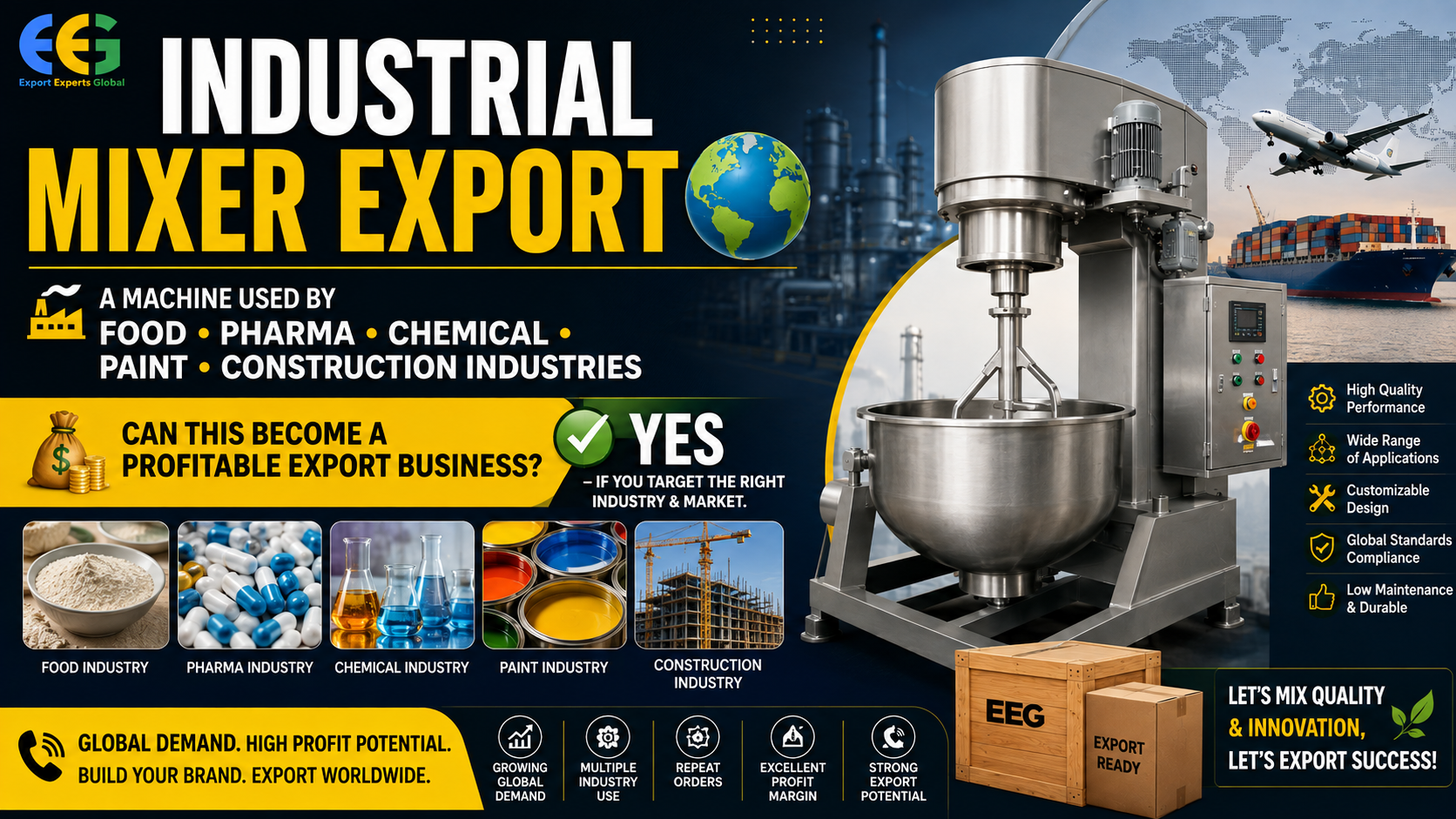
An industrial mixer is equipment designed to combine, blend or homogenize different materials to achieve a consistent mixture.
Depending on the application, an industrial mixer can handle:
🥣 Powders
💧 Liquids
🧪 Chemicals
🌾 Grains and feed
🍪 Food ingredients
💊 Pharmaceutical materials
🎨 Paints and pigments
🧱 Construction materials
🧴 Cosmetic ingredients
Different industries require different mixing technologies. Therefore, an exporter should not treat all industrial mixers as one product.
For example, a ribbon blender may be suitable for dry powders, while a planetary mixer may be preferred for viscous materials. A liquid mixing application may require an agitator or tank-mounted mixer.
This creates an opportunity for exporters to position themselves as solution providers instead of simple machine sellers.
⚙️ Types of Industrial Mixers You Can Export
There are several categories that an Indian exporter can explore.
🌀 1. Ribbon Blender
Ribbon blenders are commonly used for mixing dry powders, granules and other bulk materials.
Potential industries include:
🌾 Food processing
🧪 Chemicals
💊 Pharmaceuticals
🌱 Fertilizers
🐄 Animal feed
🔄 2. Paddle Mixer
Paddle mixers are designed for applications where efficient blending of dry or semi-solid materials is required.
They can be marketed to manufacturers dealing with:
🏭 Industrial chemicals
🌾 Feed products
🧱 Construction materials
♻️ Recycling applications
🥣 3. Planetary Mixer
Planetary mixers are used for applications involving viscous and heavy materials.
Potential users include:
🍞 Bakeries
🍪 Food manufacturers
🧴 Cosmetics
🧪 Chemicals
🏗️ Construction-material manufacturers
🧪 4. High-Speed Mixer
High-speed mixers are used where rapid dispersion and blending are required.
They can be relevant to industries such as:
🎨 Paint
🧪 Chemical
💊 Pharmaceutical
🧴 Cosmetic
💧 5. Liquid Mixer
Liquid mixing equipment can be used in manufacturing processes involving liquids, suspensions and emulsions.
Potential applications include:
🧴 Cosmetics
🧪 Chemicals
🍹 Food & beverages
🧼 Detergents
💊 Pharmaceuticals
💰 Why Consider Industrial Mixer Export?
One major advantage of machinery export is that the transaction value can be considerably higher than many conventional consumer products.
Instead of selling hundreds or thousands of low-value items, an exporter may close a smaller number of B2B machinery orders with higher individual order values.
However, this does not automatically mean high profits.
Machinery profitability depends on:
📌 Machine specifications
📌 Manufacturing cost
📌 Customization
📌 Freight
📌 Packaging
📌 Installation
📌 Warranty
📌 Payment terms
📌 Commission or margin
📌 Destination-country compliance
Therefore, the correct approach is to calculate the complete landed economics before quoting an overseas buyer.
🇮🇳 Why Source Industrial Mixers from India?
India has a large engineering and manufacturing ecosystem, including companies producing customized industrial machinery.
For a new exporter, this can create a practical business model.
Instead of investing immediately in:
❌ Factory
❌ Heavy machinery
❌ Large workforce
❌ Manufacturing infrastructure
you can initially develop relationships with reliable manufacturers.
Your role can involve:
🔍 Finding international buyers
📋 Understanding their requirements
🤝 Negotiating with manufacturers
💰 Preparing export quotations
📑 Managing documentation
🚢 Coordinating logistics
💳 Managing commercial terms
🛠️ Coordinating after-sales support
This is one possible route into machinery export from India.
🏭 Where Can You Find Manufacturers?
An exporter should research Indian engineering and machinery clusters rather than depending on a single supplier.
Potential sourcing regions include:
📍 Gujarat
📍 Maharashtra
📍 Tamil Nadu
📍 Punjab
📍 Haryana
📍 Delhi-NCR
📍 Telangana
The objective should not simply be to find the cheapest manufacturer.
A better supplier-selection checklist includes:
✅ Manufacturing capability
✅ Previous export experience
✅ Quality-control systems
✅ Machine customization capability
✅ Production capacity
✅ Delivery timelines
✅ Spare-parts availability
✅ Technical support
✅ Packaging standards
✅ Warranty policy
A low purchase price is useless if the manufacturer cannot deliver consistent quality.
🌍 Which Countries Can Be Potential Markets?
Industrial machinery is required wherever manufacturing activity is growing.
Potential markets worth researching include:
🇦🇪 UAE
🇸🇦 Saudi Arabia
🇴🇲 Oman
🇶🇦 Qatar
🇪🇬 Egypt
🇰🇪 Kenya
🇳🇬 Nigeria
🇿🇦 South Africa
🇧🇩 Bangladesh
🇻🇳 Vietnam
🇮🇩 Indonesia
But remember:
Potential market ≠ guaranteed buyer.
Before entering a country, study:
📊 Import data
🏭 Local manufacturing activity
💰 Purchasing power
🚢 Freight costs
📑 Import regulations
⚡ Electrical standards
🤝 Distributor networks
🏆 Competitor pricing
A professional exporter chooses markets using data rather than assumptions.
🎯 Who Are Your Potential Buyers?
Industrial mixer exports are primarily a B2B business.
Your potential customers could include:
🍪 Food-processing manufacturers
💊 Pharmaceutical companies
🧪 Chemical manufacturers
🎨 Paint companies
🧴 Cosmetic manufacturers
🌾 Animal-feed manufacturers
🏗️ Construction-material companies
🧼 Detergent manufacturers
🌱 Fertilizer companies
🏭 Industrial distributors
You can also target:
🤝 Machinery importers
🤝 Industrial equipment distributors
🤝 Engineering contractors
🤝 EPC companies
🤝 Factory expansion projects
🔎 How Can You Find International Buyers?
Buyer identification is one of the most important parts of the export business.
You can explore multiple channels:
🌐 B2B marketplaces
🔎 Google search
💼 LinkedIn
📧 Direct email outreach
🏢 Trade associations
📊 Import databases
🤝 Distributors
🏭 Industrial exhibitions
🌍 Trade fairs
Instead of sending a generic message such as:
“We export industrial mixers. Are you interested?”
create a targeted approach.
For example:
“We supply customized stainless-steel ribbon blenders for food-powder manufacturers, with capacities designed according to production requirements.”
Specific positioning generally creates a stronger B2B conversation.
📋 Understand the Buyer’s Technical Requirement
This is where machinery exporters need to be particularly careful.
Before preparing a quotation, collect technical information such as:
⚙️ Mixing capacity
📦 Batch size
🧱 Product density
🌀 Mixing technology
🔄 Required RPM
🔌 Motor capacity
⚡ Voltage
📏 Machine dimensions
🧪 Product characteristics
🌡️ Operating temperature
🛢️ Material of construction
🛠️ Installation requirements
For stainless-steel applications, the buyer may specify particular grades such as SS304 or SS316, depending on the application and industry requirements.
Never assume specifications.
Confirm them in writing.
💵 How to Calculate Your Export Price?
A machinery export quotation should be based on the complete cost structure.
For example:
Manufacturer Price
➕ Customization
➕ Testing
➕ Packaging
➕ Inland Transportation
➕ Documentation
➕ Port/handling expenses
➕ Freight
➕ Insurance, where applicable
➕ Your Margin
= Final Commercial Price
Your quotation also needs to clearly specify the applicable Incoterm, such as EXW, FCA, FOB or another appropriate term based on the transaction.
This avoids misunderstandings about who is responsible for transportation, insurance and other costs.
📦 Packaging Is Extremely Important
Industrial mixers are large and heavy machinery.
Improper packaging can create major problems during transportation.
Export packaging may require:
📦 Strong wooden cases
🛡️ Protective wrapping
💧 Moisture protection
🔩 Proper machine securing
🏷️ Shipping marks
📋 Packing documentation
The packaging method should be selected according to the machine’s dimensions, weight, transportation mode and destination.
A damaged machine can turn a profitable export order into a major financial and reputational problem.
📑 Export Documentation
Machinery exports require proper commercial and shipping documentation.
Depending on the transaction and destination, documents can include:
✅ IEC
✅ GST-related documentation
✅ Commercial Invoice
✅ Packing List
✅ Shipping Bill
✅ Bill of Lading / transport document
✅ Certificate of Origin, where required
✅ Insurance documents, where applicable
✅ Technical specifications
✅ Installation manuals
✅ Warranty documents
The exact documentation can vary according to the product, transaction structure, destination country and applicable regulations.
⚠️ Challenges in Industrial Mixer Export
Every export business has risks.
Industrial machinery comes with some additional technical and commercial challenges.
1️⃣ Incorrect Specifications
A small technical misunderstanding can result in a machine that doesn’t perform as expected.
2️⃣ Payment Risk
International machinery transactions can involve significant amounts.
Buyer verification and appropriate payment terms are essential.
3️⃣ Freight Cost
Heavy machinery can have substantial logistics costs.
4️⃣ Installation
Some machines require professional installation and commissioning.
5️⃣ Spare Parts
International customers may require spare parts for long-term operation.
6️⃣ Warranty
Clearly define what the warranty covers and how claims will be handled.
7️⃣ Compliance
Destination-country standards, electrical requirements and product-specific regulations must be checked before shipment.
🚀 Merchant Exporter Model
One of the interesting aspects of this business is that you can begin without manufacturing the machine yourself.
The model can look like this:
Indian Manufacturer 🏭
⬇️
Your Export Company 🌍
⬇️
International Distributor / Industrial Buyer 🤝
⬇️
Shipment 🚢
⬇️
Installation & After-Sales Support 🛠️
Your value comes from connecting the manufacturer with the international market and managing the export transaction professionally.
📈 How to Build a Long-Term Machinery Export Business
Don’t limit yourself to one machine.
Once you establish relationships with buyers, you can gradually build a wider industrial machinery portfolio.
For example:
⚙️ Industrial Mixers
🏭 Blenders
🔄 Conveyors
📦 Filling Machines
🧴 Packaging Machines
🛢️ Storage Tanks
⚡ Processing Equipment
🔧 Industrial Components
This allows you to move from being a single-product exporter to becoming an industrial equipment supplier.
💡 The Biggest Business Lesson
The biggest mistake new exporters make is thinking:
“I need a product first, then I will find buyers.”
A stronger approach is:
Market → Buyer → Requirement → Supplier → Price → Compliance → Shipment
First understand what the buyer needs.
Then identify the right Indian manufacturer.
This reduces unnecessary inventory and improves your ability to offer customized solutions.
Overall Analysis
If you’re searching for a profitable export business idea from India, industrial mixers deserve serious market research.
You can start by:
1️⃣ Select one mixer category
2️⃣ Choose one target industry
3️⃣ Identify reliable Indian manufacturers
4️⃣ Study 3–5 international markets
5️⃣ Research potential buyers
6️⃣ Understand technical specifications
7️⃣ Calculate complete export pricing
8️⃣ Verify buyer credentials
9️⃣ Use suitable payment terms
🔟 Execute the first shipment professionally
Research first. Quote correctly. Verify buyers. Deliver quality. Build relationships. 🤝🌍