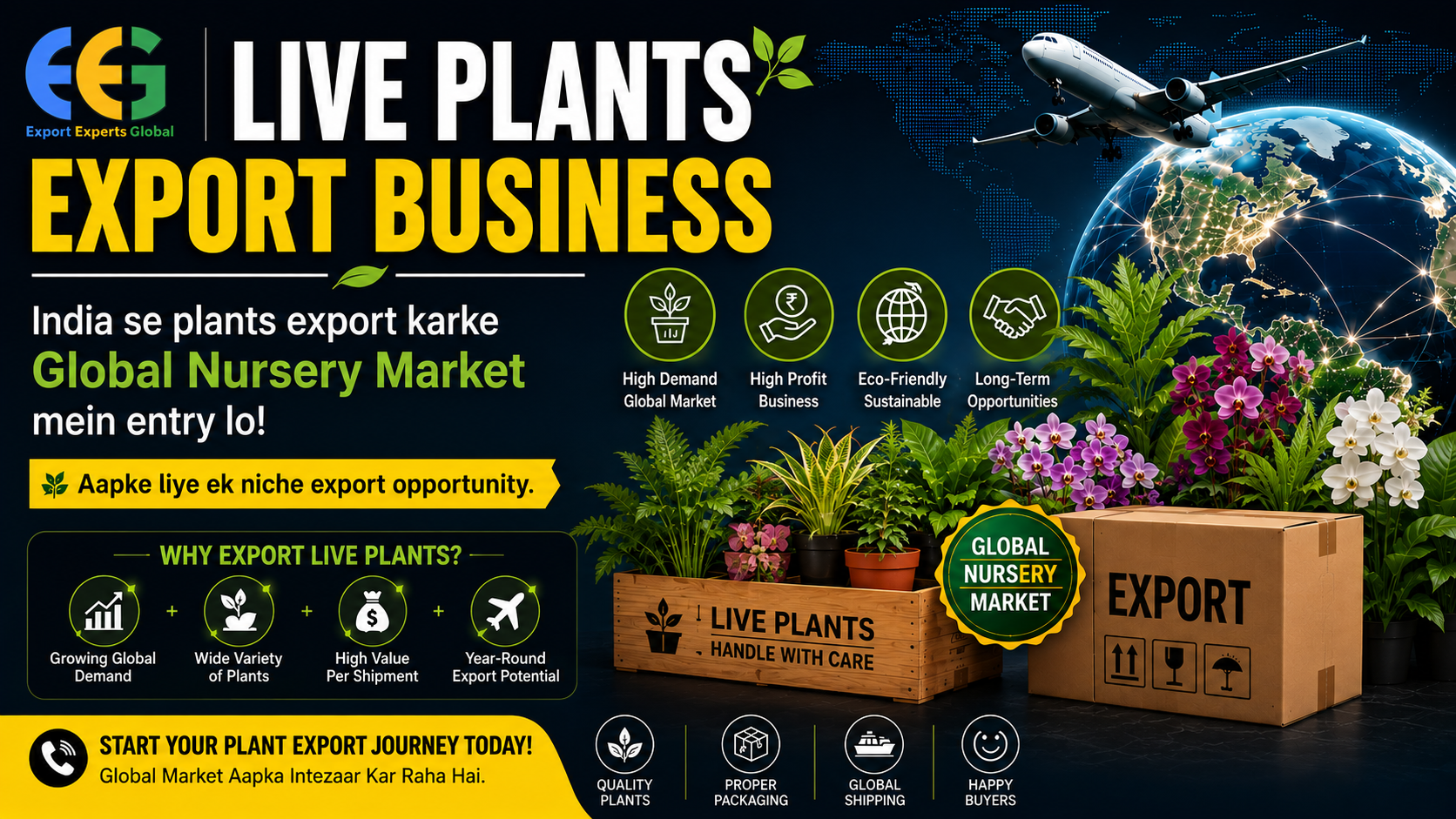
🌿 What Is the Live Plant Export Business?
Live plant export means supplying living plants, nursery plants, saplings, ornamental plants, landscaping plants, and other permitted plant materials from one country to buyers in another country.
Unlike dried flowers, seeds, or processed agricultural products, live plants require special attention because they are biological products. Their condition can change during transportation, and many countries have strict regulations to prevent the introduction of pests, diseases, invasive species, and other agricultural risks.
For an Indian exporter, the business can involve sourcing plants from domestic nurseries, preparing them according to the buyer’s requirements, completing export documentation, obtaining applicable phytosanitary certification, arranging international transportation, and ensuring that the shipment meets the destination country’s requirements.
🌱 The key lesson: In live plant exports, selling the product is only one part of the business. Compliance and logistics are equally important.
🪴 Which Plants Can Be Exported?
The product selection should be based on market demand, plant durability, export regulations, availability in India, and destination-country requirements.
Potential categories include:
🌿 Ornamental plants
🪴 Indoor foliage plants
🌵 Cactus and succulents
🌴 Palm varieties
🌳 Landscaping plants
🌸 Flowering nursery plants
🌱 Tropical foliage plants
🌿 Selected medicinal or aromatic plants
🌳 Nursery saplings
🌱 Selected fruit plants
However, an important point is that not every plant can be freely exported to every country.
Certain species may be restricted or prohibited by the importing country. Some plants may also fall under additional international conservation controls. Therefore, exporters should verify the exact requirements for the species + destination country before accepting an international order.
🌍 Why Consider Live Plant Export from India?
India has a large horticulture ecosystem with numerous nurseries, growers, landscapers, agricultural producers, and horticultural clusters.
This gives entrepreneurs the possibility of developing a sourcing network instead of establishing a large nursery from day one.
A beginner can potentially start with a merchant-exporter model:
🏡 Find reliable nursery suppliers
⬇️
🌱 Select exportable varieties
⬇️
🌍 Identify overseas buyers
⬇️
📑 Check import requirements
⬇️
📦 Prepare export shipment
⬇️
🚢 Deliver to the international buyer
This approach can reduce the initial investment compared with immediately establishing a large-scale cultivation facility.
💰 How Does the Business Make Money?
The profitability of live plant exports depends on several factors.
These include:
🌱 Plant variety
📏 Plant size
⭐ Quality and maturity
📦 Packaging cost
🚚 Domestic transportation
📑 Certification and compliance expenses
✈️ Air freight or 🚢 sea freight
💱 Currency exchange rate
🌍 Destination market
🤝 Buyer contract
📈 Purchase price versus export selling price
Premium or specialised plants can sometimes achieve significantly different pricing compared with ordinary nursery products.
However, exporters should never calculate profit simply by comparing the Indian nursery price with the overseas selling price.
A proper export costing should include:
Product Cost + Packaging + Inland Logistics + Documentation + Certification + Freight + Insurance, where applicable + Handling Charges + Bank/Payment Costs + Other Applicable Expenses = Total Export Cost
Only after calculating the complete landed or transaction cost should an exporter estimate the potential margin.
🏡 Where Can You Source Live Plants in India?
A successful exporter needs dependable suppliers.
Potential sourcing channels include:
🌱 Commercial nurseries
🌿 Ornamental plant growers
🏡 Wholesale plant markets
🌳 Horticulture farms
🌸 Flower and nursery producers
🤝 Contract growers
🌱 Specialised plant nurseries
Instead of depending on a single supplier, exporters should develop a supplier network.
Before working with a nursery, evaluate:
✅ Plant health
✅ Variety authenticity
✅ Availability
✅ Consistency of quality
✅ Production capacity
✅ Packaging capability
✅ Ability to meet large orders
✅ Harvest/dispatch scheduling
✅ Documentation support
A low-cost supplier is not necessarily a good export supplier.
For international business, consistency is often more valuable than the lowest purchase price.
🔎 How to Find International Plant Buyers?
Buyer development is one of the most important parts of the business.
Potential customers include:
🌿 Plant importers
🏡 Garden centres
🌳 Landscaping companies
🪴 Nursery chains
🌱 Wholesale plant distributors
🏢 Commercial horticulture companies
🏠 Home & garden retailers
🌍 Plant trading companies
An exporter can use several B2B approaches:
📧 Professional email outreach
💼 B2B marketplaces
🌐 Company websites
🔎 Google-based buyer research
📱 LinkedIn prospecting
🤝 Trade fairs
🌍 Horticulture exhibitions
🏢 Importer and distributor databases
Don’t simply send a message saying:
“We export plants. Do you need plants?”
Instead, create a professional product catalogue containing:
📸 Plant photographs
🌱 Botanical name
📏 Available sizes
📦 Packing details
📊 Minimum order quantity
🌍 Origin
🚢 Available shipping options
📑 Certification information
💰 Indicative pricing, where appropriate
This makes your business appear more professional to international buyers.
📑 Documentation and Compliance
This is where live plant exports become more technical.
An exporter may need to deal with:
📄 Import Export Code (IEC)
📄 Commercial Invoice
📄 Packing List
📄 Shipping Bill
📄 Transport documents
🌱 Phytosanitary Certificate
📑 Plant Quarantine requirements
📑 Destination-country import permit, where applicable
📑 Additional certificates depending on the plant and market
The exact documentation is not identical for every shipment.
It depends on:
Plant species + plant part + country of origin + destination country + intended use + importing country’s regulations.
Therefore, exporters should not copy the documentation list from another plant shipment without checking the current requirements for their own product and market.
🌱 What Is a Phytosanitary Certificate?
A Phytosanitary Certificate is an important document in international trade involving regulated plant products.
Its purpose is to certify that the consignment meets applicable plant-health requirements established by the importing country.
Why is this important?
Because countries want to protect their agriculture and ecosystems from:
🐛 Insects
🦠 Plant diseases
🍄 Fungal pathogens
🌱 Invasive organisms
🪱 Soil-borne pests
For this reason, plant shipments can face inspection and quarantine controls.
A beginner should therefore understand the phytosanitary process before taking a confirmed international order.
📦 Packaging of Live Plants for Export
Packaging can determine whether your plant reaches the buyer alive and healthy.
The objective is to balance:
🌬️ Ventilation
💧 Moisture management
🛡️ Physical protection
🌡️ Temperature requirements
📦 Space efficiency
🌱 Root protection
Depending on the product and destination requirements, packaging may involve specialised cartons, protective materials, root systems prepared according to import rules, and carefully secured plant structures.
One major mistake is treating live plants like ordinary cargo.
A plant that survives transportation successfully can strengthen buyer confidence. A shipment with excessive mortality can result in:
❌ Claims
❌ Replacements
❌ Refund disputes
❌ Negative reviews
❌ Loss of repeat business
Therefore, exporters should conduct small-scale trial shipments before committing to large commercial volumes whenever practical.
✈️ Air Freight vs Sea Freight
Transportation mode should be selected based on:
🌱 Plant type
⏱️ Transit time
🌡️ Temperature sensitivity
📦 Shipment volume
💰 Freight cost
🌍 Destination
📑 Import requirements
✈️ Air Freight
Advantages:
⚡ Faster transit
🌱 Potentially lower exposure to prolonged transportation conditions
📦 Suitable for certain smaller or time-sensitive consignments
Disadvantage:
💰 Freight can be expensive.
🚢 Sea Freight
Advantages:
📦 Suitable for larger commercial shipments
💰 Potentially more economical per unit at scale
Challenges:
⏳ Longer transit
🌡️ Environmental conditions
📦 More complex logistics for sensitive plants
The correct choice depends on the specific product and destination rather than simply choosing the cheapest freight option.
🌍 Which Markets Can Be Explored?
Potential international markets may include:
🇦🇪 UAE
🇸🇦 Saudi Arabia
🇶🇦 Qatar
🇴🇲 Oman
🇸🇬 Singapore
🇬🇧 United Kingdom
🇳🇱 Netherlands
🇩🇪 Germany
🌍 Other markets with established horticulture and landscaping industries
But market selection should come after regulatory research.
A country may have strong demand for plants but still be difficult for a particular species because of quarantine restrictions.
Therefore, use this approach:
Demand → Regulations → Competition → Logistics → Buyer Research → Final Market Selection
Not:
Demand → Shipment
💼 Three Business Models for Beginners
1️⃣ Merchant Exporter Model
Source plants from Indian nurseries and sell them internationally.
Best for: Beginners with limited cultivation infrastructure.
2️⃣ Contract Nursery Model
You receive buyer specifications and work with partner nurseries to grow or prepare the required plants.
Best for: Exporters targeting repeat B2B orders.
3️⃣ Own Nursery + Export Model
Grow your own plants and export them directly.
Best for: Entrepreneurs planning long-term control over quality and supply.
This model requires more capital, land, horticultural expertise, and operational management.
⚠️ Major Risks in Live Plant Export
Before entering the business, understand the risks.
🌱 Plant Mortality
Some plants may not survive transportation.
🐛 Pest or Disease Issues
A shipment can face serious problems if it does not meet plant-health requirements.
📑 Regulatory Changes
Import regulations can vary by country and may change over time.
🚢 Logistics Delays
Longer transit can affect sensitive plants.
💰 Freight Cost
International freight can significantly affect profitability.
📦 Packaging Failure
Poor packaging can cause physical damage.
🌍 Import Restrictions
Certain species may be prohibited or subject to additional conditions.
💱 Payment Risk
International B2B transactions require proper buyer verification and payment-risk management.
🚀 How Can a Beginner Start?
Here’s a practical roadmap:
STEP 1️⃣
Choose one plant category.
STEP 2️⃣
Select one target country.
STEP 3️⃣
Check the destination country’s import requirements.
STEP 4️⃣
Identify 3–5 reliable Indian nursery suppliers.
STEP 5️⃣
Create an export-ready product catalogue.
STEP 6️⃣
Calculate complete export costing.
STEP 7️⃣
Research and verify potential international buyers.
STEP 8️⃣
Send samples or conduct a small trial shipment where appropriate.
STEP 9️⃣
Evaluate survival rate, documentation and logistics.
STEP 🔟
Scale only after establishing a repeatable process.
🎯 The Biggest Business Opportunity
The biggest opportunity may not simply be selling plants.
It can be creating a complete B2B plant supply chain.
Imagine:
🌱 Indian Nursery Network
+
📦 Export Packaging
+
📑 Compliance Support
+
🚢 Logistics
+
🌍 Overseas Buyer Network
= Scalable Live Plant Export Business
An exporter who controls the complete process can potentially create stronger relationships with international buyers than someone who only acts as a product trader.
Overall Analysis
The live plant export business from India offers an interesting opportunity for entrepreneurs who want to explore a specialised agricultural export segment.
With India’s large nursery ecosystem and growing global interest in landscaping, ornamental plants, and horticulture, there is potential to develop a specialised B2B export operation.
But remember:
Product + Buyer + Compliance + Packaging + Logistics + Payment Security = Export Business
Don’t just become a plant seller.
🌱 Build an international plant supply business.