🪵 What Is Particle Board?
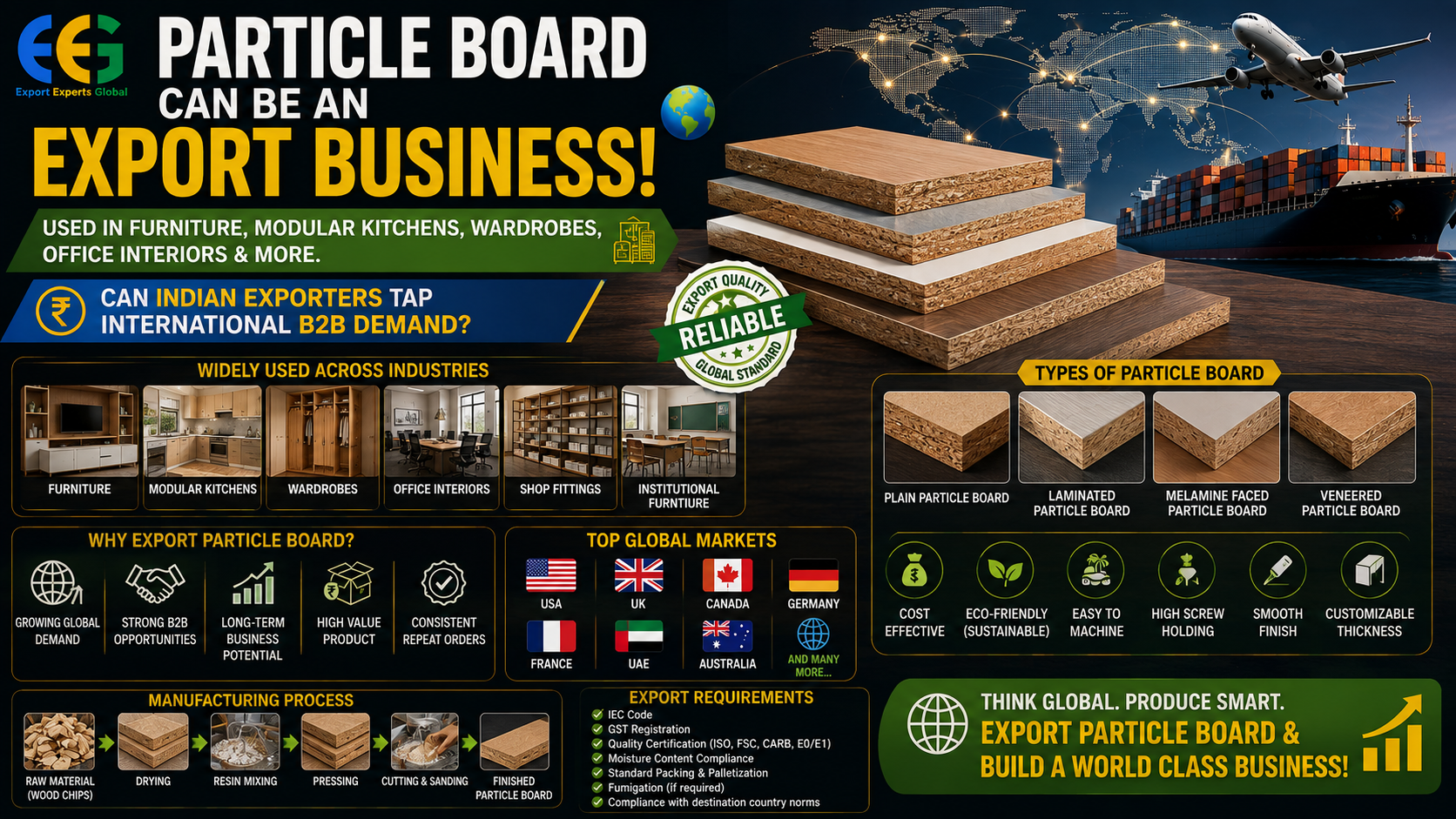
Particle board is an engineered wood panel manufactured by compressing wood particles such as chips, flakes, sawdust, and other wood residues with adhesives or resins under controlled heat and pressure.
Unlike solid timber, particle board is manufactured according to specific dimensions and technical specifications. This makes it useful for industries that require standardized panels.
Particle board can be available in different:
📏 Thicknesses
📐 Dimensions
🎨 Surface finishes
💧 Moisture-resistance levels
🔥 Fire-performance specifications
🪑 Furniture grades
✨ Decorative designs
Some products are supplied as raw boards, while others are pre-laminated or melamine-faced particle boards.
🌍 Why Consider Particle Board Export?
The furniture and interior-products ecosystem creates demand for engineered wood panels across many markets.
Furniture manufacturers require boards for producing:
🪑 Tables
🚪 Cabinets
🛏️ Bedroom furniture
🏠 Modular kitchens
📚 Bookshelves
🗄️ Storage units
🏢 Office furniture
🧱 Interior partitions
For an exporter, this creates an opportunity to sell directly to manufacturers, distributors, importers, and project suppliers rather than depending entirely on domestic retail customers.
The key is to understand that particle board is generally a B2B and volume-oriented export product. Success depends on competitive pricing, consistent quality, efficient logistics, and repeat customers.
📦 Types of Particle Board You Can Export
One of the first steps in developing a particle board export business is selecting the right product category.
1️⃣ Plain Particle Board
This is the basic engineered wood panel without a decorative surface.
It can be supplied to furniture manufacturers and other processors who want to laminate, veneer, or otherwise finish the board themselves.
2️⃣ Pre-Laminated Particle Board
These boards have a decorative surface applied during manufacturing.
They can be attractive to furniture manufacturers because they reduce additional processing requirements.
3️⃣ Melamine-Faced Particle Board
MFC products are widely used for furniture and interior applications where a decorative and relatively durable surface is required.
🎨 Different colors, textures, patterns, and wood-grain appearances can be offered depending on the manufacturer’s product range.
4️⃣ Moisture-Resistant Particle Board
For applications where humidity or moisture exposure is a concern, buyers may request boards with specific moisture-resistance characteristics.
⚠️ Exporters should never make technical claims without appropriate manufacturer documentation or testing.
5️⃣ Decorative Particle Board
Decorative finishes can create additional opportunities in furniture and interior applications.
6️⃣ Customized Boards
Some overseas buyers may require:
📏 Specific dimensions
📐 Specific thickness
🎨 Particular finishes
🏷️ Private labeling
📦 Customized packaging
Customization can help an exporter move beyond pure price competition.
🎯 Who Buys Particle Board Internationally?
A common mistake made by new exporters is searching only for “particle board importers.”
Instead, identify industries that consume the product.
Potential buyers include:
🪑 Furniture manufacturers
🏠 Modular kitchen manufacturers
🚪 Door manufacturers
🏢 Office furniture companies
🏗️ Interior contractors
📦 Building-material distributors
🏭 Wood-product manufacturers
🛒 Furniture wholesalers
🏠 Home-improvement suppliers
🌍 Importers and distributors
A furniture manufacturer may become a better long-term customer than a general trading company because it can generate recurring demand.
🌎 Potential Export Markets for Indian Particle Board
Indian exporters can research markets where furniture manufacturing, construction, interior development, and building-material distribution create demand for engineered wood.
Potential markets to investigate include:
🇦🇪 UAE
🇸🇦 Saudi Arabia
🇴🇲 Oman
🇶🇦 Qatar
🇰🇼 Kuwait
🇰🇪 Kenya
🇹🇿 Tanzania
🇱🇰 Sri Lanka
🇳🇵 Nepal
🇧🇩 Bangladesh
🇲🇻 Maldives
However, a potential market is not automatically a profitable market.
Before approaching buyers, check:
📊 Import demand
💰 Local selling prices
🚢 Freight cost
🧾 Import duties
📋 Technical regulations
🏷️ Product standards
💳 Payment practices
🏭 Local competition
🇮🇳 Where Can You Source Particle Board in India?
A merchant exporter does not necessarily need to establish a manufacturing facility.
Instead, you can develop relationships with established Indian manufacturers.
Your sourcing process should include:
🔎 Manufacturer identification
📞 Supplier communication
🏭 Factory verification
📋 Product specification collection
🧪 Quality verification
💰 Price negotiation
📦 Packaging assessment
🚚 Production capacity verification
Don’t select a supplier solely because they offer the lowest quotation.
A supplier offering a slightly higher price but maintaining consistent quality and delivery can ultimately be more profitable.
💰 How Does the Particle Board Export Business Make Money?
The basic model is:
Indian Manufacturer → Exporter → Overseas Buyer
Suppose a manufacturer provides a quotation for a particular specification.
The exporter must calculate the complete export cost rather than simply adding a random profit percentage.
Your calculation may include:
🪵 Product cost
📦 Packaging
🚚 Factory transportation
🏗️ Loading charges
🧾 Documentation
🚢 Port charges
⚓ Freight
🛡️ Insurance, where applicable
💱 Currency considerations
💰 Financing cost
📈 Exporter’s margin
Your final quotation could then be structured according to the agreed Incoterm, such as EXW, FCA, FOB, CFR, or CIF, depending on the transaction.
📊 Why Container Optimization Matters
Particle board is a relatively bulky product.
Therefore, container utilization can have a significant impact on landed cost.
Imagine two exporters buying the same product at a similar factory price.
Exporter A loads the container inefficiently.
Exporter B optimizes:
📦 Number of sheets
📏 Dimensions
⚖️ Weight
🪵 Packing method
🚢 Container capacity
Exporter B may achieve a better freight cost per unit.
This is why export pricing is not simply:
Buying Price + Profit = Selling Price
A professional exporter considers the entire logistics chain.
🔍 How to Find Particle Board Buyers?
International buyer identification is one of the most important parts of the business.
You can research potential customers through:
🌐 B2B platforms
🔎 Google searches
💼 LinkedIn
📊 Import databases
🏢 Trade directories
🤝 Trade fairs
🏭 Furniture associations
📧 Direct email outreach
📱 Professional business networks
Instead of sending the same generic message to hundreds of companies, develop a buyer profile.
For example:
“Furniture manufacturers importing 18mm melamine-faced particle board in the UAE.”
This gives your sales process a specific direction.
📧 What Should You Send to an Overseas Buyer?
A professional buyer introduction should contain useful information.
Include:
🪵 Product name
📏 Available sizes
📐 Thickness options
🎨 Surface finishes
📋 Technical specifications
📦 MOQ
🏭 Production capacity
🚢 Port of loading
💰 Price basis
📸 Product photographs
📄 Certifications/test reports, where applicable
📞 Contact information
Avoid sending only:
“We are particle board exporters. Please give us your requirement.”
A buyer needs enough information to determine whether your product fits their procurement requirements.
📑 Documents Required for Particle Board Export
Export documentation depends on the product, transaction, destination country, and applicable regulations.
Common export documents may include:
📄 Commercial Invoice
📦 Packing List
🚢 Shipping Bill
⚓ Bill of Lading
🌍 Certificate of Origin
🧾 Tax/export documentation
📋 Product specifications
🧪 Test certificates, where required
🛡️ Insurance documentation, where applicable
The exporter should also correctly determine the applicable HS classification.
⚠️ Do not select an HS code merely because another exporter is using it. Confirm classification based on the actual product characteristics and applicable customs requirements.
🏷️ Quality Is Critical
International buyers can reject shipments when the product does not match the agreed specification.
Important parameters may include:
📏 Thickness
📐 Length and width
⚖️ Density
💧 Moisture characteristics
🪵 Board composition
✨ Surface finish
📦 Packaging
🔩 Screw-holding performance, where relevant
🧪 Formaldehyde/emission requirements where applicable
The exact specifications depend on the application and destination market.
Before accepting a large order, establish a written product specification with the buyer.
⚠️ Major Challenges in Particle Board Export
Every export business has risks.
🚢 1. Freight Cost
Because particle board occupies considerable volume, shipping costs can influence the final landed price.
💧 2. Moisture Damage
Poor packaging or unsuitable storage conditions can create problems during transportation.
📦 3. Edge Damage
Panels must be packed and handled carefully to minimize chipping and damage.
🪵 4. Quality Variation
Different production batches should maintain the agreed specifications.
💳 5. Payment Risk
A profitable order can become a loss if the buyer fails to pay.
🌍 6. Market Competition
You may compete with suppliers from several manufacturing countries.
📋 7. Regulatory Compliance
Some destinations can impose specific standards, labeling, environmental, or emissions requirements.
🛡️ How to Reduce Export Risk
A new exporter should avoid jumping directly into a large shipment.
Follow a controlled process:
Buyer Verification → Sample → Specification Approval → Quotation → Payment Terms → Production → Inspection → Shipment
For new customers, carefully evaluate:
🏢 Company registration
🌐 Website and business presence
📞 Contact details
📊 Import history where available
🏦 Payment capability
📋 Purchase requirements
Never treat an attractive purchase order as proof that a buyer is genuine.
🚀 Step-by-Step Particle Board Export Business Plan
STEP 1 — Select Your Product
Choose one focused category rather than trying to sell every type of board.
STEP 2 — Identify Manufacturers
Shortlist multiple suppliers and compare technical specifications.
STEP 3 — Collect Samples
Physically inspect the board before quoting to overseas customers.
STEP 4 — Calculate Export Pricing
Calculate the complete cost under the selected Incoterm.
STEP 5 — Select Target Countries
Research countries based on demand, competition, regulations, and freight economics.
STEP 6 — Build a Buyer Database
Create a structured list of importers, furniture manufacturers, distributors, and contractors.
STEP 7 — Start Buyer Outreach
Use professional email, LinkedIn, B2B platforms, trade fairs, and direct communication.
STEP 8 — Send Samples
Where commercially practical, provide samples or technical documentation.
STEP 9 — Negotiate
Discuss:
💰 Price
📦 MOQ
📏 Specifications
🚢 Incoterm
💳 Payment terms
⏱️ Lead time
📋 Documentation
STEP 10 — Execute the Shipment
Coordinate production, quality checks, documentation, freight forwarding, customs clearance, and shipping.
STEP 11 — Focus on Repeat Orders
The strongest export businesses are built around repeat B2B customers, not one-time transactions.
💡 Merchant Exporter vs Manufacturer
You don’t necessarily need a particle board factory to enter the export business.
🏭 Manufacturer Exporter
You manufacture the product and sell internationally.
Advantages:
✅ Greater production control
✅ Potentially better manufacturing economics
✅ Ability to customize
Challenges:
❌ Higher capital requirement
❌ Factory management
❌ Production risks
🌍 Merchant Exporter
You source from manufacturers and sell to international customers.
Advantages:
✅ Lower initial infrastructure requirement
✅ Can work with multiple manufacturers
✅ Easier to test international markets
Challenges:
❌ Supplier dependency
❌ Lower control over production
❌ Need strong sourcing and quality management
For many beginners, starting with a merchant-export model can be a practical way to understand international trade before investing in manufacturing.
📈 How to Build a Long-Term Particle Board Export Brand
Don’t compete only on price.
Build your export proposition around:
🎯 Consistent quality
📦 Professional packaging
🚢 Reliable shipment planning
📋 Accurate documentation
💬 Fast communication
🏭 Verified manufacturing
📏 Consistent specifications
🤝 Long-term relationships
You can eventually develop:
🏷️ Private-label products
📦 Customized packaging
🎨 Exclusive finishes
🌍 Country-specific product ranges
🤝 Distributor partnerships
This can transform a basic trading operation into a recognizable international B2B brand.
Overall Analysis
The Particle Board Export Business can be an attractive opportunity for entrepreneurs who understand that international trade is much more than buying a product and finding a foreign customer.
Your success depends on the complete system:
PRODUCT + SUPPLIER + BUYER + QUALITY + PRICING + LOGISTICS + DOCUMENTATION + PAYMENT SECURITY
🪵 Don’t start by asking:
“How much profit can I make?”
Start by asking:
“Which buyer needs this product, what exact specification do they require, and can I supply it consistently at a competitive landed cost?”
That shift in thinking is what separates a casual trader from a professional exporter.
🌍 India has a diverse manufacturing ecosystem, and engineered wood products can be explored as part of a broader B2B export portfolio. But before investing money, conduct product-specific market research, verify current regulations, confirm the HS classification, and calculate your complete landed economics.
🚀 Research → Source → Sample → Find Buyers → Quote → Negotiate → Ship → Repeat
That is the practical foundation of building a sustainable Particle Board Export Business from India.