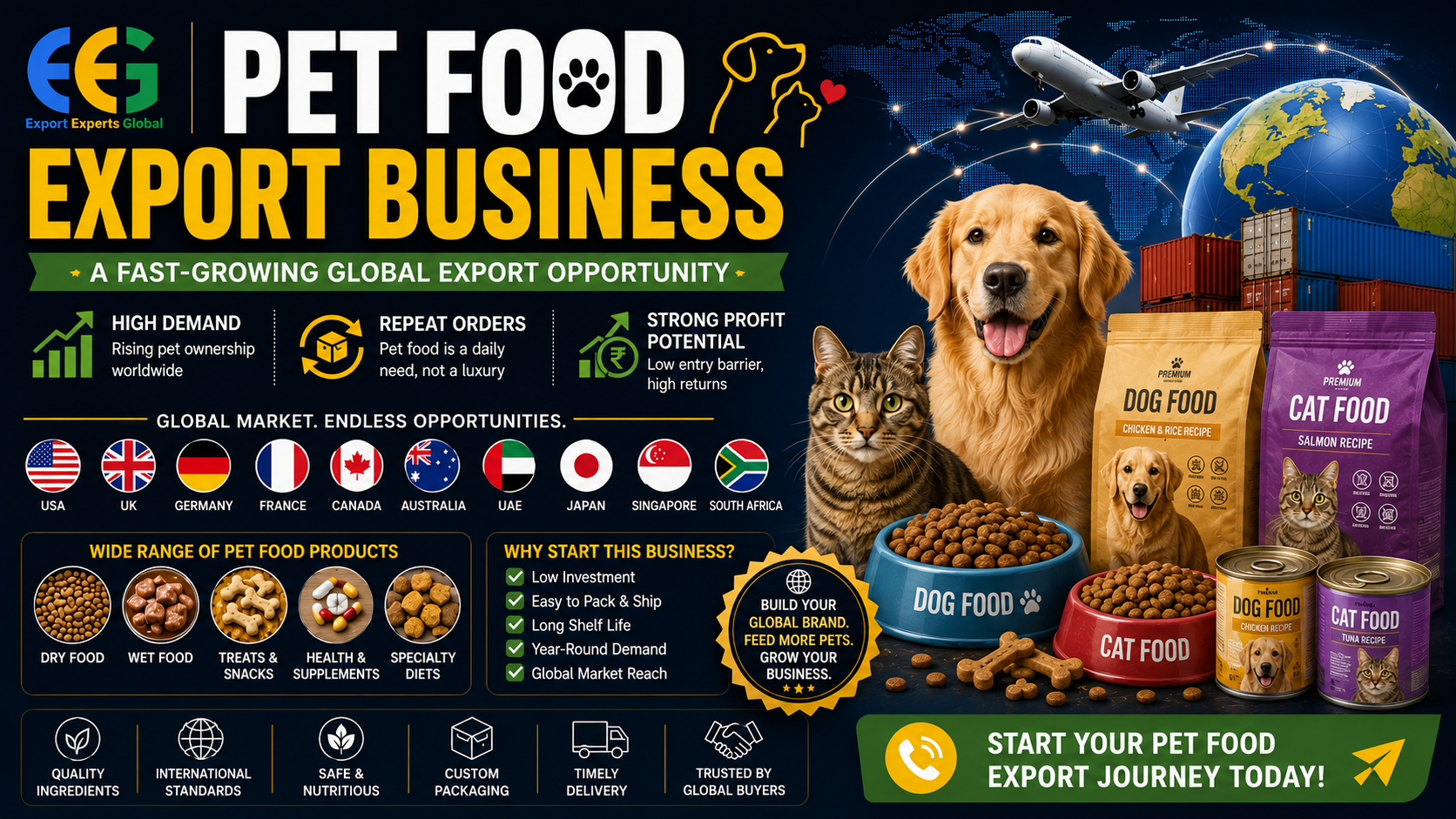
🐶 What Is Pet Food Export Business?
Pet food export refers to the international sale and shipment of food and nutritional products intended for domestic animals such as dogs and cats.
Depending on the manufacturing capabilities and target market, an exporter can deal in:
🦴 Dog treats
🐕 Dry dog food
🐕🦺 Puppy food
🐱 Cat food
🐈 Kitten food
🍖 Meat-based treats
🐟 Fish-based pet products
🥩 Freeze-dried treats
🍪 Pet biscuits
🌾 Grain-free formulations
🥕 Natural and functional pet foods
💊 Nutritional pet supplements, where permitted
The exact product classification, HS code, import requirements, and regulatory treatment can vary according to the product composition and destination country.
This means product research should come before investment.
📈 Why Consider Pet Food Export?
The biggest attraction of the pet food business is the combination of recurring demand and product diversification.
Pet owners increasingly consider their animals part of the household. This has encouraged demand for products positioned around nutrition, convenience, natural ingredients, specialized diets, and premium treats. 🌱🐾
For exporters, this creates multiple market segments.
💎 Premium Pet Food
Premium products can focus on:
✔ High-quality ingredients
✔ Specialized formulations
✔ Natural positioning
✔ Functional nutrition
✔ Attractive packaging
✔ Premium treats
💰 Mass-Market Pet Food
Another segment focuses on affordability, volume, and distribution.
The business model you select should depend on:
📊 Target market
💵 Buyer purchasing power
🏭 Manufacturing cost
🚢 Logistics expenses
📦 Packaging requirements
📋 Regulatory compliance
🤝 Buyer category
A smart exporter doesn’t simply ask, “Which country imports pet food?”
Instead, ask:
“Which buyer in which market needs my specific product at a price that allows both of us to make money?”
🇮🇳 India’s Opportunity in Pet Food Exports
India has a broad manufacturing ecosystem, agricultural resources, food-processing capabilities, packaging suppliers, and contract manufacturers. This provides opportunities for entrepreneurs who want to develop or source pet food for overseas markets.
An exporter doesn’t necessarily need to establish a large manufacturing plant.
There are several possible models.
🏭 Model 1: Manufacturer Exporter
You manufacture the pet food yourself and export it under your own brand.
🤝 Model 2: Merchant Exporter
You purchase compliant products from an Indian manufacturer and sell them to an overseas buyer.
🏷️ Model 3: Private Label Exporter
An overseas buyer provides branding or product requirements while an Indian manufacturer produces the goods.
🌎 Model 4: Contract Manufacturing
You develop the commercial relationship while an experienced manufacturer handles production according to agreed specifications.
For beginners, working with an experienced and compliant manufacturer can reduce the initial infrastructure burden.
🦴 Which Pet Food Products Can Be Exported?
Product selection is one of the most important decisions.
A beginner should avoid launching dozens of SKUs simultaneously. Start with a focused range and test buyer demand.
Popular categories include:
🐕 Dog Kibble
Dry formulated food designed for different dog sizes and life stages.
🐱 Cat Food
Dry or wet formulations designed for cats.
🦴 Dog Treats
Biscuits, training treats, dental-style treats, and chew products.
🐟 Fish-Based Treats
Products using permitted fish or seafood ingredients.
🥩 Meat-Based Treats
Products formulated with animal proteins according to destination-market requirements.
🌱 Natural Pet Food
Products marketed around recognizable ingredients and specific nutritional positioning.
🍪 Pet Biscuits
A potentially accessible category for manufacturers with suitable production capabilities.
The right product depends on destination-country regulations and buyer requirements, not merely on domestic popularity.
🌍 Which Countries Can Be Target Markets?
Potential markets may include:
🇺🇸 United States
🇬🇧 United Kingdom
🇩🇪 Germany
🇫🇷 France
🇨🇦 Canada
🇦🇪 United Arab Emirates
🇸🇦 Saudi Arabia
🇯🇵 Japan
🇦🇺 Australia
🇳🇱 Netherlands
But don’t select a country simply because it appears to have a large pet market.
Analyze:
🔎 Import demand
🔎 Competition
🔎 Local brands
🔎 Distributor network
🔎 Product regulations
🔎 Import duties
🔎 Freight costs
🔎 Required certifications
🔎 Retail pricing
🔎 Buyer preferences
A smaller market with limited competition can sometimes be more attractive to a new exporter than a massive market dominated by established multinational brands.
🔍 How to Find International Pet Food Buyers?
Buyer sourcing is the heart of export business.
Potential buyers can include:
🏪 Pet stores
🏢 Importers
📦 Distributors
🛒 Supermarket chains
🌐 E-commerce companies
🏷️ Private-label brands
🐾 Pet product wholesalers
🏥 Veterinary distribution businesses
You can research buyers through:
🌐 B2B marketplaces
🔎 Google searches
💼 LinkedIn
📊 Import databases
🏢 Trade directories
📰 Industry exhibitions
🤝 Trade fairs
📧 Direct email outreach
For example, instead of searching only for “pet food buyer USA,” build targeted searches such as:
“pet food distributor USA”
“private label dog food importer Germany”
“pet treats wholesaler UAE”
“cat food distributor UK”
The more specific the search, the better your prospecting list can become.
📧 How to Approach a Foreign Buyer?
A professional export enquiry should be short, specific, and commercially useful.
Provide:
📌 Company introduction
📌 Product catalogue
📌 Product specifications
📌 Ingredients
📌 Packaging options
📌 MOQ
📌 Certifications
📌 Production capacity
📌 Target pricing
📌 Private-label capability
📌 Shipment terms
Avoid sending a generic message such as:
“We are exporters from India. Please give us your order.”
Instead, demonstrate that you understand the buyer’s product category and market.
A buyer should quickly understand:
What are you selling?
Why should they consider it?
Can you meet their specifications?
Can you supply consistently?
What documentation can you provide?
📋 Documents and Compliance
Pet food can be a regulated category, so compliance requires special attention.
Depending on the product and destination, an exporter may need documentation such as:
📄 Commercial Invoice
📦 Packing List
🚢 Bill of Lading / Air Waybill
🧾 Certificate of Origin
📑 Product specifications
🏭 Manufacturing documents
🧪 Laboratory test reports
🐾 Veterinary or sanitary certificates where applicable
📋 Import permits or destination-specific approvals where applicable
Indian exporters should also examine the requirements of the relevant Indian authorities and the importing country’s competent authority.
⚠️ Important
Don’t assume that a certificate required for one country will automatically satisfy another country’s requirements.
Destination-specific compliance is essential.
🧪 Product Quality Is Critical
In pet food exports, quality consistency is more important than simply offering a cheap price.
Buyers may evaluate:
✔ Ingredient quality
✔ Nutritional composition
✔ Moisture
✔ Microbiological parameters
✔ Shelf life
✔ Packaging integrity
✔ Product appearance
✔ Batch consistency
✔ Manufacturing controls
✔ Laboratory testing
The exporter should maintain appropriate quality-control procedures and documentation.
If a buyer receives inconsistent products from different batches, the possibility of repeat business can decline dramatically.
📦 Packaging for International Markets
Packaging is not merely about making the product look attractive.
It protects the product during:
🏭 Manufacturing
🚚 Inland transportation
🚢 Ocean freight
📦 Warehousing
🛒 Retail handling
Depending on the product, packaging options may include:
🛍️ Stand-up pouches
📦 Printed bags
🥫 Cans
🧴 Containers
📦 Bulk cartons
International packaging should clearly communicate relevant information required by the destination market.
This may include:
✔ Product name
✔ Net weight
✔ Ingredients
✔ Feeding instructions
✔ Batch information
✔ Manufacturing/expiry information
✔ Storage conditions
✔ Manufacturer details
✔ Importer information
✔ Required warnings
Label requirements vary by country, so always verify the destination-market rules before printing large quantities.
💰 How Does the Pet Food Export Business Make Money?
Profitability depends on the complete export cost structure.
Your calculation should include:
Product Cost + Packaging + Testing + Documentation + Inland Transport + Port Charges + Freight + Insurance + Bank Charges + Other Costs = Export Cost
Then determine your selling price.
For example:
Suppose:
🏭 Product + packaging = ₹100/kg
🚚 Other pre-shipment costs = ₹15/kg
🚢 Logistics and freight allocation = ₹20/kg
📑 Documentation and miscellaneous costs = ₹5/kg
Your approximate cost becomes:
₹140/kg
If your commercial selling price is ₹175/kg, the gross contribution before applicable overheads and other business expenses would be:
₹35/kg
This is only an illustration—not a guaranteed export margin.
Actual profitability depends heavily on product formulation, order quantity, destination, freight rates, payment terms, duties, currency movements, and buyer pricing.
📊 Why Repeat Orders Matter
Pet food can have an important business advantage: consumption creates recurring demand.
A distributor may initially purchase a trial shipment.
If the product performs well and sells successfully, the buyer may reorder.
The export cycle can become:
Sample → Trial Order → Commercial Order → Repeat Order → Distributor Relationship → Larger Volume
This is why an exporter should focus on customer retention, not merely acquiring new leads.
Good communication, predictable quality, accurate documentation, and reliable delivery can become major competitive advantages.
🏷️ Private Label Pet Food Export
Private-label manufacturing can be an interesting opportunity.
Here, the overseas buyer sells the product under its own brand while an Indian manufacturer produces it according to agreed specifications.
For example:
🇮🇳 Indian Manufacturer
⬇️
🏭 Production
⬇️
🏷️ Buyer’s Brand
⬇️
🌍 Overseas Distributor/Retailer
The buyer may specify:
✔ Formula
✔ Ingredients
✔ Packaging
✔ Brand design
✔ Product size
✔ Quality standards
✔ Target price
Private-label exports can potentially generate larger commercial relationships, but they require strong manufacturing capability and strict compliance with buyer specifications.
⚠️ Major Challenges in Pet Food Export
Every export opportunity comes with risks.
1️⃣ Regulatory Restrictions
Animal-origin ingredients can be subject to specific import controls.
2️⃣ Product Rejection
Non-compliant labels, ingredients, documents, or testing results can cause shipment problems.
3️⃣ Freight Costs
International logistics can significantly affect profitability, especially for lower-value products.
4️⃣ Buyer Payment Risk
Never treat every overseas enquiry as a genuine buyer.
Conduct proper due diligence.
5️⃣ Quality Complaints
A product that doesn’t match approved samples can damage long-term relationships.
6️⃣ Currency Risk
Exchange-rate fluctuations can affect your final realization.
7️⃣ Competition
International pet food markets include established global brands and local manufacturers.
Therefore, competing solely on price can be difficult.
🛡️ How to Reduce Export Risk?
A professional exporter should build a risk-control system.
Before accepting an order:
🔎 Verify buyer identity
🏢 Check company registration
🌐 Study the buyer’s website
📧 Verify business email
📊 Review purchasing history where available
📑 Confirm product requirements
💰 Negotiate secure payment terms
📦 Approve final packaging
🧪 Confirm testing requirements
For new buyers, avoid taking unnecessary financial exposure.
The commercial contract should clearly establish:
✔ Product specifications
✔ Quantity
✔ Price
✔ Incoterm
✔ Payment method
✔ Delivery timeline
✔ Inspection terms
✔ Packaging requirements
✔ Claim procedure
🚢 Understanding Incoterms
International buyers may ask for:
EXW
FCA
FOB
CFR
CIF
or other applicable Incoterms.
A beginner exporter should understand exactly where the seller’s cost and risk responsibilities end and where the buyer’s responsibilities begin.
Never quote a price like “USD 2/kg” without clarifying the commercial basis.
A proper quotation could specify:
USD X/kg FOB Indian Port
or
USD X/kg CIF Destination Port
depending on the agreed trade terms.
📦 Start With a Small Export Strategy
One common mistake beginners make is trying to enter ten countries with twenty products.
Instead:
Step 1
Choose 1–3 products.
Step 2
Select one target market.
Step 3
Research its regulations.
Step 4
Identify 50–100 potential buyers.
Step 5
Contact qualified buyers.
Step 6
Send samples where commercially appropriate.
Step 7
Collect buyer feedback.
Step 8
Finalize specifications and pricing.
Step 9
Negotiate payment and delivery terms.
Step 10
Execute the first shipment carefully.
This approach allows you to learn the export process while controlling unnecessary risk.
🧠 Mentor’s Strategy: Don’t Sell a Product—Sell a Solution
By Harsh Dhawan 🎓
If you’re entering the pet food export industry, don’t think only like a trader.
Think like an international supplier.
A foreign buyer doesn’t simply need “pet food.”
They may need:
📦 Reliable monthly supply
💰 Competitive landed cost
🏷️ Private-label production
🧪 Consistent quality
📋 Complete documentation
🚢 On-time shipment
🤝 Long-term cooperation
Your objective should be to become a reliable supply partner.
That’s where sustainable export business is created.
🚀 Step-by-Step Pet Food Export Roadmap
🟢 Stage 1: Market Research
Identify countries, product categories, competitors, prices, and import regulations.
🟢 Stage 2: Product Selection
Select products based on demand, compliance, manufacturing capability, and profitability.
🟢 Stage 3: Supplier Identification
Find reliable manufacturers or develop your own production capability.
🟢 Stage 4: Compliance
Check applicable Indian and destination-country regulations.
🟢 Stage 5: Export Setup
Arrange the required business registrations, banking, documentation, logistics, and registrations.
🟢 Stage 6: Buyer Search
Create a database of genuine international importers and distributors.
🟢 Stage 7: Buyer Communication
Send professional product information and commercial quotations.
🟢 Stage 8: Sampling
Provide samples according to buyer requirements.
🟢 Stage 9: Negotiation
Finalize:
💵 Price
📦 Quantity
🚢 Incoterm
💳 Payment terms
📅 Delivery schedule
🟢 Stage 10: Shipment
Complete documentation, freight arrangements, customs procedures, and dispatch.
🟢 Stage 11: Follow-Up
After delivery, ask for feedback and work toward the next order.
💡 Is Pet Food Export Suitable for Beginners?
Yes, it can be, particularly through a merchant-export or private-label model—but beginners should not underestimate compliance.
The easiest entry point isn’t necessarily the product with the highest theoretical margin.
A better product is one where you can achieve:
✅ Reliable manufacturing
✅ Stable quality
✅ Regulatory compliance
✅ Competitive pricing
✅ Manageable logistics
✅ Consistent supply
✅ Genuine buyer demand
Export success is created when all seven factors work together.
Overall Analysis
The Pet Food Export Business presents an interesting opportunity for Indian entrepreneurs looking to participate in the international pet-care market. From dog food and cat food to treats, biscuits, and specialized products, the sector offers multiple product possibilities.
But remember:
Export is not simply buying cheap and selling expensive.
It is a combination of:
🌍 Market Research
🏭 Manufacturing
🧪 Quality Control
📋 Compliance
📦 Packaging
💰 Costing
🚢 Logistics
🤝 Buyer Management
💳 Payment Risk Management
📈 Long-Term Business Strategy
If you can identify the right market, source a compliant product, calculate the complete export cost, locate genuine buyers, and maintain consistent quality, pet food can become a scalable international business category.