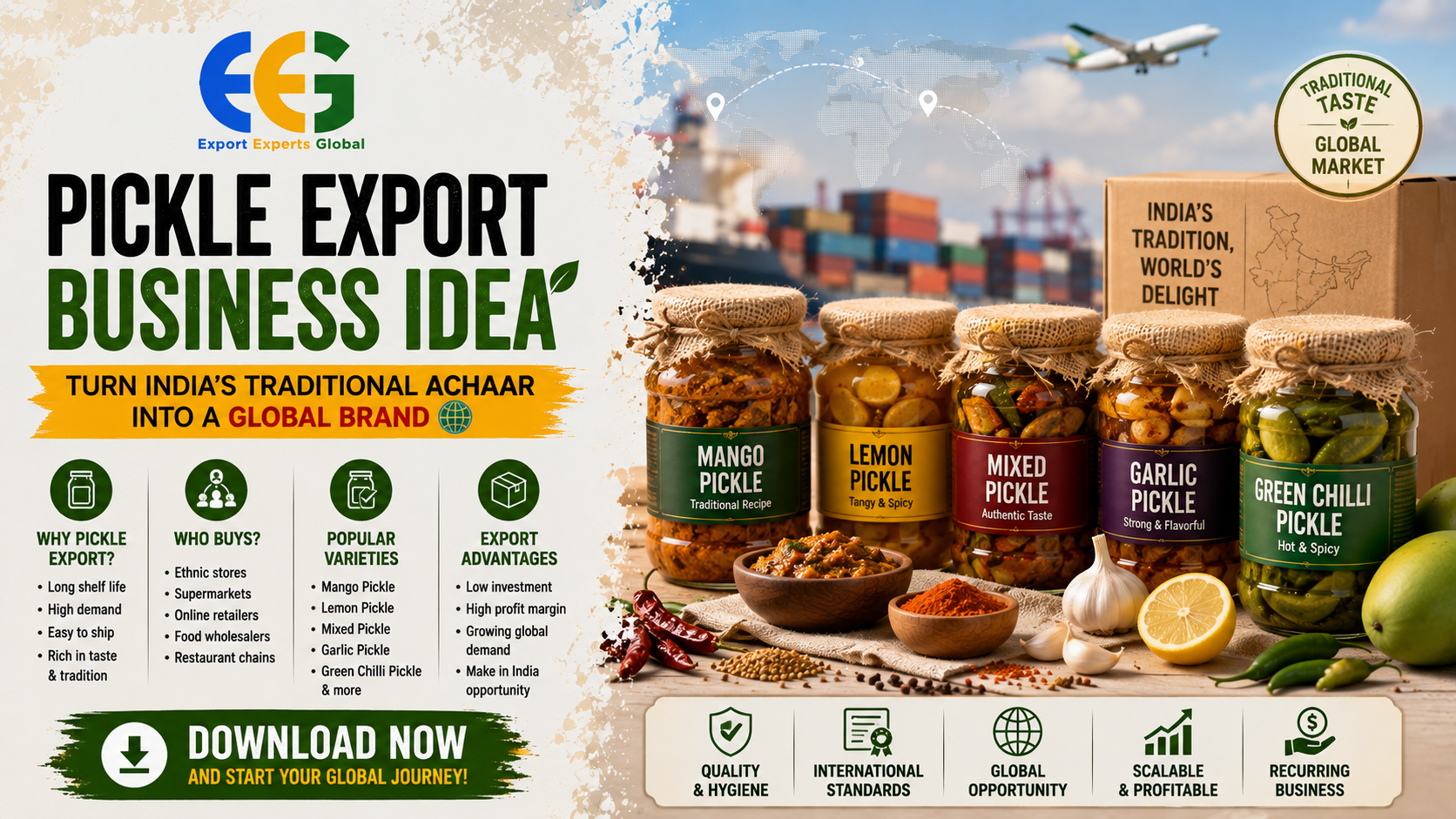
🌍 Why Consider Pickle Export from India?
India has several natural advantages in the pickle business. The country has access to a wide range of agricultural raw materials, spices, edible oils, packaging suppliers, food processors, and experienced food manufacturers.
Indian pickles also have a strong cultural connection with consumers from India, Pakistan, Bangladesh, Nepal, Sri Lanka, and other South Asian communities living overseas. At the same time, international consumers are increasingly experimenting with ethnic cuisines and spicy condiments.
This creates opportunities for Indian exporters to sell pickles through multiple channels:
🏪 Indian grocery stores
🛒 Supermarket distributors
🍽️ Restaurants and foodservice companies
📦 Food importers
🌐 E-commerce retailers
🏷️ Private-label brands
🏢 Wholesale food distributors
The important point is to identify the right market and buyer before investing heavily in production.
🥭 Which Pickles Can You Export?
An exporter does not necessarily need to start with a large product catalogue. It is often better to begin with a few commercially attractive varieties and expand after receiving market feedback.
Popular options include:
🥭 Mango Pickle – One of the most recognizable Indian pickle varieties.
🍋 Lemon Pickle – Suitable for consumers looking for a tangy and spicy condiment.
🌶️ Green Chilli Pickle – Can appeal to consumers who prefer stronger flavours.
🧄 Garlic Pickle – A popular specialty product with opportunities in ethnic markets.
🥕 Mixed Vegetable Pickle – Combines different vegetables and spices.
🫚 Ginger Pickle – A niche product that can be positioned as a specialty Indian condiment.
🌶️ Regional Pickles – Traditional recipes from different Indian states can create premium-market opportunities.
The right product depends on the target country’s consumer preferences, food regulations, competition, pricing, and distribution network.
📦 Pickle Export Packaging Strategy
Packaging is extremely important in international food trade. A product may have excellent taste, but poor packaging can reduce its marketability and create problems during transportation.
Common packaging formats include:
🫙 Glass jars – Suitable for premium retail positioning.
📦 PET containers – Lightweight and practical for certain markets.
🛍️ Pouches – Useful for economical and bulk-oriented products.
🏷️ Private-label packaging – Manufactured in India and sold under the overseas buyer’s brand.
The packaging must be suitable for the product and transportation conditions. The exporter should also ensure that the container, closure, seal, label, and outer carton provide adequate protection.
A professional label should provide relevant information required by the destination country’s regulations, such as product name, ingredient information, net quantity, batch information, manufacturing details, expiry or best-before information where applicable, storage instructions, and importer information where required.
Never assume that an Indian retail label automatically meets another country’s requirements. Destination-market regulations must be checked before printing large quantities.
📋 Registrations and Compliance
Before beginning commercial food exports, an entrepreneur needs to understand the applicable registrations and regulatory requirements.
Depending on the business structure and product, the exporter may need:
✅ Import Export Code (IEC)
✅ GST registration, where applicable
✅ FSSAI licence
✅ APEDA registration/RCMC where applicable
✅ Appropriate food-processing and manufacturing documentation
✅ Product testing and quality documentation
✅ Country-specific certificates or registrations where required
The exact requirements can vary according to the product composition, manufacturing arrangement, destination country, and current Indian regulations.
For example, exporting to the United States involves requirements administered by the U.S. Food and Drug Administration, while other countries can have their own food-import rules, labeling requirements, and registration systems.
For markets in the Middle East, buyers may also request Halal certification, depending on the product, market, importer, and commercial requirements.
Therefore, compliance should be checked before accepting an international purchase order.
🧪 Quality Control Is the Real Foundation
One of the biggest mistakes made by new food exporters is focusing only on taste.
International buyers want a product that tastes the same every time.
Imagine an overseas supermarket selling your mango pickle. A customer purchases the product today and buys another jar three months later. If the flavour, oil level, texture, colour, or spice profile changes significantly, the brand can lose customer confidence.
Therefore, exporters should develop a standardized production process covering:
🔹 Raw material quality
🔹 Ingredient specifications
🔹 Recipe formulation
🔹 Spice quality
🔹 Oil quality
🔹 Salt level
🔹 Acidity/pH where relevant
🔹 Moisture control
🔹 Hygiene procedures
🔹 Batch consistency
🔹 Packaging integrity
🔹 Shelf-life validation
Laboratory testing should be carried out according to the requirements applicable to the product and destination market.
🌎 Which Countries Can Be Targeted?
Pickle exporters can explore several international markets, but the ideal market should be selected through research rather than simply choosing the country with the largest population.
Potential markets may include:
🇺🇸 USA
🇬🇧 United Kingdom
🇨🇦 Canada
🇦🇺 Australia
🇦🇪 UAE
🇸🇦 Saudi Arabia
🇶🇦 Qatar
🇴🇲 Oman
🇰🇼 Kuwait
🇸🇬 Singapore
🇳🇿 New Zealand
🇿🇦 South Africa
Countries with established Indian grocery distribution networks can provide an easier starting point for traditional Indian pickle products.
However, competition may also be strong in these markets. The exporter should therefore investigate existing brands, retail prices, packaging formats, product sizes, importer margins, and consumer preferences.
🔎 How to Find International Pickle Buyers?
Finding buyers is one of the most important stages of an export business.
Potential buyers can be identified through:
🌐 B2B marketplaces
📧 Direct email outreach
💼 LinkedIn
🏪 Importer databases
📱 Trade directories
🏢 Food exhibitions
🤝 Distributor networks
🛒 Ethnic grocery chains
🍽️ Restaurant suppliers
Search specifically for terms such as:
“Pickle importer”
“Indian food distributor”
“Indian grocery wholesaler”
“Ethnic food importer”
“Indian sauces and condiments distributor”
Do not send the same generic message to hundreds of companies. Research the buyer first and create a professional offer based on their market.
A strong buyer introduction should communicate:
📌 Product name
📌 Country of origin
📌 Available pack sizes
📌 MOQ
📌 Certifications
📌 Packaging options
📌 Private-label availability
📌 Product specifications
📌 Indicative pricing
📌 Sample availability
Understanding Pickle Export Pricing
Export pricing should never be calculated by simply adding a profit percentage to the manufacturing cost.
The exporter should consider the complete export cost structure.
For example:
Product Cost + Packaging + Labelling + Quality Testing + Inland Transportation + Documentation + Port Charges + Freight + Insurance where applicable + Bank/Payment Costs + Other Applicable Expenses = Export Cost
The final selling price will also depend on the agreed Incoterm, such as EXW, FOB, CFR, CIF, or another suitable term.
The buyer’s destination, shipment size, packaging requirements, freight rates, payment terms, and order volume can significantly affect the final price.
💡 Mentor Tip: Always prepare an export costing sheet before quoting the buyer. A low quotation may win an order but create a loss if hidden costs have not been included.
🚢 Choosing the Right Incoterm
Incoterms define important responsibilities between the seller and buyer, including costs, delivery points, and risk transfer.
For beginners, it is essential to understand exactly what is included in the quotation.
For example, an FOB quotation and a CIF quotation are not comparable simply by looking at the headline price.
Before quoting, clearly determine:
📦 Who handles inland transportation?
🚢 Who arranges international freight?
🛡️ Who handles insurance where applicable?
📄 Who manages export clearance?
🏁 Where does the seller’s delivery responsibility end?
A professional exporter should never use an Incoterm without understanding its cost and risk implications.
💳 Payment Terms in Pickle Export
Payment risk is an important consideration when dealing with international buyers.
Possible payment structures can include:
💵 Advance payment
🏦 Letter of Credit
📄 Documentary collections
💳 Other agreed commercial payment methods
For new buyers, exporters should conduct proper due diligence before offering generous credit terms.
Never allow attractive order quantities to replace proper buyer verification.
Before accepting a large order, investigate the buyer’s:
🔍 Company existence
🔍 Website and business profile
🔍 Import history where available
🔍 Contact details
🔍 Trade references
🔍 Payment reputation
🔍 Country and market presence
A large purchase order is valuable only when the buyer is genuine and financially capable of completing the transaction.
🏷️ Private Label Pickle Export
Private labeling can be an interesting business model for pickle exporters.
Instead of selling only under your own brand, you can manufacture or source pickle products for an overseas distributor that wants to sell them under its own brand.
For example:
🇮🇳 Indian manufacturer → Overseas importer → Overseas supermarket → Customer
The importer may provide its own brand identity, while the Indian manufacturer handles production and packaging according to agreed specifications.
Private-label orders can potentially create repeat business, but they require strict control over:
📋 Product specifications
🏷️ Label artwork
📦 Packaging materials
🧪 Quality standards
📅 Production schedules
🔢 Batch identification
📑 Documentation
The contract should clearly define responsibilities before production begins.
📈 How to Build a Pickle Export Brand
If your long-term goal is to build a global Indian food brand, focus on differentiation.
Instead of competing only on price, consider:
✨ Authentic regional recipes
✨ Premium packaging
✨ Clean and professional branding
✨ Multiple pack sizes
✨ Strong product photography
✨ Consistent taste
✨ Transparent ingredients
✨ Convenient packaging
✨ Storytelling around Indian culinary heritage
A regional speciality can sometimes provide stronger positioning than a generic “Indian pickle” product.
For example, an exporter could build a brand around traditional recipes from a particular Indian region, provided the product claims are accurate and compliant.
🚨 Common Mistakes Beginners Should Avoid
Several mistakes can make a promising food-export business difficult.
❌ Producing huge quantities before finding buyers
❌ Ignoring destination-country labeling rules
❌ Giving unrealistic quotations
❌ Failing to calculate freight costs
❌ Accepting unknown buyers without verification
❌ Changing ingredients between batches
❌ Using poor-quality packaging
❌ Ignoring shelf-life requirements
❌ Offering excessive credit to new buyers
❌ Depending entirely on one customer
The better approach is to validate the market first, then scale production.
🧭 A Practical Roadmap for Beginners
Here is a simple step-by-step approach:
Step 1: Select 1–3 pickle products. 🥭
Step 2: Identify a reliable manufacturer or develop your own compliant manufacturing setup. 🏭
Step 3: Standardize the recipe and specifications. 🧪
Step 4: Complete applicable registrations and compliance requirements. 📋
Step 5: Develop professional packaging and labels. 🏷️
Step 6: Calculate complete export costing. 💰
Step 7: Select 2–3 target countries. 🌍
Step 8: Research importers and distributors. 🔎
Step 9: Contact qualified buyers and offer samples where appropriate. 📦
Step 10: Negotiate price, MOQ, specifications, payment terms, and Incoterms. 🤝
Step 11: Complete documentation and arrange shipment. 🚢
Step 12: Collect buyer feedback and work toward repeat orders. 🔄
This approach reduces unnecessary investment and helps beginners understand the market before expanding.
💡 Can Pickle Export Be a Profitable Business?
Pickle export can offer attractive commercial opportunities because the product is value-added compared with exporting many agricultural raw materials directly.
However, profit is not guaranteed.
Your profitability depends on:
💰 Procurement cost
🏭 Manufacturing cost
📦 Packaging cost
🚢 Freight
🌍 Destination market
📊 Competition
💳 Payment terms
📦 Order quantity
🏷️ Brand positioning
📋 Compliance expenses
A small retail pack may have a different economics from a large foodservice pack. Similarly, private-label manufacturing may operate on different margins than selling a premium consumer brand.
Therefore, exporters should calculate actual landed economics rather than relying on generic claims such as “20–40% profit.”
Overall Analysis
Pickle export can be a powerful entry point into the international processed-food business, but the winning strategy is not simply to make a tasty achaar and search for customers. 🌍 The real export opportunity comes from combining product quality, food safety, compliance, packaging, buyer research, professional costing, logistics, and long-term relationships. Start with a focused product range, identify a suitable market, study your competition, and approach genuine importers with a professional export proposal. 🥭📦 Do not manufacture large quantities just because you believe the product will sell. First validate demand, obtain buyer feedback, understand regulations, and then scale. Your objective should be to convert the first shipment into repeat business. In international trade, one reliable buyer who orders consistently can be more valuable than dozens of unqualified enquiries. Build your pickle business like an export company—not simply like a local food business. Research → Compliance → Quality → Buyer → Sample → Order → Shipment → Repeat Business. 🚢🌎