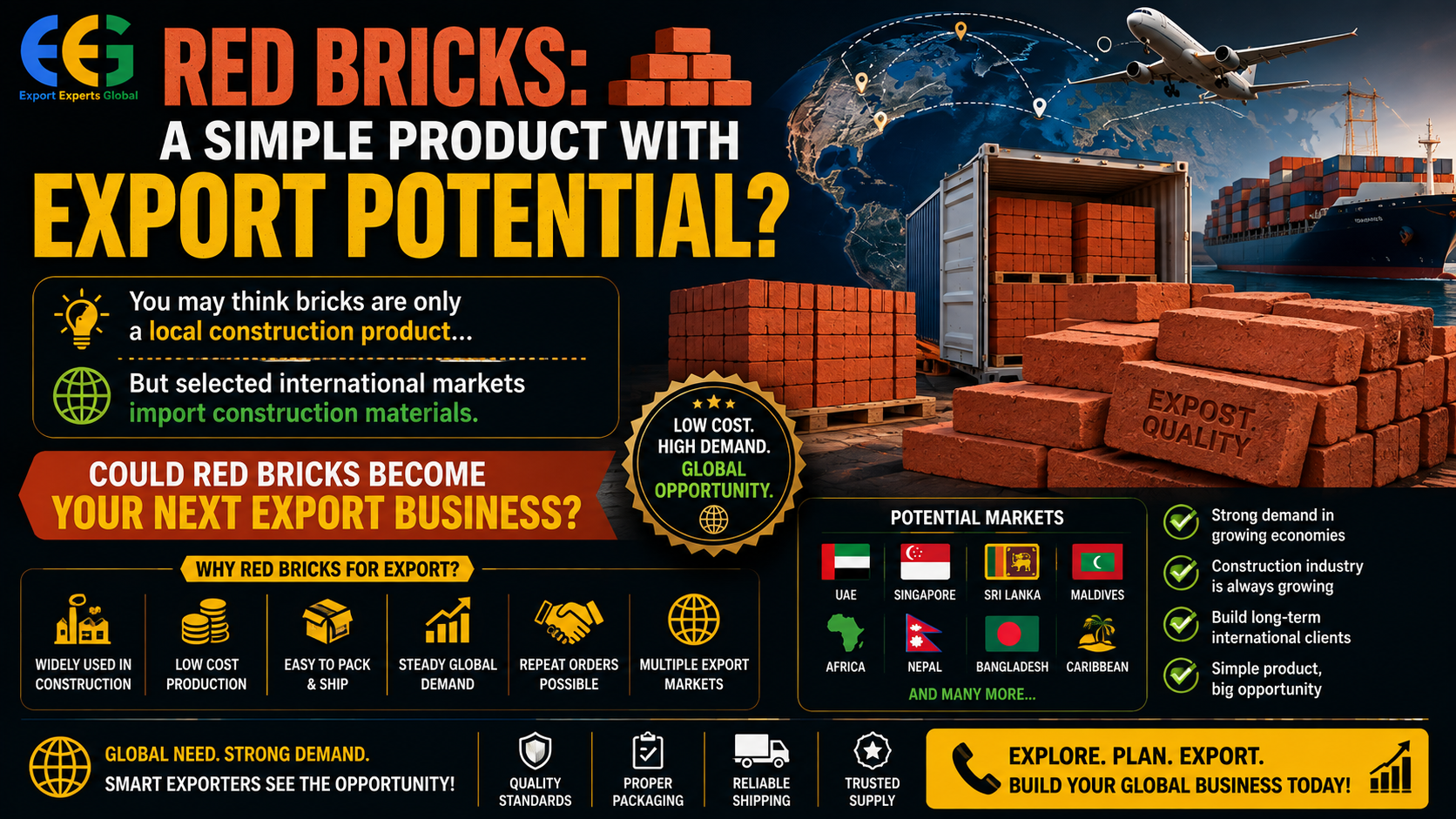
🧱 What Is the Red Bricks Export Business?
Red bricks are generally manufactured from clay or other suitable mineral materials and processed through forming, drying, and firing. They are widely used in:
🏠 Residential construction
🏢 Commercial buildings
🏗️ Infrastructure projects
🌳 Landscaping
🔥 Traditional architectural structures
🎨 Decorative and architectural applications
An exporter does not necessarily need to own a brick manufacturing plant. One possible business model is to source bricks from an established manufacturer, conduct quality checks, arrange logistics, and sell them to an overseas buyer.
The basic export model can be:
Manufacturer → Exporter → Freight Forwarder → Overseas Importer → Distributor/Project Buyer
This makes the business potentially accessible to traders who have strong sourcing and international-sales capabilities.
🌍 Why Consider Red Bricks for Export?
India has a large construction-material manufacturing ecosystem and numerous brick-producing clusters. This creates opportunities for exporters who can identify manufacturers capable of meeting specific international requirements.
The opportunity becomes more interesting when you move beyond ordinary commodity bricks.
For example:
🔸 Facing bricks
🔸 Architectural bricks
🔸 Handmade bricks
🔸 Decorative bricks
🔸 Premium clay bricks
🔸 Customized-size bricks
Premium and specialized products may have better value density than basic construction bricks, making international transportation relatively easier to justify.
💡 The objective should not simply be to export the maximum number of bricks. The objective should be to build a commercially viable export order.
🏭 Where Can You Source Red Bricks in India?
A prospective exporter should identify manufacturing clusters rather than purchasing randomly from local suppliers.
Your sourcing process should include:
✅ Manufacturer verification
✅ Production capacity
✅ Brick dimensions
✅ Raw material information
✅ Firing process
✅ Compressive strength
✅ Water absorption
✅ Appearance and finish
✅ Available packaging
✅ Minimum order quantity
✅ Production lead time
Visit the factory whenever possible.
A physical factory inspection can reveal important information that photographs and WhatsApp conversations may not show.
Look for:
🏭 Production facilities
🔥 Kiln/firing systems
📦 Storage conditions
🧱 Finished-product consistency
⚙️ Quality-control procedures
🚚 Loading arrangements
🔎 How to Select the Right Brick Supplier?
Choosing the cheapest supplier can create problems later.
Instead, evaluate suppliers using a structured comparison.
Supplier Evaluation Checklist
| Factor | What to Check |
|---|
| Product Quality | Strength, dimensions, finish |
| Capacity | Monthly production |
| Consistency | Batch-to-batch quality |
| Packaging | Pallets/strapping/protection |
| Pricing | Ex-factory rate |
| Lead Time | Production schedule |
| Documentation | Business and product documents |
| Export Experience | Previous international shipments |
| Logistics | Distance from port |
| Customization | Sizes, colors and designs |
📌 Remember: The supplier located closest to your port may not always be the cheapest supplier overall. Compare the complete cost.
🌎 Which Countries Can Be Explored?
Potential markets should be identified through actual import data, construction demand, freight rates, tariffs, regulations, and competition.
Depending on product specifications and economics, exporters may research markets such as:
🇲🇻 Maldives
🇱🇰 Sri Lanka
🇦🇪 UAE
🇴🇲 Oman
🇶🇦 Qatar
🌍 Selected African markets
🌏 Other nearby construction-material markets
But don’t assume that every country listed above will be profitable.
A country may import bricks but still be unsuitable for an Indian supplier because:
❌ Freight is too expensive
❌ Local manufacturers offer lower prices
❌ Import duties are high
❌ Technical specifications differ
❌ Demand is concentrated in a different brick type
Market selection must be data-driven.
📊 How to Research an Export Market?
Before approaching buyers, study the destination country.
Research:
🔍 Import volumes
🔍 Existing suppliers
🔍 Average import prices
🔍 Major importing companies
🔍 Construction activity
🔍 Port infrastructure
🔍 Import duties
🔍 Product standards
🔍 Certification requirements
🔍 Local brick prices
You should also investigate competitors.
Ask:
Who is already supplying this market?
If another country can supply similar bricks at a significantly lower landed cost, competing purely on price may be difficult.
🏗️ Who Buys Red Bricks Internationally?
Your target customer should be selected according to your product.
Potential B2B buyers include:
🏢 Building-material importers
🏪 Construction-material wholesalers
🏗️ Contractors
🏠 Real-estate developers
🚧 Infrastructure companies
🌳 Landscaping companies
🎨 Architectural-material distributors
🧱 Brick distributors
For premium architectural bricks, architects, designers, and specialized construction-material distributors may also become relevant prospects.
Buyer Search Strategy
You can explore:
🌐 B2B marketplaces
🔎 Google search
💼 LinkedIn
📧 Direct email outreach
🏢 Importer databases
🚢 Shipment/trade databases
🤝 Trade fairs
🏛️ Export-promotion networks
The objective is to build a verified buyer database, not simply collect thousands of email addresses.
📦 Red Brick Export Packaging
Packaging is particularly important because bricks can chip, crack, or break during handling and transportation.
Depending on buyer requirements, exporters may consider:
📦 Palletized loading
🔒 Industrial strapping
🛡️ Protective wrapping
📐 Proper stacking
🚛 Safe truck loading
🚢 Container optimization
Your packaging should balance protection and cost.
Over-packaging can increase expenses, while inadequate packaging can create product damage.
Before finalizing the packaging method, conduct a trial shipment or loading test.
🚢 The Biggest Challenge: Freight Cost
This is perhaps the most important point in the red-brick export business.
Bricks have a high weight-to-value ratio.
Suppose the factory price appears attractive. Once you add:
🧱 Product cost
🚚 Inland transportation
📦 Packaging
🏗️ Loading
⚓ Port charges
📄 Documentation
🚢 Ocean freight
🛡️ Insurance
💰 Duties/taxes at destination
…the final landed price may become significantly higher.
Therefore, never quote an overseas buyer simply by adding a profit margin to your factory price.
You need to calculate the landed economics first.
💰 Red Bricks Export Pricing Formula
A basic export costing structure can be:
Product Cost
- Packaging Cost
- Factory Handling
- Inland Freight
- Loading Charges
- Documentation
- Port/Terminal Charges
- Freight
- Insurance
- Other Applicable Costs
= Total Export Cost
Then:
Total Export Cost + Exporter Margin = Selling Price
Your final quotation should be based on the agreed Incoterm.
For example:
📌 EXW
📌 FCA
📌 FOB
📌 CFR
📌 CIF
The exact responsibilities and cost allocation differ under each Incoterm.
📈 How to Improve Profitability?
Selling ordinary bricks at the lowest price can produce thin margins.
A smarter strategy may be to create a differentiated product portfolio.
Consider:
✨ Premium facing bricks
✨ Handmade bricks
✨ Antique-style bricks
✨ Decorative bricks
✨ Architectural bricks
✨ Custom dimensions
✨ Special textures
✨ Project-specific designs
Instead of selling only “red bricks”, develop a clear product proposition.
For example:
“Premium architectural clay bricks for villas, landscaping and heritage-style construction.”
This positions the product differently from a generic commodity brick.
🧪 Quality Parameters Matter
International buyers may have specific technical requirements.
Depending on the destination and intended application, buyers can ask about:
🧱 Dimensions
💪 Compressive strength
💧 Water absorption
🔥 Firing quality
📏 Dimensional tolerance
🎨 Color consistency
🔨 Resistance characteristics
📋 Applicable technical standards
Never promise a specification that your supplier cannot consistently deliver.
If a buyer requests testing, arrange testing through an appropriate laboratory or according to the applicable destination-market standard.
📑 Documents for Export
The exact documents depend on the product, transaction, country, and shipment structure.
Common export documentation can include:
📄 Commercial Invoice
📄 Packing List
📄 Purchase Order/Contract
📄 Shipping Bill
📄 Bill of Lading
📄 Certificate of Origin, where required
📄 Insurance document, where applicable
📄 Product/test certificates, where required
📄 Export-related banking documents
The exporter should also ensure that its business, tax, customs, and product-related compliance requirements are properly addressed before shipment.
🧾 HS Code: Don’t Guess
Correct classification is essential.
The exporter should identify the applicable HS classification for the exact brick product based on its material, composition, manufacturing characteristics, and intended classification rules.
Don’t simply copy an HS code from another seller.
A wrong classification can create:
⚠️ Customs delays
⚠️ Incorrect duty calculations
⚠️ Documentation problems
⚠️ Compliance issues
⚠️ Buyer disputes
For a commercial shipment, verify the classification using the applicable customs/tariff system and professional trade advice where necessary.
💻 How to Find International Buyers?
Buyer acquisition is one of the most important skills in export business.
Create a professional buyer-search system.
Step 1 — Define Your Product
Specify:
🧱 Brick type
📏 Dimensions
💪 Strength
🎨 Color
📦 Packaging
🚢 Minimum order
📍 Port of loading
Step 2 — Select Countries
Choose 5–10 markets for research.
Step 3 — Identify Importers
Build a database containing:
👤 Company name
🌍 Country
📧 Email
📞 Phone
🌐 Website
🏢 Business type
📦 Product requirement
Step 4 — Contact Buyers
Send a concise introduction with:
📸 Product images
📋 Technical specifications
📦 Packing details
💰 Indicative pricing
🚢 Port details
📑 Certifications/test reports where applicable
📧 Don’t Send Generic Buyer Messages
A message like:
“Hello Sir, we are red brick exporter from India. Please give order.”
is unlikely to create a professional impression.
Instead, understand the buyer’s market and product requirement before making your proposal.
International B2B sales are built around:
🎯 Relevance
🤝 Trust
📊 Product information
💰 Competitive economics
📦 Reliable supply
📑 Compliance
⚠️ Major Risks in Red Brick Export
Every export business contains risks.
For red bricks, pay particular attention to:
1️⃣ Freight Risk
Ocean freight can significantly influence your final price.
2️⃣ Breakage Risk
Improper handling can cause damage.
3️⃣ Quality Variation
Different batches may not have identical characteristics.
4️⃣ Payment Risk
Never ignore buyer verification and payment security.
5️⃣ Regulatory Risk
Destination countries may impose standards or import requirements.
6️⃣ Market Competition
Local manufacturers may have a substantial cost advantage.
7️⃣ Working Capital
Large orders can require substantial funds before payment is received.
🛡️ How to Reduce Export Risk?
Use a systematic process.
✅ Verify the buyer
✅ Verify the supplier
✅ Confirm specifications in writing
✅ Use a proper sales contract
✅ Clearly define Incoterms
✅ Agree on inspection requirements
✅ Calculate landed cost
✅ Confirm payment terms
✅ Insure cargo when appropriate
✅ Start with a manageable shipment
Don’t rush into a large container order simply because a buyer sends a purchase inquiry.
🚀 Red Bricks Export Business: Practical Roadmap
Here is a simple starting roadmap:
STEP 1️⃣
Select your brick category.
STEP 2️⃣
Identify reliable Indian manufacturers.
STEP 3️⃣
Collect technical specifications.
STEP 4️⃣
Calculate ex-factory and export costs.
STEP 5️⃣
Research international markets.
STEP 6️⃣
Compare local and imported brick prices.
STEP 7️⃣
Build a verified buyer database.
STEP 8️⃣
Start B2B buyer outreach.
STEP 9️⃣
Negotiate specifications and payment terms.
STEP 🔟
Arrange samples or trial shipments where commercially appropriate.
STEP 1️⃣1️⃣
Complete export documentation and logistics.
STEP 1️⃣2️⃣
Scale only after validating profitability.
💡 Is Red Brick Export a Good Business for Beginners?
The answer depends on your market, supplier, freight rates, product quality, and buyer requirements.
It can be interesting because:
🧱 The product is easy to understand
🏭 India has substantial manufacturing capacity
🌍 Construction is a global industry
🤝 B2B buyers can purchase in bulk
📈 Specialized products can create differentiation
But it also has challenges:
⚠️ Heavy cargo
⚠️ Freight-sensitive pricing
⚠️ Breakage
⚠️ Competition
⚠️ Potentially thin commodity margins
Therefore, don’t start by purchasing a container full of bricks.
Start with market research → supplier verification → costing → buyer validation → sample/specification confirmation → commercial order.
Overall Analysis
The red bricks export business can be explored as a niche within the broader construction-material export industry. India’s manufacturing ecosystem provides potential sourcing opportunities, while international construction and architectural markets can create demand for different brick categories.
However, success will depend on more than simply having a good supplier.
You need:
🧱 Consistent product quality
🌍 Correct market selection
🔎 Verified buyers
💰 Competitive pricing
🚢 Efficient logistics
📑 Accurate documentation
🤝 Secure payment terms
📊 Professional export costing
If you can solve these areas systematically, red bricks can become more than just a traditional construction product—they can become part of a structured B2B export business model.