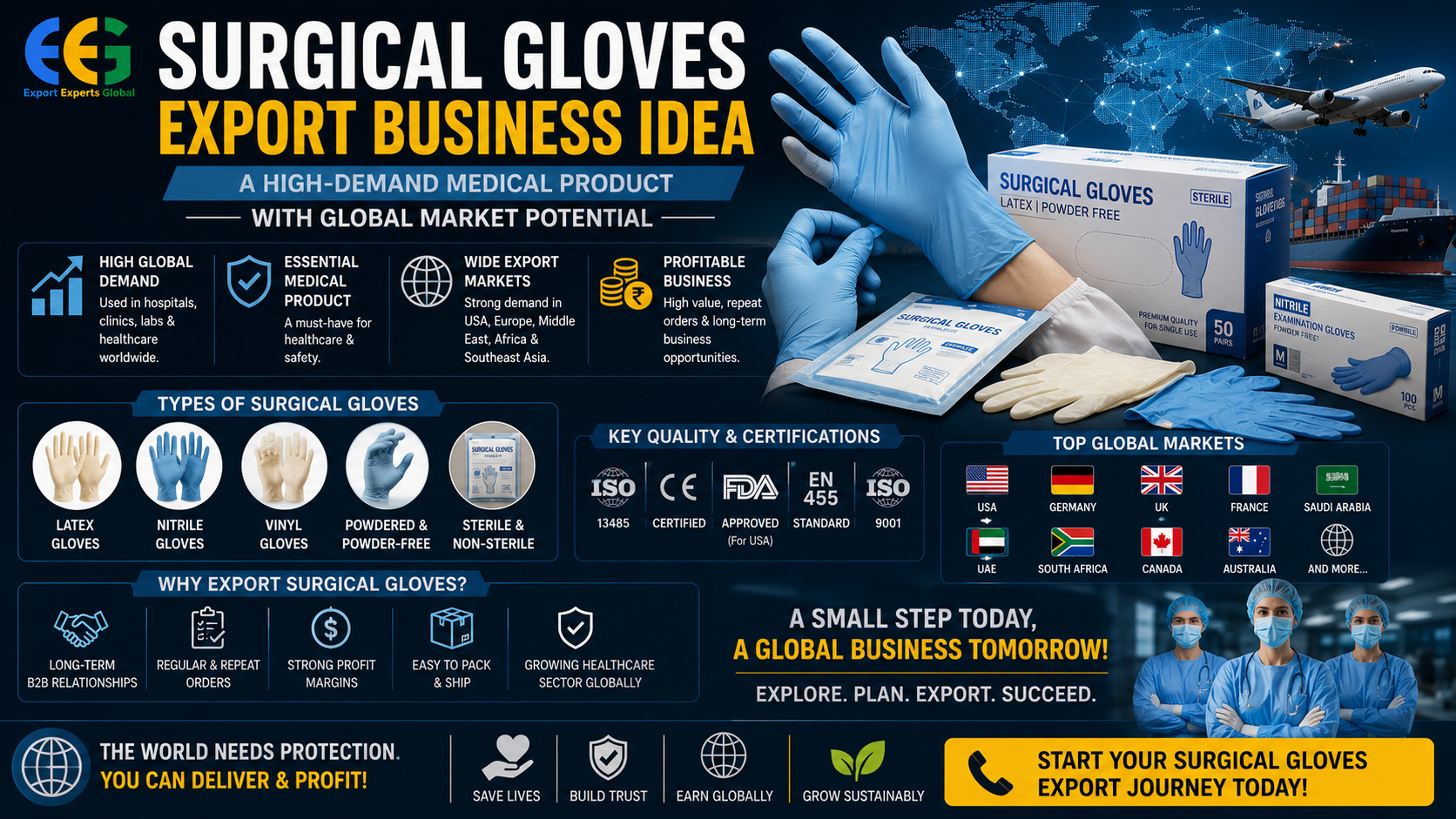
🧤 1. What Are Surgical Gloves?
Surgical gloves are sterile medical gloves designed primarily for use during surgical procedures and other situations where maintaining a controlled sterile environment is essential.
They are manufactured from different materials, including:
🔹 Natural rubber latex
🔹 Nitrile
🔹 Neoprene and other synthetic materials
Gloves may also differ according to:
📌 Sterility
📌 Thickness
📌 Size
📌 Material
📌 Surface texture
📌 Powder-free or powdered construction
📌 Packaging
📌 Intended medical application
For an exporter, understanding these specifications is extremely important because an overseas buyer may not simply ask for “surgical gloves.” They may provide detailed technical specifications that must be matched accurately.
🌍 2. Why Consider Surgical Gloves for Export?
Healthcare products have an important advantage: many are regular-use consumables.
Hospitals and healthcare distributors continuously require gloves because they are consumed during medical procedures and cannot simply be reused indefinitely.
This creates potential demand from:
🏥 Hospitals
🩺 Clinics
🔬 Laboratories
🧪 Diagnostic centres
🦷 Dental clinics
💊 Pharmaceutical companies
🏢 Healthcare distributors
🌎 Medical procurement companies
For an Indian exporter, the opportunity can become particularly attractive when the business is built around repeat B2B orders rather than individual retail sales.
The objective should be to develop long-term relationships with importers and distributors who regularly purchase medical supplies.
🇮🇳 3. Why Source Surgical Gloves from India?
India has a large pharmaceutical, healthcare, medical-device, and manufacturing ecosystem.
For an export entrepreneur, working with Indian manufacturers can offer several advantages:
✅ Domestic sourcing
✅ Competitive manufacturing costs
✅ Multiple supplier options
✅ Private-label possibilities
✅ Access to established logistics networks
✅ Availability of export-oriented manufacturers
However, never select a supplier only because they offer the lowest price.
For medical products, quality consistency is more important than simply obtaining the cheapest quotation.
Before finalising a manufacturer, evaluate:
📋 Product specifications
📋 Manufacturing standards
📋 Quality-control procedures
📋 Relevant certifications
📋 Testing documentation
📋 Production capacity
📋 Packaging standards
📋 Previous export experience
📋 Ability to meet destination-market requirements
🏭 4. How to Find Reliable Suppliers?
Finding a supplier is one of the most important stages of the business.
You can explore manufacturers through:
🔎 B2B marketplaces
🏭 Industrial directories
🤝 Trade exhibitions
📑 Industry associations
🌐 Manufacturer websites
📞 Direct manufacturer outreach
👥 Healthcare industry networks
When contacting suppliers, don’t ask only:
“What is your price?”
Instead, request a complete commercial and technical quotation.
Ask for:
✔ Product name
✔ Material
✔ Size options
✔ Sterility
✔ Packaging configuration
✔ MOQ
✔ Price basis
✔ Production lead time
✔ Testing reports
✔ Certifications
✔ Private-label availability
✔ Export markets served
This gives you a much clearer understanding of whether the supplier is suitable for your target market.
📦 5. Product Quality Matters
In medical exports, quality cannot be treated as an afterthought.
Buyers may evaluate gloves based on several technical parameters.
These can include:
🧤 Material composition
🧤 Physical dimensions
🧤 Tensile properties
🧤 Strength
🧤 Barrier performance
🧤 Sterility
🧤 Packaging integrity
🧤 Biocompatibility requirements
🧤 Shelf life
🧤 Labelling
The exact requirements depend on the product classification and destination country.
Therefore, before quoting a foreign buyer, determine exactly what product they are requesting.
📋 6. Certifications & Regulatory Compliance
This is one of the most important areas of the surgical gloves export business.
Medical gloves can fall under medical-device regulations, and requirements vary between countries.
Depending on the destination market and product classification, buyers may ask for documentation relating to:
✅ ISO 13485
✅ CE requirements for applicable European markets
✅ US FDA requirements for applicable products
✅ Product testing reports
✅ Sterility documentation
✅ Quality-management documentation
✅ Manufacturer declarations
✅ Country-specific regulatory approvals
An exporter should never assume that one certificate automatically makes a product acceptable everywhere.
🌍 Different countries have different regulatory systems.
Before entering a market, research the applicable authority and determine what registration, conformity assessment, labelling, testing, and documentation are required.
🇺🇸 7. Potential Export Markets
Depending on regulatory requirements, competition, pricing, and buyer demand, exporters can research markets across:
🇺🇸 United States
🇬🇧 United Kingdom
🇩🇪 Germany
🇫🇷 France
🇦🇪 United Arab Emirates
🇸🇦 Saudi Arabia
🇦🇺 Australia
🇯🇵 Japan
🇨🇦 Canada
🌍 African healthcare markets
🌏 Asian healthcare markets
But don’t make the mistake of targeting ten countries simultaneously.
Start with one or two carefully researched markets.
Study:
📊 Import demand
💰 Average pricing
🏥 Healthcare infrastructure
📋 Regulatory requirements
🚢 Shipping costs
🏢 Local distributors
🥇 Existing competitors
Then select the market where your supplier, product, compliance capability, and pricing provide a realistic competitive advantage.
🔎 8. How to Find International Buyers?
Buyer discovery is the heart of an export business.
Potential customers include:
🏢 Medical distributors
🏥 Hospital-supply companies
🧤 PPE distributors
💊 Pharmaceutical distributors
🩺 Healthcare procurement companies
🌎 Importers
🏪 Medical-supply wholesalers
You can research buyers through:
🔍 B2B platforms
🌐 Google searches
📧 Cold email campaigns
💼 LinkedIn
🤝 Trade fairs
📑 Import-export data
🏢 Distributor directories
📞 Direct business outreach
A professional buyer-search strategy should focus on company verification, not simply collecting hundreds of email addresses.
Before accepting a large order, investigate:
✔ Company website
✔ Business registration
✔ Buyer history
✔ Product requirement
✔ Payment terms
✔ Shipping destination
✔ Import capability
💰 9. How Does the Pricing Work?
Export pricing should never be calculated simply as:
Purchase Price + Profit = Selling Price
A professional export quotation should consider the complete cost structure.
For example:
🏭 Product cost
📦 Packaging
🏷️ Labelling
🧪 Testing
📑 Documentation
🚚 Inland transportation
🏢 Handling charges
⚓ Port expenses
🚢 Freight
🛡️ Insurance, where applicable
💱 Bank charges
💰 Exporter’s margin
The final quotation will also depend on the selected Incoterm.
Examples include:
EXW – Ex Works
FCA – Free Carrier
FOB – Free On Board
CFR – Cost and Freight
CIF – Cost, Insurance and Freight
Understanding Incoterms helps the exporter clearly determine which costs and responsibilities are included in the quotation.
📈 10. Profit Margin in Surgical Gloves Export
Profitability can vary significantly.
There is no universal fixed export margin because it depends on:
💰 Supplier price
📦 Order quantity
🌍 Destination country
🚢 Freight cost
📋 Regulatory expenses
🏷️ Branding
🤝 Buyer negotiation
💱 Currency fluctuations
🏆 Product quality
An exporter handling private-label products may have a different business model from an exporter selling an established manufacturer’s brand.
Similarly, bulk institutional orders may have lower per-unit margins but provide higher overall order value and repeat business.
Therefore, focus on net contribution per shipment and repeat-order potential, rather than assuming a fixed percentage margin.
🏷️ 11. Private Label Opportunity
One interesting business model is private-label medical products, subject to applicable regulations and contractual arrangements.
Instead of selling only under the manufacturer’s brand, an exporter may work with a qualified manufacturer to develop products for a specific overseas distributor or brand.
Potential requirements may include:
🏷️ Custom packaging
📦 Customized cartons
🧤 Product branding
📋 Regulatory labelling
🎨 Artwork development
📑 Technical documentation
This can help create a stronger B2B relationship.
However, private-label medical products require careful regulatory and quality coordination. The brand owner, manufacturer, importer, and distributor may each have different legal responsibilities depending on the target market.
🚢 12. Export Logistics
Once the order is confirmed, logistics becomes the next major stage.
The process generally involves:
1️⃣ Buyer enquiry
2️⃣ Product specification confirmation
3️⃣ Supplier quotation
4️⃣ Export pricing
5️⃣ Buyer negotiation
6️⃣ Purchase order
7️⃣ Production
8️⃣ Quality inspection
9️⃣ Packaging
🔟 Documentation
1️⃣1️⃣ Freight booking
1️⃣2️⃣ Customs procedures
1️⃣3️⃣ Shipment
1️⃣4️⃣ Document submission
1️⃣5️⃣ Payment collection
For larger shipments, containerised sea freight may be considered depending on order volume, destination, urgency, and product economics.
📄 13. Important Export Documents
The exact documentation depends on the transaction, product, destination, and shipping arrangement.
Common export documents can include:
📑 Commercial Invoice
📦 Packing List
🚢 Bill of Lading / Air Waybill
📜 Certificate of Origin
📋 Purchase Order
💰 Proforma Invoice
🧾 Shipping Bill
📄 Insurance documents, where applicable
🧪 Product testing or quality documentation
📋 Regulatory documents required by the destination market
The exporter should coordinate with the freight forwarder, customs professional, bank, and regulatory specialists where necessary.
⚠️ 14. Major Risks in This Business
Medical exports can be profitable, but they also involve significant risks.
🚨 Regulatory Risk
A product that is acceptable in one market may require additional compliance in another.
🚨 Quality Risk
A defective batch can result in complaints, rejection, financial loss, or reputational damage.
🚨 Payment Risk
Unknown overseas buyers can create payment-default or fraud risks.
🚨 Supplier Risk
A manufacturer may fail to maintain consistent quality or delivery schedules.
🚨 Logistics Risk
Freight delays, port congestion, documentation errors, or customs issues can affect delivery.
🚨 Currency Risk
Exchange-rate fluctuations can influence the final profitability of an order.
Professional exporters manage these risks before accepting the order, not after problems occur.
🔐 15. How to Protect Your Export Payment
Never treat an international order as safe simply because the buyer has sent a purchase order.
For new buyers, evaluate suitable payment structures such as:
💳 Advance payment
🏦 Letter of Credit
💰 Secure documentary arrangements
🤝 Other agreed B2B payment mechanisms
The appropriate method depends on the buyer, transaction size, relationship, country risk, and negotiation.
Always conduct buyer due diligence.
📊 16. Build a Strong Export Business Model
There are several possible approaches:
Model 1 – Merchant Exporter
Purchase from an Indian manufacturer and sell internationally.
Model 2 – Manufacturer-Exporter
Manufacture and export your own products.
Model 3 – Private Label
Work with a qualified manufacturer to supply products under a customer’s brand.
Model 4 – Distributor Model
Develop relationships with overseas healthcare distributors.
For a beginner, the merchant-exporter model can be easier to explore because it may require less manufacturing infrastructure. However, compliance and product responsibility still need careful attention.
🚀 17. Step-by-Step Roadmap
If you want to start a surgical gloves export business, follow a structured process:
STEP 1️⃣
Select the exact glove category.
STEP 2️⃣
Research the relevant HS classification and customs requirements.
STEP 3️⃣
Identify your target country.
STEP 4️⃣
Study destination-market regulations.
STEP 5️⃣
Find multiple qualified Indian manufacturers.
STEP 6️⃣
Compare quality, certifications, MOQ, and pricing.
STEP 7️⃣
Obtain samples and technical documentation.
STEP 8️⃣
Calculate your complete export cost.
STEP 9️⃣
Develop a professional buyer list.
STEP 🔟
Contact and qualify international buyers.
STEP 1️⃣1️⃣
Send quotation and product documentation.
STEP 1️⃣2️⃣
Negotiate payment and Incoterms.
STEP 1️⃣3️⃣
Confirm purchase order and production.
STEP 1️⃣4️⃣
Conduct quality checks.
STEP 1️⃣5️⃣
Complete export documentation and shipment.
STEP 1️⃣6️⃣
Follow up for repeat orders.
Overall Analysis
🧤 Surgical gloves can be a promising export product, particularly for entrepreneurs who understand medical-product compliance and B2B international trade.
Your success formula can be:
**Quality Manufacturer 🏭
- Correct Compliance 📋
- Competitive Pricing 💰
- Verified Buyers 🔎
- Secure Payment 🔐
- Efficient Logistics 🚢
- Repeat Orders 🔄
= Sustainable Export Business 🌍**